This thread has been locked.

If you have a related question, please click the "Ask a related question" button in the top right corner. The newly created question will be automatically linked to this question.

THVD2450V-EP: THVD2450VDRCREP – Clarification on Pull Resistors, Series Resistors, and DE/RE Control

Part Number: THVD2450V-EP

Tool/software:

I am using the THVD2450VDRCREP RS-485 transceiver in my design and I have a few questions regarding the recommended external components and control logic:


1. Internal vs External Pull Resistors:
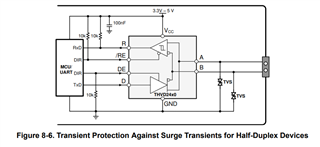
The datasheet mentions that the DE, RE and DI pins have internal pull-up/down resistors. However, the application and layout guidelines suggest adding external resistors.

  • Is it mandatory to add external pull-up/down resistors if internal ones already exist?

  • In which conditions would the external resistors become necessary?


2. Series Resistors on A/B Lines:
Can I add series resistors (say, 10–33Ω) on the A and B differential lines for debugging or signal integrity tuning purposes?

  • Will this affect RS-485 communication compliance or performance?


3. Controlling DE and RE Together:
Can I control both DE and RE using a single GPIO from an MCU?

    • Is it mandatory to add external pull-up/down resistors if internal ones already exist?

    • In which conditions would the external resistors become necessary?

    External resistors are not required in most situations. The internal resistors are very weak (2M with ~30% tolerance). If your system is in a high noise environment then the noise could couple onto the pin and change the state since the 2M resistors are fairly weak.

    I personally recommend pull up/down resistors on the D and R pins though. They can be do not populate. My reason for this is sometimes the processor/MCU can be unpowered or the pin connected to D is in a tri state/hi-Z state and D pin will appear to be floating. If noise occurs or D floats to GND, it may appear on the RS485 side as a transmitted bit and cause glitches to any receivers that see this. A pull up on D would prevent this from occurring.

    For the R pin, if the RE pin is ever disabled (held high) then R becomes high-Z. If the processor sees R float to GND or noise appear on R then it may look like garbage data appearing and the processor may try to do something with that data that it shouldn't. Putting a pull up resistor on that pin will generate a known bias (must systems want the bias voltage to be a logic high so a pull up is usually used).

    My opinion on these questions is put it in the schematic, populate them if you see issues like what I pointed out. If you do not need them then leave them as do not populate. It is better to have them and not use them than to not have them but need them.

    2. Series Resistors on A/B Lines:
    Can I add series resistors (say, 10–33Ω) on the A and B differential lines for debugging or signal integrity tuning purposes?

    • Will this affect RS-485 communication compliance or performance?

    You can but I would recommend to be very light on the resistor. RS485 drives large amounts of current to send signals when you put a resistor in the line you do 2 things.

    1) you limit the current which will then lower the output voltage VoD so the distance and speed (because you increased the RC constant of the bus) you can support lowers.

    2) you changed the characteristic impedance of the bus, this is critical in high speed or long distance applications. A deviation in this results in higher reflections that can occur on the receiver nodes as this goes into high speed transmission theory.

    I would recommend if you decide to do this, keep the maximum resistance to 10 ohms on each pin. I would recommend a resistor with higher power for those peak voltage situations that may occur due to surge. 

    3. Controlling DE and RE Together:
    Can I control both DE and RE using a single GPIO from an MCU?

    Yes, but please keep this in mind:

    https://www.ti.com/lit/an/slla660/slla660.pdf?ts=1749594271976&ref_url=https%253A%252F%252Fwww.ti.com%252Fproduct%252FTHVD1400%253FkeyMatch%253DTHVD1400%2526tisearch%253Duniversal_search

    Other notes:

    You should include a termination resistor (usually 120 ohms) between A/B. These should be populated on the two furthest end points of your RS485 system. 

    You can include external fail safe resistors on the RS485 pins (not required).

    -Bobby