This thread has been locked.

If you have a related question, please click the "Ask a related question" button in the top right corner. The newly created question will be automatically linked to this question.

TUSB321: Interface with TMUXHS4212

Part Number: TUSB321
Other Parts Discussed in Thread: TMUXHS4212

Tool/software:

In my schematic the VBUS_DET of TUSB321 is 910k. The current mode is connected to grounded via 0 ohm resistor. I have inerfaced it TMUXHS4212 to have USB3 on both sides of the type C. But now only USB2.0 is working. The CC pin detection is happening one side its 3.1V and other is around 0.04V. The USB3 channels are properly routed but not able to detect why is that ? 
Can share the schematics in private.

  • Hello,

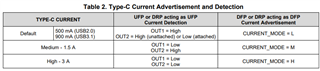
    If you are seeing 3.1V on one CC pin and 0.04V on the other, then it sounds like there is no active CC connection being made. Typically, if there is a proper CC connection, the voltage on the CC pins should be lower, closer to something like what is listed in the datasheet:

    Can you monitor the DIR pin on the TUSB321 and ensure it's flipping direction when you flip the USB-C cable? Additionally, you can monitor VBUS_DET and ensuring it's seeing VBUS properly.

    You can PM me the schematic. Just to confirm, is this for a DFP or UFP connection?

    Thanks,

    Ryan

  • Hello,

    Sorry, what I meant was that one side the DIR shows 0.04 V and when flipped it shows 3.14V. I have shared the schematic in PM. It's for DRP role.

  • Hello,

    If the TUSB321 is set to DRP and it is connecting to another DRP or UFP device, it's possible that it is not configuring as a UFP but as a DFP. Setting PORT to UFP is the best way to guarantee this.

    Can you monitor the CC lines and see what activity you see on there during a connection. Plus, another way you can confirm whether the device is being set as a UFP is by changing CURRENT_MODE to something lower, like 900mA or 1.5mA, and monitoring the OUT1 and OUT2 pins:

    Is the TUSB321 connecting to another type-C connector? If so, then if it's a UFP it should also be receiving VBUS, so you can monitor VBUS_DET.

    Thanks,

    Ryan

  • The OUT1 and OUT2 are NC in our case. Yes the TUS321 is connecting to another type C connector, the VBUS is receiving and the VBUS_DET is 0.4V.
    Thanks 

  • Hello,

    For a UFP application, the OUT pins are typically used to indicate to a device when a DFP connection is made, and can be used to monitor what the desired current is. If possible, monitoring those can help to indicate what the device is seeing. You can see if a device is set as a DFP typically by pulling the ID pin up to VDD with a 200KOhm resistor, and seeing if that is being pulled low. If so, that indicates the TUSB321 is set as a DFP.

    You can guarantee the TUSB321 sets as a UFP via the port pin, which might be best for testing if possible.

    Have you already confirmed the TMUXHS4212 works correctly? If the DIR pin is flipping, the mux should be flipping as well. Is there any USB3 connection? As long as it is receiving VBUS, it should be able to make a USB3 connection, as long as the capacitance on the TX/RX lines are within the expected level (75nF-265nF).

    Thanks,

    Ryan

  • Hello,

    Yes we had designide a dev board for it previously, it was working. The schematics was the as shared now. But there is no USB3 connection happening. Previously 10k was used for VBUS_DET in the design but on the input suggested from the forum changed it to 910k.
    Will try to monitor the OUT and CC pins and get back to you.

    Thanks

  • Hello,

    So when 10KOhms was being used for VBUS_DET you did not see an issue, but now with the 910KOhm resistor you see an issue in establishing a connection? If you want, you can try adjusting the value of the VBUS_DET resistor within this range and see if that improves the issue:

    Yes, please let me know what you see on the OUT and CC pins.

    Thanks,

    Ryan

  • Hello,

    Yes, previosly 10k was used for VBUS_DET there was no issue. Now with 910k it's not establising USB3 connection. Tried with 0 ohms the result was showing not recognised in the laptop for once, then it stopped showing adn works on USB2 itself.

  • Hello,

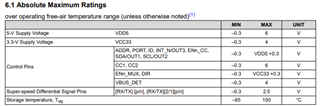
    The VBUS_DET pin is not meant for greater than 4V. If you are using a 0Ohm resistor, then 5V will be entering the device, which may cause damage to the device or cause it to stop functioning completely.

    It is recommended to follow the resistor values listed in the datasheet to prevent this any damage being done to this pin:

    If 5V entered the VBUS_DET pin, is it possible to test replacing the device as well to ensure there is no damage?

    Thanks,

    Ryan

  • Hello,

    I am marking this thread as resolved due to inactivity. If you have any questions or need more assistance, feel free to reply here.

    Thanks,

    Ryan

  • Hello,

    Sorry for the delay in response, due to re assembly from the vendor was not able to come back, tried it on different board but not able to measure the CC1 and CC2 pins voltage levels, With 900k VBUS_DET shows 1.2V when connected. 
    3.3V was not generating hence gave external 3.3V to the mux, still no signs of USB3.

  • Hello,

    This is even after reassembly? Or are you still waiting for reassembly?

    Were you able to monitor the OUT pins and see any activity there?

    Thanks,

    Ryan

  • Hello,

    This is after reassembly. The OUT pins are not connected as mentioned previosly.

  • Hello,

    If there is no way to ensure there is a connection, I.E through the CC pins, OUT pins, or even the ID pin, it may be hard to determine whether a proper connection is being made or not. 

    If the TMUXHS4212 is connected and powered though, it should be able to make a connection in at least on orientation. Is the customer able to manually control the SEL pin of that mux and see if they can see a connection?

    Thanks,

    Ryan

  • Hello,
    Right now CC pins are the only option but the pads are not completely feasible to hand solder a wire to it. Manually it can be done, will test it and get back to you. 

    Thanks

  • Hello,

    Got it, yes please let me know if you can test it, that way we can ensure there is a connection being made.

    Thanks,

    Ryan

  • Hello,

    No not able to measure it. Sorry for the delay got caught in other work

  • Hello,

    No worries. What pins are you able to probe which might help give an idea of what the status of the TUSB321 is then?

    Thanks,

    Ryan