This thread has been locked.

If you have a related question, please click the "Ask a related question" button in the top right corner. The newly created question will be automatically linked to this question.

THVD1500: Help deciding if RS485 application can be non-isolated

Part Number: THVD1500
Other Parts Discussed in Thread: THVD2410

Tool/software:

Setup:

  1. Max nodes on the bus = 25, all with 1/8th unit load
  2. Termination will be done at the last node
  3. All nodes are connected via CAT5 Ethernet cable in a daisy chain fashion with each node imposing a minimal stub to it's transceiver. A+ and B- correctly applied to a twisted pair. Cable has shield, but a ethernet cable that actually connects the shield will probably not be used. 
  4. Max cable run for the full bus for all nodes is <400ft
  5. A common ground wire will/can be connected between each node via CAT5 cable
  6. Master/Slave Architecture on the bus
  7. Master node will be connected to a PC via a USB to RS485 board setup. Since we only need 1 master node, I'd be happy to make the master node fully isolated and the rest not isolated. That would be within budget if it helps.
  8. Each node is independently powered inside a slot machine type of cabinet. Customer supplied 12V power supply, not something we control. 
  9. Max baud rate is 200kbps. But we can go down to 115,200 or even 19200 if it gets us reliability with no isolation. 
  10. I will be adding bus biasing resistors to the master node to insure fail safe operation if nothing is driving the bus

Why the hesitancy of isolation? The THV1500 can cost $0.31/unit. But an isolated driver can cost 5x that, and does not include the circuitry needed for isolating the power supply. So more $ and more board space. Which is why I would be willing to spend more on the master node, to prevent the device nodes from having to isolate. 

From what I have been researching, the fact that each node is independently powered via a customer supplied power supply is the biggest reason we may NEED to go to an isolated solution due to ground loops. Especially if the 12V power supply used is earth referenced. 

Any advice, concerns or reassuring comments that a non-isolated solution can be reliable would be appreciated. 

Regards,

Matt

  • Hi Matt,

    So the THVD1500 is able to withstand up to +/-18V of common mode shift. 

    So the question of if you need isolation would depend on if you expect the common mode to shift larger than 18V. 

    Usually the common mode shift occurs when the communication GNDs are very far apart and there is a lot of current being driven into the local GND of one of the nodes. An example would be if one of the 'slave' nodes (or master node) has a motor that turns on and sinks huge amounts of current. If the GNDing on that node isn't ideal (like has a large chassis GND) then the local GND can shift up and try to send current from that local GND to other GNDs through the cable. (Current goes to the path of least impedance). So the resistance from the cable (if very long) and large current from the local node and maybe it driving current because it's communicating on the bus could result in a GND shift (current flowing through the GND cable with a voltage drop across it). 

    I ultimately do not know if your system requires the isolation because we don't really know the current load that may occur across the cable and the local nodes. If you're other nodes are driving huge current loads with a non-ideal GND, we could see large GND shifts. If all the nodes have a good local chassis GND, then isolation probably isn't needed. 

    Putting isolation on the master node will protect it from seeing damage if the other nodes are shifted up by if the master node is shifted up, the other nodes could get damaged.

    https://www.ti.com/product-category/interface/rs-485-rs-422-transceivers/products.html#1065=Half&1550=-42%20to%2042%3B-70%20to%2070%3B-27%20to%2027&976max=0.03%3B1&

    Above is a filter of other potential devices with higher common mode. I'm not sure about pricing since TI has different pricing when done directly through the field team but there could be some more cost competitive devices on that list that may be more expensive than the THVD1500 (the THVD15XX is the most cost competitive RS485 family) but less than the isolated solution. 

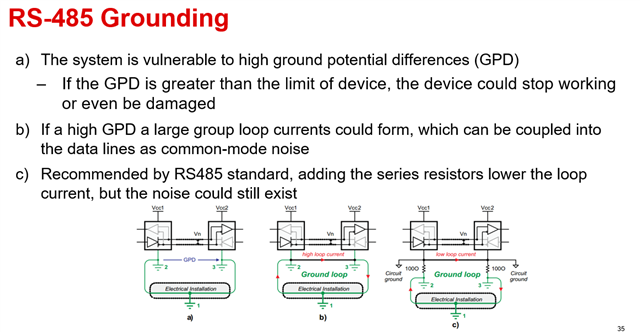
    For additional advice, the RS485 standard does recommend adding series resistors (100 ohms) on the local GNDs to prevent large GND loops between nodes (from current flowing from one node to the other through GND). I usually also see designs have caps in parallel to the GND resistors to help with higher frequency shifts from showing up. You could probably use 1uF and .1uF in parallel. You should try to do this on all the nodes if you can. 

    -Bobby

  • Thank you for your reply. I would be happy to choose a little more expensive non-isolated chip to get a higher common mode voltage tolerance. Instead of going full isolated.

    I have decided to move to the THVD2410DR part. Each node does not have large motors or inductive loads. It's really just a desktop computer and a big screen. So a part that has +-25V common mode tolerance should be more than enough for my application.

    Question:

    If I go non-isolated. Should I still provide a common ground wire that connects the nodes ground together via the CAT5 cable? Connecting that ground wire to each nodes local ground via a 100Ohm resistor that is (or does the 100 Ohm only apply to connecting to earth ground location)? Or does intentionally adding that common ground wire just make ground loops more likely and now more susceptible to noise due to the intentional loop I just made with the extra ground wire connecting the nodes?

    Image C in your diagram shows a common ground connection between nodes, and the 100 ohm resistor to the electrical installation, which I'm assuming is earth ground here.

    Would the below be correct? Or would this make us more susceptible radiated noise since the ground loop now has higher impedance, therefore a smaller induced current can cause large magnitude noise?

  • Hi Matt,

    My understanding is that RS485 is differential communication so it technically does not require the GNDs to be all connected together but connecting should help offset some of the GND shifts that can occur (I've heard in industrial HVAC systems, this can be a problem and the THVD2400/THVD2410 is used to survive the huge GND shifts, they use common GND across nodes). If I had to pick between no connected GNDs or all connected, I would choose all connected (RS485 standard also chooses this implementation so I would follow the standard when possible). 

    With the 100 ohm resistors, the current would need to be 700mA or greater to generate a 70V GND shift that would break the THVD24XX due to the GND shift. This seems like a lot of margin here and the local GNDs would need to be pretty weak/small for the GND build up to shift so much (when we compare any node vs the master node's gnd.) Since the image you shown has all the nodes referencing the master node, any shifts from the master's GND will shift all over RS485 device GND's to it. So Master node GND shifts should be okay. 

    Or does intentionally adding that common ground wire just make ground loops more likely and now more susceptible to noise due to the intentional loop I just made with the extra ground wire connecting the nodes?

    The noise would have to be kinda large to shift it up by more than 70V. What I would recommend though is to place a capacitor in parallel with the 100 ohm resistors so that higher frequency noise can travel through that rather than the resistor so the voltage doesn't build up from the noise. Maybe 3x caps in parallel with 1uF, .1uF, and 10nF so they can filter different higher frequency noise or current spikes. The 100 ohm resistor will allow low frequency noise to pass.  

    -Bobby