This thread has been locked.

If you have a related question, please click the "Ask a related question" button in the top right corner. The newly created question will be automatically linked to this question.

TCAN4551-Q1: Why Cannot detect BUSOFF?

Part Number: TCAN4551-Q1

Tool/software:

Will a short circuit between CAN_H and CAN_L cause this CAN chip to detect a BUSOFF? Currently, we are encountering such an issue:
  • When one product using TCAN4551 is mounted on a bus, and CANoe is used to monitor the data reported by the product, after CAN_H and CAN_L are shorted, the product fails to report data and a BUSOFF fault occurs.
  • When two products using TCAN4551 are mounted on the same bus, and CANoe is used to monitor the data reported by the products, after CAN_H and CAN_L are shorted, the products will report that a BUSOFF fault has occurred.
How does this chip determine whether a BUSOFF fault has occurred? Why can’t BUSOFF be detected when there is only one product?
  • Hello Wang,

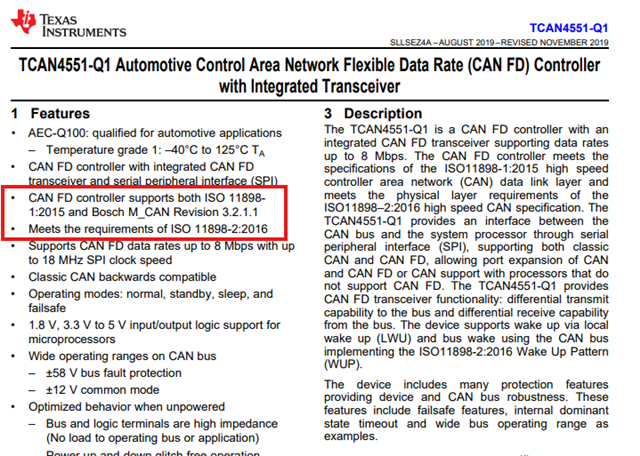
    As stated in the datasheet, the TCAN4551-Q1 follows the ISO 11898-1:2015, ISO 11898-2:2016, and Bosch M_CAN Revision 3.2.1.1 specifications.

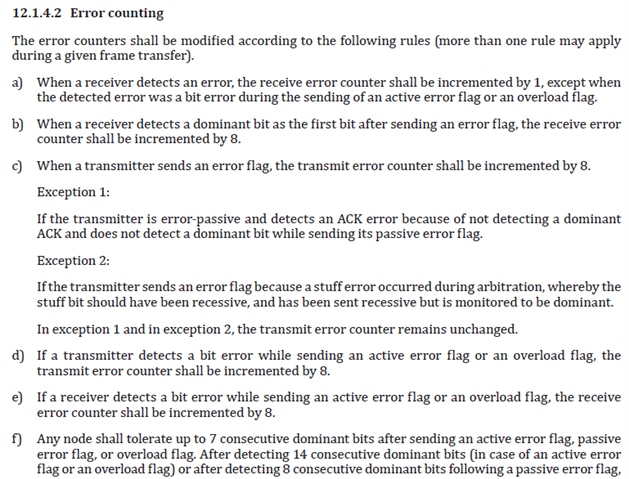
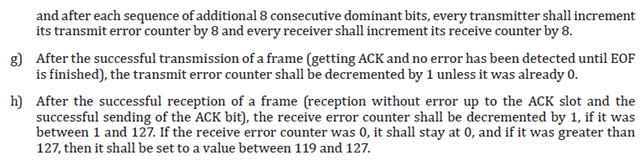
    The ISO 11898-1 Standard defines the error counting and there are a couple of exceptions that would prevent the TEC error counter from causing a Bus Off condition, particularly when there is not another device to send an ACK which would occur when there is only one device used during testing.  Two devices are needed.

    Because the TCAN4551 uses the Bosch M_CAN IP for the CAN FD Controller, you may also want to reference the M_CAN User's Manual (Link) for more detailed information. 

    Regards,

    Jonathan

  • If there is only one device on the bus, and this device uses the TCAN4551 chip, will short-circuiting CAN_H and CAN_L trigger a BUSOFF state? If not, what is the reason? Is it related to CANFD chips? If I want to detect BUSOFF, what solutions are available?
    If an external device that does not use the TCAN4551 chip (such as monitoring via TSMAster) is connected at this time, and a fault of short-circuiting CAN_H and CAN_L is created, will it trigger BUSOFF?
  • Hi Wang,

    You will need a minimum of two functioning CAN nodes in order to cause a Bus Off condition.  Any single node that is transmitting without an acknowledgement from any other node will only enter an error passive state, not a BUSOFF state.

    Regards,

    Jonathan

  • If CANoe is used to monitor data on the bus, does this device count as a normally operating CAN node? If so, can shorting CANH and CANL trigger a BUSOFF fault?

  • Hi Wang,

    I'm sorry for the delay in my response. 

    If CANoe was configured to participate in CAN bus communication and to provide ACK pules when it received CAN messages, then this should count as a valid 2-node CAN bus. 

    If however CANoe was configured in a monitor or silent mode where it could see the CAN bus messages but did not acknowledge any messages, then this would not be a valid 2-node CAN bus.

    The Bus Off condition is reached when the transmit error counter (TEC) exceeds 255.  Therefore the TCAN4551 must repeatedly try to transmit a message while the CANH and CANL pins are shorted to cause the TEC counter to exceed 255 and enter a Bus Off condition.

    Can you monitor the Interrupt (0x1050), Protocol Status (0x1044) and Error Counter (0x1040) registers? so we can see the error counter values and the Error warning, error passive, and bus off status bits while you are shorting CANH and CANL?

    Regards,

    Jonathan