This thread has been locked.

If you have a related question, please click the "Ask a related question" button in the top right corner. The newly created question will be automatically linked to this question.

TCAN1145-Q1: sleep and wake up question

Part Number: TCAN1145-Q1

Hi team

Could you please help check these questions:

After initialization, once the TCAN1145-Q is powered only by VBAT, the chip should operate in Standby mode. Should the chip's leakage current be evaluated according to the standby mode diagram below?(Sector 8.6)
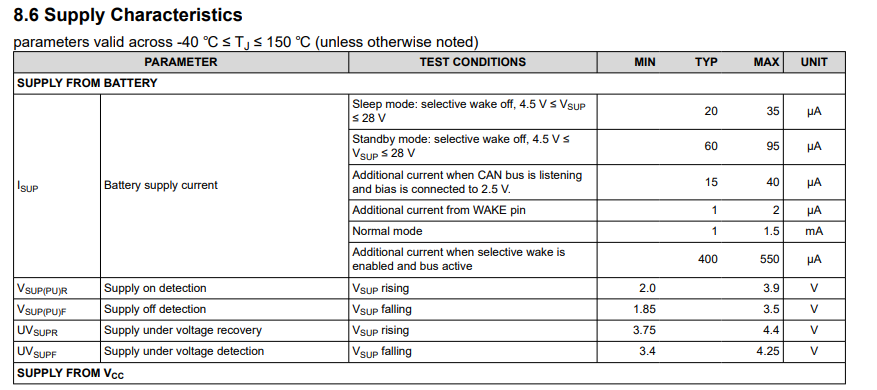
image.png

Additionally, the following needs to be confirmed:

1. How should we understand that "Receiver Off" in Sleep mode of this state machine refers to its bus receive function being disabled? Does this mode support wake-up via a specified frame? And after receiving a wake-up event, does the INH function switch from Floating to On?

2. Are the valid wake-up events for WUP and WUF when switching from Sleep mode to Standby distinguished from wake-up via a specified frame?


  • Hi Jerry,

    After initialization, once the TCAN1145-Q is powered only by VBAT, the chip should operate in Standby mode. Should the chip's leakage current be evaluated according to the standby mode diagram below?(Sector 8.6)

    Yes, the transceiver will enter Standby mode when only VSUP is applied at power up. ISUP, ICC, and IIO will all be drawing current depending on what supply is present (depending on VCC and VIO). ISUP is the primary supply though while in Standby mode. Note that at power up, the Sleep Wake Error (SWE) timer is active. This means that if TCAN1145 stays in Standby mode for more than 5 minutes, then it will transition to Sleep mode to conserve power on its own. 

    1. How should we understand that "Receiver Off" in Sleep mode of this state machine refers to its bus receive function being disabled? Does this mode support wake-up via a specified frame? And after receiving a wake-up event, does the INH function switch from Floating to On?

    There are two effectively two receivers in TCAN114x-Q1. The primary, high-power receiver is disabled in Sleep mode, but a low power receiver is on while in Sleep mode to receive wake up requests from the CAN bus. Please consult Table 10-1 for this. 

    After TCAN114x has received a valid wake-up request on the CAN bus, it will enter Standby mode with INH high. 

    2. Are the valid wake-up events for WUP and WUF when switching from Sleep mode to Standby distinguished from wake-up via a specified frame?

    This depends on if selective wake (SW) is enabled. Figure 10-11 further explains this.

    • If SW enabled:
      • A valid Wake-Up Pattern (WUP) must first be received.
      • Then the particular Wake-Up Frame (WUF) is necessary for the transceiver to wake up
      • If WUF does not match, then TCAN1145 stays in Sleep mode
    • If SW disabled:
      • Only a WUP is needed to wake the transceiver

    Best,

    Ethan

  • Hi Ethan:

    For the first question, when calculate the leakage current, whether the additional current when CAN bus is listening should be add, the 15uA, the condition is that the chip works in standby mode waiting for the valid wake-up request?

    Thank you for reply

    Best regards,

    Zephlyn Zhu

  • Hi Zephlyn,

    You can reference Figure 11-4 (Figure 11-3 can also be helpful) in the datasheet for how TCAN114x biases the CAN bus. 

    Essentially, if the CAN bus is inactive, then bus biasing will be turned off and the additional 15uA can be disregarded. With a valid WUP (aka an active CAN bus), the bus will be biased to 2.5V while in Standby mode (meaning an extra 15uA is used). After time tSILENCE of ~1 second of bus inactivity, the bus will become unbiased.

    Let me know if that helps, or if you have any other questions,

    -Ethan

  • Hi Ethan:

    That's helpful, thank you for your clear reply.

    The conclusion is if the chip works in sleep mode, the leakage current only calculate the type 20uA, right?

    And the test condition "Selective wake off", whether it means the funtion is enable, not be effective?

    Thanks for your reply, best regards

    -Zephlyn Zhu

  • Hi Zephlyn,

    We are currently on holiday. Please help give until next week for some feedback, thanks.

    Best Regards,

    Michael.

  • Hi Zephlyn,

    Apologies for my delayed response. 

    The conclusion is if the chip works in sleep mode, the leakage current only calculate the type 20uA, right?

    Yes this is correct. Only 20uA should be considered for the leakage current while in Sleep mode. If Selective Wake is enabled and active (400uA), it will only be active for a short period of time. 

    And the test condition "Selective wake off", whether it means the funtion is enable, not be effective?

    "Selective wake off" means that is not active at that moment, regardless whether it is enabled or not. TCAN1145 can be in Sleep mode with SW off (since it is not actively checking for a Valid ID), while SW is still enabled

    Let me know if that makes sense!

    -Ethan

  • Hello Ethan:

    I got my all questions solved, thank you so much!

    Wish you enjoy a wonderful winter weekend.

    -Zephlyn Zhu