This thread has been locked.

If you have a related question, please click the "Ask a related question" button in the top right corner. The newly created question will be automatically linked to this question.

SN65LVDS2: Input termination of SN65LVDS2DBVR

Part Number: SN65LVDS2

Hi TI team,

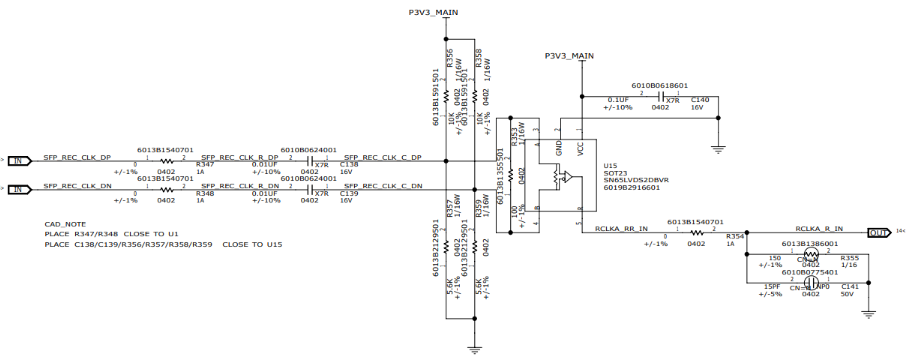
My applicatioin needs a differential to LVCMOS/LVTTL conveter to convert a 78.125Mhz differential clock to a 78.125Mhz single end clock. I plan to do ac-coupling and external bias as below. Could you help check if it is feasible? Thank you!

Differential clock output characteristic

GTY_CLK.png

Schematic

SN65LVDS2.png

Thanks,

YW

  • Hi YW,

    You should remove R356 and R357. R358 and R359 will provide the common-mode voltage to both terminals, however, there will be a slight skew between the 2 terminals due to the 100Ohm termination resistor. If you don't want this skew, you can implement split termination with common mode biasing as shown below. For other biasing schemes you can refer to this app note: https://www.ti.com/lit/ab/slaa840/slaa840.pdf?ts=1765295614326&ref_url=https%253A%252F%252Fwww.google.com%252F 

    Also, SN65LVDS2 does not have an integrated termination resistor in it, but the symbol in your schematic shows an integrated termination resistor. The way you have the 100 Ohm termination (R353) with current part number you are using is correct, but if you meant to use the device with an integrated resistor (SN65LVDT2), then you will need to remove R353.

    Regards,

    Matt 

  • Hi Matt,

    Thank you for your feedback.

    More questions as below...

    1. Should 0.1uF be placed close to driver or receiver in layout?

    2. Should external biasing resistors be placed close to driver or receiver in layout?

    3. Can I do DC-coupling to interface below clock output to SN65LVDS2?

    Thanks,

    YW

  • Hi YW,

    The capacitors and resistors should be placed close to the receiver. 

    The specs you shared suggest that the LVDS output is already DC-coupled since it has on offset voltage of 1.25V. If this is the case, then you probably don't need to AC-couple anything and just have a single 100Ohm termination resistor at the receiver. The SN65LVDS2 receiver will be able to read these DC-coupled signals. 

    Regards,

    Matt