This thread has been locked.

If you have a related question, please click the "Ask a related question" button in the top right corner. The newly created question will be automatically linked to this question.

TSER953: Capacitor short in POC section of TSER953

Part Number: TSER953

Hi,

We are using the V3-Link serializer (PN: TSER953) for our cameras. The cameras will be used in a high vibration automotive environment. Initially we found a capacitor short (C15 capacitor) issue in few cameras. The schematics is shown below.
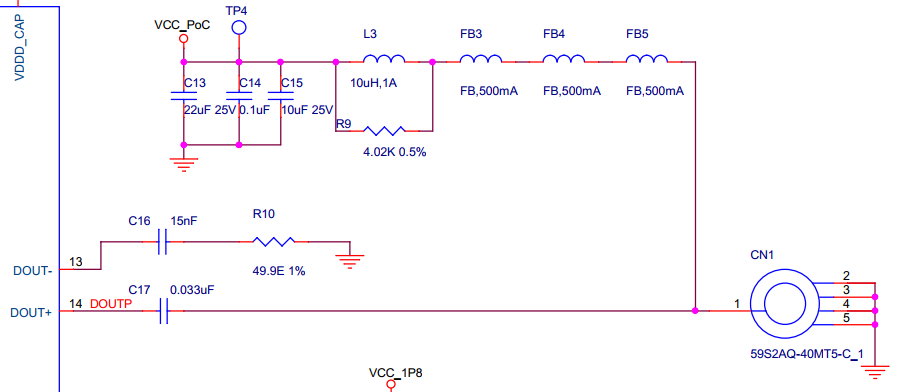
image.png

So, we added a TVS diode (PN: SPHV15-01ETG-C) just after the inductor resistor pair. The updated schematics is shown below. But still out of 100, 2 cameras produces the same capacitor short issue.
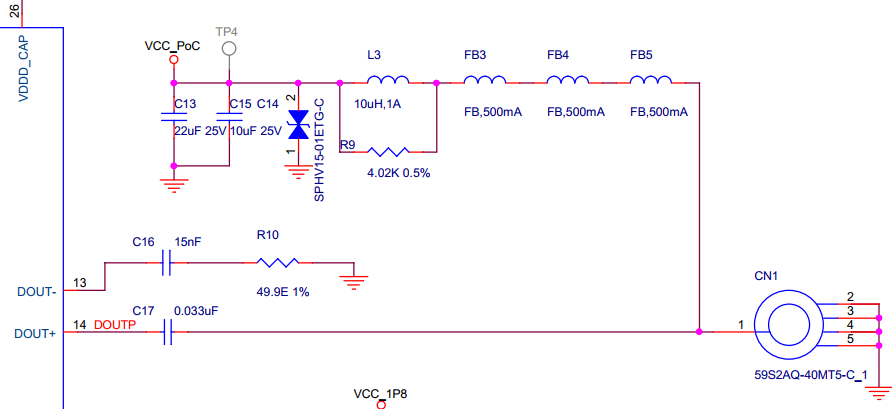
image.png

Can you think of any possiblities for this issue occurance?

  • Hello Vignesh,

    Could you elaborate more on the "capacitor short" issue?

    Do you mean to say that either C13 or C15 are being damaged, shorted to GND? Which is causing your camera module to lose power and thus turn off?

    Have you confirmed which capacitor is the issue, by discharging all of them and then using a multimeter to check if there is a short across a specific capacitor?

    Best,

    Justin Phan

  • Hi Justin,

    Yes, only the C15 capacitor gets shorted to GND. We removed the capacitor C15 and found it to be short while checking with the multimeter. After removing it, the camera is working properly. Also, we used another capacitor with same part number (MPN: GRT188R61E106ME13D) as C15 in the same VCC_PoC line, but no issue found in that part.

  • Capacitors short when they are damaged, either voltage applied was above the capacitor rating. Or temperature is too high. Or part was damaged somehow during manufacturing. Or you had defective capacitor components.

    I think the best solution is to use the appropriately rated capacitor for your system.

    The only purpose of a diode would be to prevent overvoltage spikes from damaging the capacitors.

    What is the PoC voltage? And have you probed to see what the voltage behavior at the capacitors looks like during normal operation?

  • The PoC voltage is 12V only.

    Also we have probed the capacitors during normal operation. There is no undershoot/overshoot or any other irregular behavior observed in the voltage waveform and no sudden current spike observed. But during hot plugging, The voltage spike of 27V for few nano seconds and 2.5A current spike for 200us is observed.

  • Hello Vignesh,

    Even the new capacitor (GRT188R61E106ME13D) is only rated up to 25V, so if there is a spike in voltage up to 27V, then that is why your capacitors are getting damaged.

    Possible solutions:

    1. Use all capacitors rated at higher DC voltage.
    2. Try using a tvs diode with a lower clamp voltage.
      1. Are you still seeing a 27V spike at C15, even with the TVS diode populated?
    3. Are you able to add a footprint to your design, adding the TVS diode closer to the connector?
      1. This is how it is normally done in modt designs.

    Best,

    Justin Phan

  • Hello Justin,

    We have tested by hot plugging the cameras many times, but the issue didn't recur at our end. It happens only in the field. In the field there is no possibility of hot plugs, the whole robot is powered ON and OFF. 

    As the TVS diode is placed before the capacitor, we didn't see the 27V spike after using the TVS diode. Also, adding the TVS diode near the connector will create issue during Link Margin Analysis. This may lead to poor link between Serializer and deserializer.

    Can you provide any other possible reason for the capacitor short issue? As only the 10uF capacitor C15 gets damaged, remaining capacitors have no issues.

  • Somehow, the C15 capacitor is getting damaged. The only things I can think of are if the part itself was exposed to some condition that is out of spec, such as excess voltage or being exposed to temperatures outside of the datasheet spec. 

    Other possibilities include mechanical damage (maybe the part was physically colliding with something?) or if the capacitor was somehow exposed to a voltage short or shock directly (and thus bypassing the TVS diode).

    Or, you are somehow getting faulty capacitor parts that are/were damaged before assembly.

  • We have verified the capacitor part number and confirmed that it is correct. The same capacitor is used at multiple locations within the same camera, and components from the same manufacturing batch were assembled across all cameras.

    Could you suggest any other possible reasons for this behavior, such as LC self-resonance or related effects?

  • We have not observed any type of self resonance effect between the decoupling capacitors and the PoC inductors that can cause this type of issue.

    It is a bit difficult to debug since your team is not able to replicate the issue in your lab setups. And the issue only happened in the field when the robot power supply was turned ON and OFF.

    The only thing I can think of is mechanical stress, temperature stress, or over voltage/current stress that can cause this damage. Or perhaps there is some short along the C15 capacitor pads (maybe due to low quality soldering job) that is causing an overheat or overcurrent type situation.

     If you can identify the specific test circumstances to replicate this issue, then perhaps I can help provide more suggestions.