This thread has been locked.

If you have a related question, please click the "Ask a related question" button in the top right corner. The newly created question will be automatically linked to this question.

AM26C31-EP: Can exceeding maximum threshold for a short burst damage device?

Part Number: AM26C31-EP

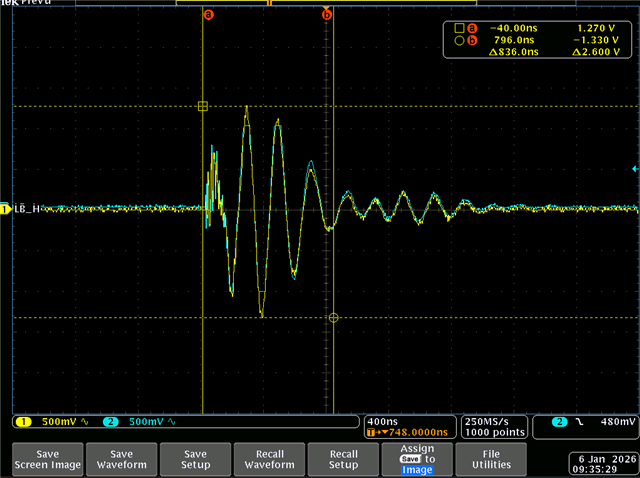
I am using a DAQ to measure the output of the line driver, but when the DAQ switches, i can see that it induces an oscillation on the output of the line driver. The oscillation lasts approx. for 800ns, with 3 oscillations in that time frame, with a peak to peak voltage of 2.6V (+1.3V to -1.3V). Each osillation lasts approx 200ns.


Can this noise from the measurement equipment damage the device? The DAQ measures multiple times a second so it is constantly seeing this noise. I am measuring at the DAQ, not the device.

  • Hi Hamza,

    Do you have a scopeshot of what the pin is seeing? Also, can you specify which pin? Is it one of the A pins?

    -Bobby

  • Attached screenshot.  Channel 1 is pin 10 of the line driver, and Channel 2 is pin 11 of the line driver.

  • Hi Hamza,

    Pin 10 and 11 of this device are the differential output pins which are quite robust. They can handle +/-14V so the +/-1.3V over and undershoots won't damage the device.

    -Bobby

  • I think I am confused by the absolute maximum rating of the datasheet. It states that the differential input voltage range is +14V, but aren't these differential outputs? Vo (Output Voltage Range) is what i was looking at (-0.5V to 7V)

  • Hi Hamza,

    I'm going to double check with my collegue who used to support these devices to get a second opinion here. 

    I'll try to get back to you tomorrow if he's in the office.

    -Bobby

  • Thank you

  • So after discussing with him, he states technically the ViD abs max is specific for RS422 receivers (even though this device doesn't have a RS422 receiver circuit) and the RS422 standard doesn't explicitly call out the drivers being compliant to the receiver common mode voltage (this is where I argue it doesn't make sense for it not to because then the driver would be useless in an actual system if it couldn't survive damage that a receiver could potentially see). 

    Both of us agreed that in actual practice, the designers of the device would aim for making the driver capable of the same receiver boundaries though. These devices would probably have really high return/failure rates if it were only up to -0.5V.... This is why we don't think this is the actual limit for the driver. 

    However technically, our datasheet would guarantee the Vout spec is the one that shouldn't be violated instead of the ViD. 

    So with that in mind..... Can you tell me how often you would expect this kind of transient to occur? Generally breaking the abs max at ~1.5V in the nanosecond range shouldn't damage the device. But if you're doing this over a long period of it's life cycle it could affect the fail rate in time (FIT rate).

    Second, is it possible to add capacitance to the bus to lower this transient? Maybe 100pF?

    -Bobby