This thread has been locked.

If you have a related question, please click the "Ask a related question" button in the top right corner. The newly created question will be automatically linked to this question.

TCAN1462-Q1: [TCAN1462-Q1]SiC network termination

Part Number: TCAN1462-Q1
Other Parts Discussed in Thread: TCAN1042H-Q1, TCAN1472H-Q1

Hi,Ti

Our application environment consists of multiple devices operating under the same 48 V power system, interconnected via a CAN bus.
The devices include motors, cameras, and displays, and the target data rate is 8 Mbps.

Would TCAN1462-Q1 be the recommended choice for this application?

The bus fault voltage rating of TCAN1462-Q1 is ±58 V.
Is this rating sufficient for our application environment?

Under what application conditions would you recommend using an isolated (ISO) CAN transceiver instead?

In the TCAN1462-Q1 user guide, the recommended termination for CAN SIC is not a standard 120ohm resistor, but a termination network that includes a 60ohm filter.

If this termination filter is implemented,
is it compatible with a CAN FD network, especially at high data rates such as 8 Mbps?
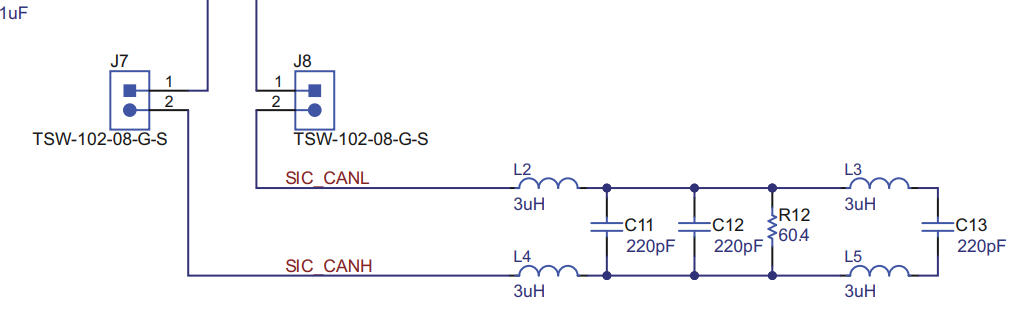


image.png

  • Hi Austin,

    48 V transients typically exceed 58 V ratings and would recommend the H-devices as mentioned. TCAN1042H-Q1 for example. TCAN1472H-Q1 (if a SIC device rated for 8 Mbps is a strong requirement) is currently under development with samples estimated for the end of 2026. Please help share your business case, customer / OEM, volume and timelines to help provide additional support.

    And do not use the CAN SIC network. The EVM has the option for evaluation purposes I.e., worst case network to help evaluate how SIC devices perform. CAN FD devices can also be evaluated but just for evaluation purposes and would recommend to use the termination recommendations in the data sheet instead, similar to the data sheet layout guidelines.

    You may use isolated CAN transceivers if any concerns for unclean, unsafe, lower impedance GND with the local ECU (different / uncontrolled GND domains) or when faults on the bus / harsher environments exceed what non-isolated devices can tolerate, thanks.

    Best Regards,

    Michael.

  • Thank you for your suggestion.
    Our project is currently in the design phase and is scheduled for mass production in Q3 2026. Therefore, TCAN1472H-Q1 does not appear to be a suitable option for us.

    Although our power system is 48 V, the operating voltage is stepped down through DC/DC conversion, so any overvoltage condition should be transient in nature.

    Regarding transient protection, would it be acceptable to add a protection device with a clamping voltage below 58 V on the BUS pins of TCAN1462-Q1 to address this concern?
    Alternatively, do you have other recommendations to suppress transient disturbances while still maintaining an 8 Mbps data rate?

  • Hi Austin,

    Yes using the protection device is acceptable and would recommend for the VRWM that is still above the max steady voltage that could appear on CANH / CANL while clamping below 58 V. For 8 Mbps, would recommend CMC, split terminations, while ensuring low capacitance on the bus overall and a low cap (single digit pF) TVS close to the connector (very short) with an overall low-inductance return to chassis reference. Also ensure short stubs with solid return path similar to the data sheet design recommendations, thanks.

    Best Regards,

    Michael.

  • Hi, Michael

    Regarding the protection components, I would like to further confirm which of the following three conditions is more reasonable for selecting the VRWM value:

    1. Refer to the TCAN1462-Q1 and use ±12 V.

    2. Refer to the current system input voltage and use 48 V (with clamping voltage > 70 V).

    3. In order to keep the clamping voltage below 58 V, use 36 V.

    In addition, the TCAN1044VDRBRQ1 does not support SiC, but its data rate can still reach 8 Mbps. Are there any limitations or constraints when using it?

  • Hi Austin,

    2 seems to be the most reasonable and would recommend VRWM high enough that the TVS do not conduct at the max expected fault voltage on the bus (≥ 52 V to include margin for your case + still protect the TCAN pins from exceeding the abs max rating, and verify). May also reach out to the PD team as they are experts and can share their plans for 48 V system protection devices.

    Also, they can both be used for 8 Mbps. However, SIC helps improve signal integrity in environments with topology constraints that may result to ringing as data rates increases such as long cables, stubs, impedance mismatches, non-linear topologies etc, and would recommend paying close attention to the data sheet's design and layout's guidance if you decide on non-SIC, thanks.

    Best Regards,

    Michael.