TCA9517A: Supply restrictions between VCCA and VCCB

Part Number: TCA9517A
Other Parts Discussed in Thread: TCA9517-Q1, TCA9517

Dear Technical Support Team,

I belive that  TCA9517A can supply for “VCCA > VCCB”.
However TCA9517A website states “Supply restrictions: VCCA ≤ VCCB”.

Is this typo?

According to revision history, it said "Deleted VCCA < VCCB from the Design Requirements list".

So “Supply restrictions: VCCA ≤ VCCB” 

Therefore, it seems that the previous restrictions remain in place on the website.
I would appreciate it if you could delete them.
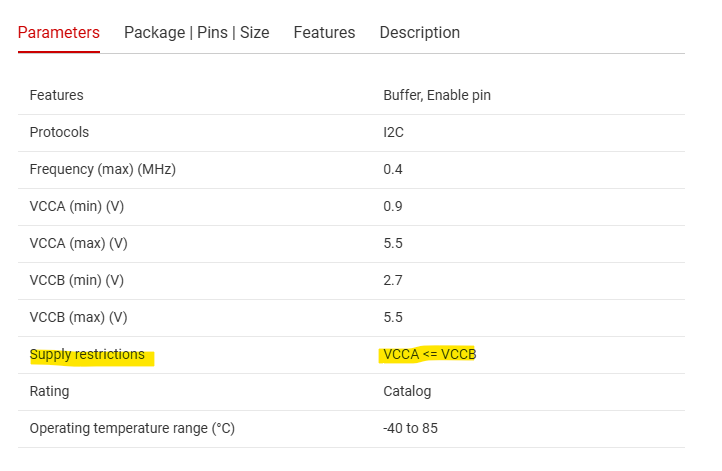
image.png

Best Regards,

ttd

  • Hi TTD,

    The TCA9517A has this supply restriction. 

    Are you referring to the automotive version? TCA9517-Q1? 

    Where there is some margin for VCCA above VCCB? 

    Regards,

    Tyler

  • Hi Tyler,

    Thank you for your reply.

    I seethe data sheet for TCA9517 version(not Q1).

    I understood that there are restriction for Vcc min. therefore website shows VCCA ≤ VCCB.

    In my use case,VCCA=3V < VCCB=5V.

    According to this previous post, it’s possible.

    e2e.ti.com/.../tca9517a-about-vcca-vccb

    Best Regards,

    ttd

  • Hi TTD,

    According to Bobby, I would agree with this portion of the e2e: 

    ------------

    I found out later that testing showed the device was functional when VccA>VccB. I do think I should point out if VccA is much larger than VccB then the ViL on A side will no longer meet datasheet spec of 30% of VccA. In the worst cases according to the test reports ViL on A side was as low as 0.25*VccA.

    In your case, your Vcc here is 5V so at worst case, your ViLc would be 1.25V which would still allow for communication on I2C.

    "Is my understanding wrong?"
    So there are two things here. One is does the device work? And two: Does it meet datasheet spec?

    #1 The device will still function, where you will be able to transmit a low from A side to B side and B side to A side no problem.

    #2 The prop delays and ViL on A side MAY not meet our datasheet spec anymore

    So if you are okay with not being able to meet datasheet spec BUT are able to use the device functionally then using TCA9517 in your application will be fine.

    -------------------

    I am not sure of the testing that was done 7 years ago, but at one point it looks like VCCA > VCCB would work. 

    As long as you understand that the device may not function entirely to the datasheet spec when used in a case VCCA > VCCB, I don't see why you can't use this device in this manner if it works for your system conditions. It looks like the VIL is affected, so adding more margin there would help to account for the supplies being VCCA > VCCB. 

    Regards,

    Tyler

  • Hi Tyler,

    Thank you for your reply.

    Back to your respose of VCCA restriction about (2) Low-level supply voltage, Dose it mean "When VCCA is low, caution is required because the A-side input low judgment level (VIL) becomes very low."?  In other words, when VCCA=0.9V (min), VIL=0.27V (0.9V * 0.3).

    Best Regards,

    ttd

  • Hello, 

    The team is currently out of office due to holidays, we will get back to you as soon as possible.

    Regards,

    Jack

  • Hi TTD,

    Back to your respose of VCCA restriction about (2) Low-level supply voltage, Dose it mean "When VCCA is low, caution is required because the A-side input low judgment level (VIL) becomes very low."?  In other words, when VCCA=0.9V (min), VIL=0.27V (0.9V * 0.3).

    That is part of the caution. A VCCA = 0.9 V means VILA = 0.3 x 0.9 = 0.27 V. This is a very low input voltage on A-side. 

    The note is also referring that VCCA is the low side supply voltage while B-side VCCB is the larger supply. In a level translation scenario, VCCB >= VCCA. 

    Regards,

    Tyler