This thread has been locked.

If you have a related question, please click the "Ask a related question" button in the top right corner. The newly created question will be automatically linked to this question.

P82B96: Additional Question about P82B96

Part Number: P82B96
Other Parts Discussed in Thread: TCA9803,

Hello,

I asked about 5 days ago with the subject of "82B96: Question about using 1 peace of 82B96" and received an answer, but I received the following additional question/request.

"Would it be possible for you to tell us the VOL characteristics of Tx and Ty in the form of the VOL characteristics of Sx and Sy in the red box in the table of item 7.7 below?
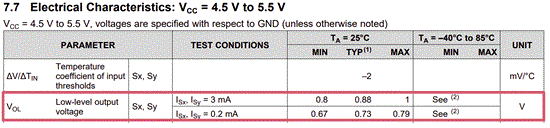
Fig (2).gif

I think VOL is only mentioned as a condition or rating in the table in section 7.3.
In order to confirm whether the VIL regulation of the master side can be satisfied, the VOL regulation of the buffer IC is necessary.
We are also concerned that the characteristics of Sx and Sy may change depending on the current value.
I would like to know exactly the VOL characteristic values of Tx and Ty together with their measurement conditions."

Thank you,

  • Hi Takashi,

    The best data we can gather is from table 7.3 recommended operating conditions. The maximum IOL is given. This means that at any VOL lower than 0.42V will yield a current load < 3 mA. 

    Same idea for Tx/Ty. A max IOL = 30 mA is given when VTx, VTy = 0.4 V. A VTx, VTy < 0.4 V will yield an IOL < 30 mA. And this is across operating free-air temperature (-40C to 85C). 

    If you design for the maximum IOL spec, your IOL will be lower for an output low voltage < 0.4 V which is adjusted through the choice of your pull-up resistor. 

    What is the buffer IC being used and what is it's VIL characteristics? 

    Regards,

    Tyler

  • Hi Tyler,

    Thank you for your support.

    I would like to inform your reply to the customer.

    I am not familiar to this IC. Could you please let me know why you want to know the buffer IC beign used and it's VIL characteristics? If you get information on your question, can you give more advice to the customer?

    Thank you,

  • Hi Takashi,

    I am not familiar to this IC. Could you please let me know why you want to know the buffer IC beign used and it's VIL characteristics? If you get information on your question, can you give more advice to the customer?

    Some buffers can work in series with a P82B96. Others cannot. A buffer like TCA9803 cannot be connected on its B-side to P82B96. I am trying to understand why only 1 P82B96 is being used as well. 

    Regards,

    Tyler

  • Hi Tyler,

    Thank yo for the explanation. I will respond to the customer and ask your question. I will contact you if there is an update.

    Thank you,

  • Hi Tyler,

    I had following response and questions from the customer.

    Regarding your questuion, the customer won't use any buffer IC.

    Their current configuration is "Master - P82B96DGKR - P82B96DGKR - Slave". But they want to change it to "Master - P82B96DGKR - Slave", only one P82B96DGKR configuration.  Their desired VIL characteristic is VIL≦0.95 V at VCC=5 V (±5%).

    There are three new questions. Could you give me an answer?

    1) With regards to the characteristic table 7.3 recommended operating conditions, if the IOLs of Tx and Ty are 30 mA or less, is it correct to understand that VTx and VTy are 0.4 V or less?

    2) How do the VOL characteristics of Tx and Ty change when VSx and VSy are 0.4 V or more? On the characteristic table, I read that VSx and VSy are 0.4 V, but I would like to know the VOL characteristics of Tx and Ty when the condition is not satisfied.

    3) About the following information, hat is the condition for the output voltage (VTx, VTy?) to be less than 0.4 V?

    > If you design for the maximum IOL spec, your IOL will be lower for an output low voltage < 0.4 V which is adjusted through the choice of your pull-up resistor. 

    If there is anything unclear about the customer's question, please let me know.

    I would appreciate your support.

    Thank you,

  • Hi Takashi,

    1) With regards to the characteristic table 7.3 recommended operating conditions, if the IOLs of Tx and Ty are 30 mA or less, is it correct to understand that VTx and VTy are 0.4 V or less?

    Yes this is correct. At maximum current load of IOL = 30mA, the VOL <= 0.4 V on the transmission side Tx/Ty. 

    2) How do the VOL characteristics of Tx and Ty change when VSx and VSy are 0.4 V or more? On the characteristic table, I read that VSx and VSy are 0.4 V, but I would like to know the VOL characteristics of Tx and Ty when the condition is not satisfied.

    The varying in voltage input of 0.4 V or more is independent of the drivers strength on the transmission side. If you have a VOL(Sy,Sx) = 0V, 0.4V, or >0.4V, the VOL is still the same driver on the transmission side --> VOL = 0.4V at 30 mA

    3) About the following information, hat is the condition for the output voltage (VTx, VTy?) to be less than 0.4 V?
    > If you design for the maximum IOL spec, your IOL will be lower for an output low voltage < 0.4 V which is adjusted through the choice of your pull-up resistor. 

    Yes this is correct. If your Transmission side pull-up voltage is 5V, and you design for only 3 mA of IOL, then you can adjust the pull-up resistor to sink the current required for your target device. 

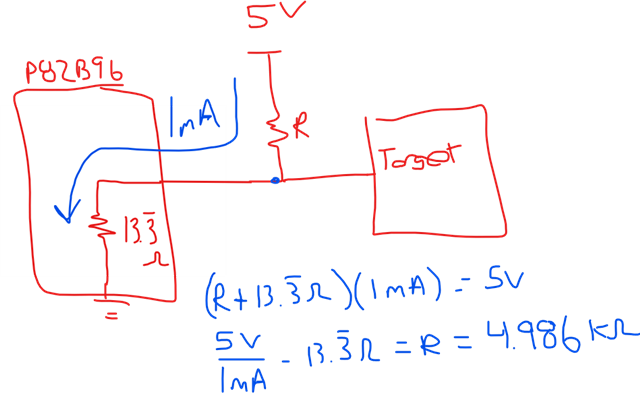
    Resistance of the driver is ~ 13.333 ohms

    I performed some rough calculations. 

    Based upon a 1 mA current sink, a Rpull-up of 4.986 kohm would sink roughly 1 mA of current through the driver. 

    THis would result in a VOL = 0.0133 V, which is a very low VOL to the target and should satisfy any I2C target whose VIL = 0.4 V. 

    Now you do have to take into consideration the rise time of using a 4.986 kohm PU resistor with your system. If the bus capacitance is too large, your rise-time may be over spec. 

    Please see this application note: 

    I2C Bus Pullup Resistor Calculation

    Regards,

    Tyler

  • Hi Tyler,

    Thank you so much for your quick reply. I informed the customer about your reply. If customer seems ok with it, or if there are no further questions, I would like to clode this session.

    Please wait a moment.

    Thank you,