THVD2410: Circuit validation THVD2410DR use for RS485

Part Number: THVD2410


Hello TI Team,

I am using the THVD2410DR RS-485 transceiver in an industrial Modbus application and would like clarification on the following points:

  1. A/B Input Voltage Tolerance
    Can the A and B pins of the THVD2410DR tolerate a direct 24 V DC fault (applied accidentally from field wiring)?

    • If yes, for how long (continuous or transient)?

    • If not, what external protection is recommended?

  2. Termination Resistor Recommendation
    What TI-recommended part numbers (120 ohm termination resistor) have been validated with THVD2410 devices for reliable RS-485 communication?

  3. Circuit Validation for 24 V Fault
    Please help validate whether the following front-end protection is sufficient for a 24 V field fault:

    • TVS diodes on A/B lines

    • Common-mode choke

    • Series resistors

    • 120ohm termination resistor

    We observed that during a 24 V fault, some interface components (resistors/chokes) were damaged, and we want to ensure the circuit is robust enough to survive such conditions without damaging the transceiver.

Any guidance on recommended protection topology or reference designs for 24 V fault-tolerant RS-485 interfaces using THVD2410DR would be very helpful.

Please see the below image of the circuit and protection validation:
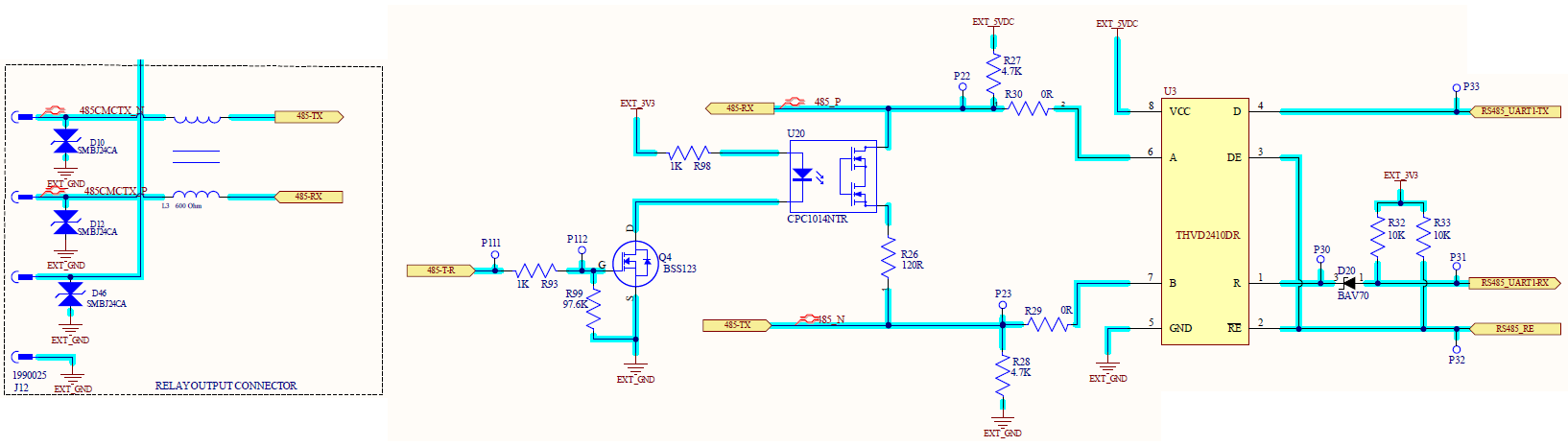
image.pngThank you for your support.

Best regards,

Milan

  • Hi Milan,

    Thanks for reaching out on E2E!

    Yes, this device can handle a continuous 24V DC short on the A or B pins (70V is the abs max). Just note that this transceiver (and any other transceiver with this rating) will survive the short, but communication is not guaranteed during this time of course. 

    Now for the attached components:

    • TVS/ESD diodes are fine, just ensure they are rated correctly for 24V shorts as well. The Vrwm or working voltage should be at or above 24V. Even though this is technically a CAN ESD diode, I would look into our ESD2CAN24. CAN has nearly identical conditions to what you are describing, and this diode is intended for that kind of environment with 24V shorts.
    • Series resistors (specifically pulse proof) will help with transients but not with continuous shorts. These are not necessary and can be removed.
    • For the 120 Ohm termination resistor, just ensure it has a 1W rating for the most conservative approach. But I would double check your termination switching setup is rated properly. 

    Saving the best for last: the common-mode choke. During short conditions, a common-mode choke can severely increase the voltage, sometimes up to 5x the short voltage. If you want to understand how a common-mode choke responds to short conditions, I highly recommend reading this app note that we have. Just note that while it does mention CAN transceivers, it is nearly identical in its behavior to RS-485:

    https://www.ti.com/lit/an/slla271/slla271.pdf 

    But the summary of it is a 24V short while a CMC is present can cause voltages spikes that damage downstream components. Depending on the layout, CMC spec, and other conditions this transient voltage spike can widely vary. But I wouldn't be surprised that under the right conditions, it could be hitting 48V+. Now the THVD2410 will survive assuming it does not exceed 70V. But the other components will very likely be damaged. 

    So the easiest solution would be to try to remove the CMC. But if you do need to keep it, I would measure the exact voltage at the transceiver pins during the short. Then rate the other components based on this voltage. 


    Now for a completely different approach: I would look into our THVD1454 which has a built in switchable termination resistor to remove your external termination circuitry. You could combine this transceiver with SIDAC diodes and PTC fuses (reference design linked here). 

    Best,

    Ethan