This thread has been locked.

If you have a related question, please click the "Ask a related question" button in the top right corner. The newly created question will be automatically linked to this question.

DP83826AI: 10BASE T

Part Number: DP83826AI
Other Parts Discussed in Thread: DP83822I

Does the DP83826AI support 10BASE-T, or is it limited to 10BASE-Te only?

Based on the description in the datasheet, I understand that EEE is disabled by default.
In this case, is it correct that the device will operate at 10BASE‑T?
I also understand that both ENHANCED mode and BASIC mode have EEE disabled by default.
Is this understanding correct?
Furthermore, during auto‑negotiation, if either side has EEE disabled, I understand that EEE will not be supported and the link will simply operate at 10BASE‑T.
Is this correct?

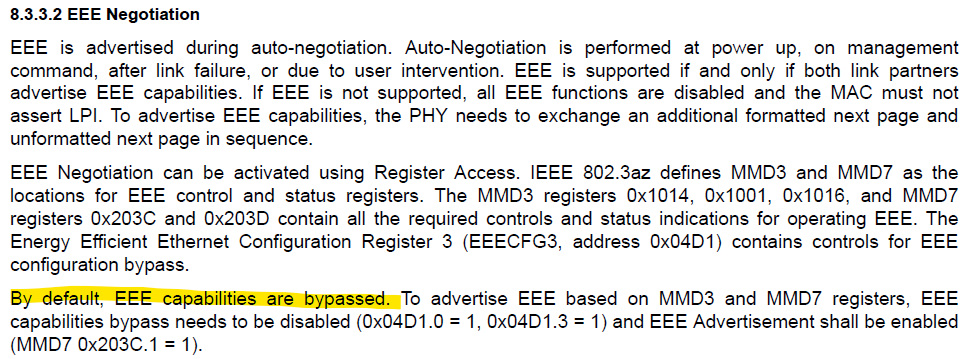
 

image.png

image.png

  • Hi, 

    DP83826A has 10Base-Te enabled by default and it does not support 10Base-T. The only difference between 10Base-T and 10Base-Te is the Vpp of the MDI signal in which 10Base-Te has a lower Vpp than 10Base-T to save power. 
    Because this is the case, DP83826A is defaulted to transmit 10M MDI signal with lower Vpp at all times and cannot be configured to transmit at a higher Vpp. 

    Best,
    J

  • In Section 8.3.3.1 EEE Overview, it says 'EEE must be enabled through register programming.'
    Does this not mean that EEE is disable by default?

    I would also like to confirm regarding the DP83822I, does this not support 10Base-T?

  • Hi,

    That statement refers to 100M EEE. 100M EEE and 10Base-Te work differently. 10Base-Te and 10Base-T transmit signals the same way but 10Base-Te transmit signals with lower Vpp. In 100M EEE, the MAC sends signals to put the link partner into low power state or wake the link partner up for signal transmission.100M EEE is disabled by default.

    DP83822 also does not support 10Base-T.

    You can read more about EEE from this document: https://www.ti.com/lit/pdf/snla265

    Best,

    J