TUSB211A-Q1: USB2.0 device side compliance test?

Part Number: TUSB211A-Q1

Hi team, 

We image USB2.0 data is bidirectional as below.
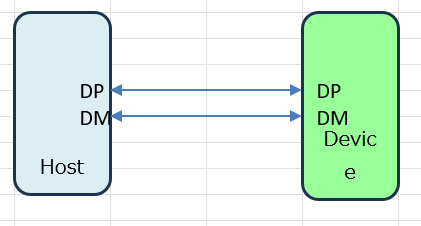
image.png

For USB2.0 compliance test, electrical test, we understand Host data "send" and Device data "send" has to be tested. Circuit and data direction image is below. 
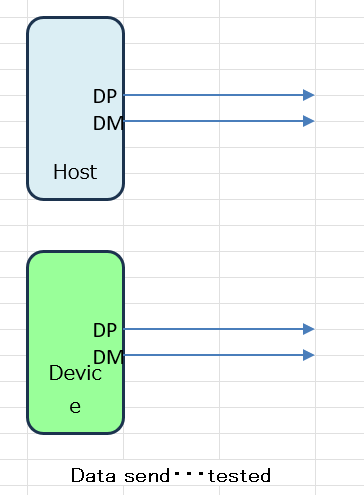
image.png

Is there no test spec shown in USB2.0 comliance test for Host data "receive" and Drvice data "receive"? If no test, do you know its background? Data direction image is shown below.
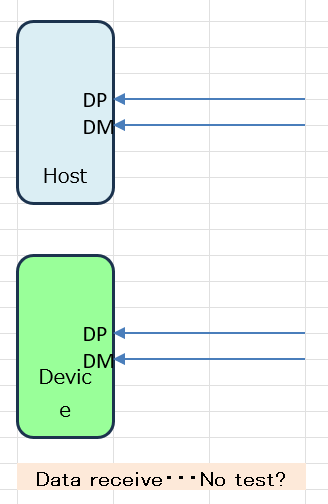
image.png 

If no specific test for "receiver" side, how Host data "receive" and Device data "receive" is evaluated as application system level in general? 

In USB2.0 compliance, how do we guarantee received data correct by only Host data "send" and Device data "send" test? 

Regards,
Ochi

  • Hi Ochi-san,

    Is this for an OTG application? If so, the FS/HSSQ Upstream tests would serve as a device data "receive" test, where the device is configured as a "peripheral" and receives data from a host.

    There is no test where the host receives data, as in most cases, receiving data tends to be more dependent on the device sending data and the connection between the two devices, rather than how it appears at the far-end of the signal path. The FS/HSSQ Upstream test typically outlines what is needed to perform these tests.

    Thanks,

    Ryan

  • Hello,

    Thank you for your explanation.
    I am supporting this discussion and would like to add a clarification question.

    Just to confirm our understanding, we would like to ask the following:

    1. Is it correct to understand that, in the USB 2.0 compliance philosophy, receiver performance is indirectly guaranteed by ensuring transmitter-side compliance (such as signal mask, jitter, amplitude, etc.), and therefore no dedicated electrical test for the receiver is defined?

    2.Is it also correct to understand that receiver performance is not verified through electrical compliance testing, but instead validated at the system level (e.g., through interoperability or functional testing)?

    Best regards,
    Katsuya Mine

  • Hi Katsuya-san,

    1. Is it correct to understand that, in the USB 2.0 compliance philosophy, receiver performance is indirectly guaranteed by ensuring transmitter-side compliance (such as signal mask, jitter, amplitude, etc.), and therefore no dedicated electrical test for the receiver is defined?

    Correct, for a host application, typically only the host side of the system needs to be tested, as this will guarantee that the host at least has no issues and is compliant to the USB2 standard. For the device side, outside factors such as cable length and quality can have an effect on the signal going from the host to the device, making the signal quality at the device side more dependent on the system as a whole rather than the host.

    For an OTG port, both downstream and upstream tests should be done, according to the USB2 test spec and test matrix:

    2.Is it also correct to understand that receiver performance is not verified through electrical compliance testing, but instead validated at the system level (e.g., through interoperability or functional testing)?

    Correct, this can be validated via functional testing and inter-op testing. If desired though, you can also take an eye-diagram at the far-end of the signal, on the receiver/device end, and test this with the far-end eye mask to ensure it is still within expected levels. But again, far-end eye diagrams are more likely to be affected by the system and may not be an accurate representation of host performance.

    Thanks,

    Ryan

  • Hello,

    Closing thread due to inactivity. If you have any follow-up questions or concerns, feel free to reply.

    Thanks,

    Ryan