A related question is a question created from another question. When the related question is created, it will be automatically linked to the original question.
If you have a related question, please click the "Ask a related question" button in the top right corner. The newly created question will be automatically linked to this question.
The power dissipation for this buffer would be determined by the pull-up resistors used on A-side and the voltages used for VCCA and VCCB, do we have this information?
The power dissipation is worst case when the buffer is constantly driving a logic low from B-side to A-side. This is not the normal use of the part since this will be buffering I2C signals most of the time.
The worst case power consumption is when SDAA = SCLA = low. There will be some power consumption by your open-drain driver (from target or MCU) that will sink the current from the pull-up resistors on A-side. This however does not factor into the power consumption of the buffer.
I assume there are no pull-up resistors on B-side of the buffer, as this is the proper use of the buffer relying only on the internal current source which has a typical current of 3.3 mA pull-up current for TCA9803.
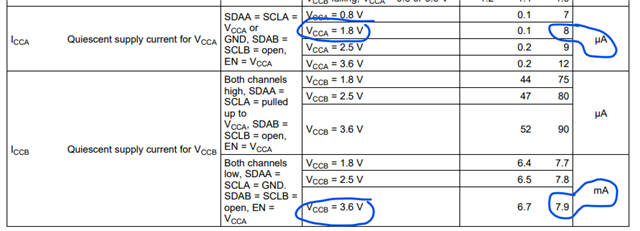
A majority of the current will be through ICCB supply. There is some current from ICCA.
This is the DC state if A-side is held low. In practice, I2C will run a logic low only for short periods of time (microseconds of time) for each I2C transaction. You will dissipate more power overtime the more times that the device drives a low.
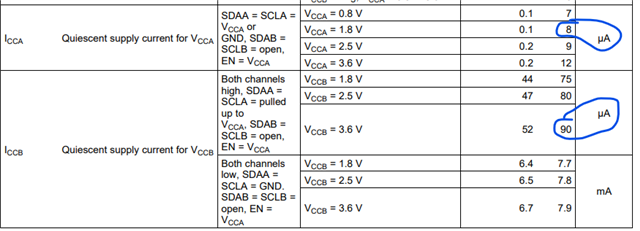
In the Idle state when both sides are high, the quiescent supply current drops. You can expect much less power dissipation:
Ptotal(idle) = (1.8V x 8uA) + (3.3V x 90 uA) = 0.0144 mW + 0.297 mW = 0.3114 mW