THVD1426: How to use automatic-direction function

Part Number: THVD1426
Other Parts Discussed in Thread: THVD1406

Hi team, 

My customer wants to use THVD1426 in DOBOT.

Now they don't have enough GPIO to control REn so they plan to use auto-direct function.

Datasheet said user needs to connect both REn and SDn to high and when D's status changes, Receive will work even REn is high.
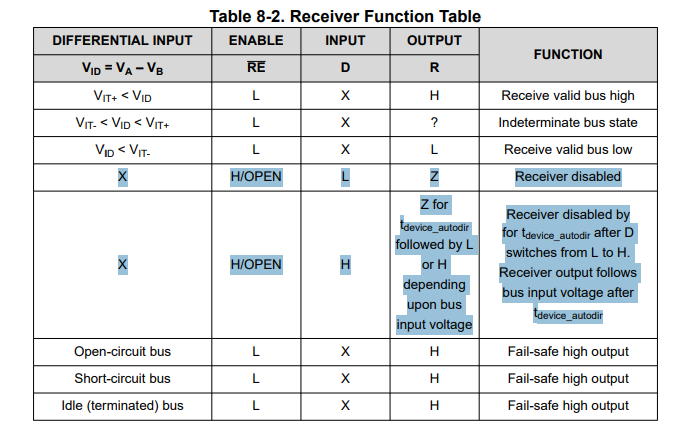
image.png

But when D is from L to H, THVD1426 will keep Z for 8us and then receive signal from BUS.

Customer don't want to receive signals what they send by D.

How about customer send continue high high high signal by D. 


  • Hi Gary,

    For general reference, please consult our Auto-direction app note for best practices: https://www.ti.com/lit/an/slla574/slla574.pdf 

    Note that another way to save GPIO pins is to connect the DE and RE enable pins together on a regular RS-485 half duplex transceiver. That way only one GPIO pin is needed to turn on the driver/receiver. However, if they do not want to use any GPIO pins to control the driver/receiver, then the THVD1426 is the right device to use. 

    But when D is from L to H, THVD1426 will keep Z for 8us and then receive signal from BUS.

    This is incorrect. 8us is for the THVD1406 which has a data rate of 500Kbps max. The THVD1426 time is 0.8us since it is supposed to be used with data rates at ~12 Mbps. 

    Customer don't want to receive signals what they send by D.

    This is not possible to change. The receiver will stay enabled while the driver is transmitting. We do not have another transceiver that accomplishes this. 

    How about customer send continue high high high signal by D. 

    If the D input is high for greater than t_device-auto-dir, then the driver will be high-impedance. Again, this is not changeable due to the nature of the auto-direction feature. Otherwise, the transceiver would not know when to switch modes.

    Best,

    Ethan

  • Hi Sempsrott,

    Got it.

    Could you please help review below Schematic?

  • Hi Gary,

    The A and B pins have the wrong pullup/pulldown orientation. The A pin should be pulled high, and the B pin should be pulled low. 

    They also need to check how the other nodes have implemented the failsafe resistors (i.e. the bus pullup/pulldown resistors). If there are multiple nodes with failsafe resistors, then these resistors are effectively in parallel, which affects how THVD1426 drives the bus. Additionally, double check whether 120 Ohm termination is needed. If it is implemented elsewhere on their RS-485 bus, then it is likely not necessary here.

    Best,

    Ethan