THVD8010: THVD8010/THVD8000 Frequency and Length

Part Number: THVD8010
Other Parts Discussed in Thread: THVD8000

Hi,

I know that the THVD8000 and THVD8010 have a +/-25% tolerance on their OOK frequency.

If I have THVD8010 with 300Khz Fset and a THVD8000 with 500Khz Fset, would we expect the communication to work correctly? With these Fsets, the only overlapping frequency would be 375Khz. In my desktop testing, both devices are able to receive and transmit correctly.


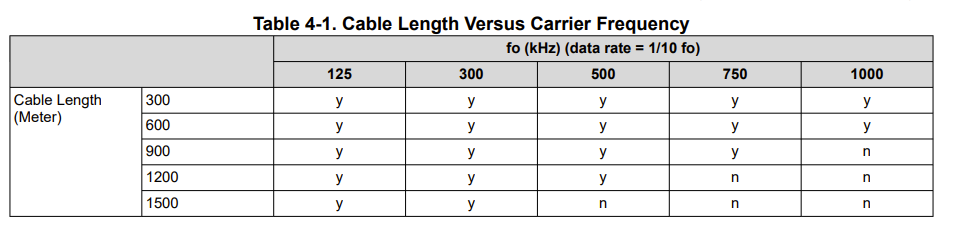
In addition, I saw that the THVD8000 has this chart about length vs carrier freq in its design guide, shown below. How applicable is this chart towards the THVD8010? I know that the thresholds are higher on the THVD8010, but is there any documentation or table that refers to the max possible lengths with the 100 - 300kHz carrier frequency? Would 1000m still be possible with 300kHz carrier?image.png
  • Hi Yixing,

    What is your reason for mixing the THVD8000 and the THVD8010? Even if both versions of our PLC transceiver were able to communicate, we still wouldn't recommend it as the setup could be more sensitive to noise/ripple in a real world environment. The reason you are able to receive and transmit is likely due to the fundamental principles of the OOK modulation scheme. Even with different carrier frequencies, the THVD80x0 must have enough margin in the demodulation process and can read the incoming signal as seen in Figure 8-2 in the datasheet. However, there should be no reason to design a system this way, and slight noise or ripples on the A/B lines could create issues for the demodulation process. At the correct matching carrier frequency, noise and ripple would become much less of an issue. 

    Table 4-1 can loosely still apply to the THVD8010. We do not have a table similar to this for the THVD8010. The lower carrier frequency will still help enable longer distances similar to the THVD8000. The greater threshold on THVD8010 can also make it less sensitive to noise, which will improve its ability to communicate over long distances. I would expect THVD8010 to communicate fine at 1000m at 300kHz carrier frequency while following our design guide principles. I would also recommend this guide which has more detail and equations to help design the best system: https://www.ti.com/lit/an/slla600/slla600.pdf 

    Best,

    Ethan

  • Hi Ethan,

    I was previously testing out a system with THVD8000 and I wanted to switch over to the THVD8010, but it unfortunately had a max frequency of 300kHz. Do you happen to know if TI will plan to create a THVD8010 variant but with a higher frequency?

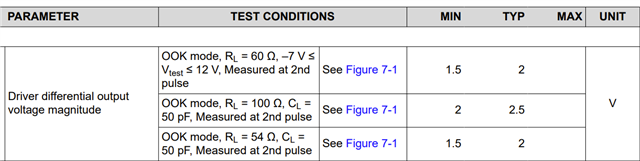
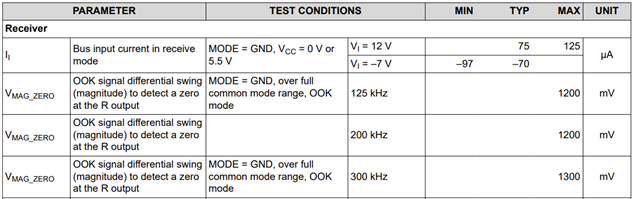
    As for the max wirelength, the one thing that I am concerned about is that for a fully loaded 54 Ohm bus, the max differential output magnitude will be 1.5V min and the Vmag_zero diff swing threshold is max 1.2-1.3V. The doesn't leave a lot of margin with long cable length attenuation. Am I missing something here? 

  • Hi Yixing,

    If you need a higher carrier frequency, you will need to use the THVD8000. 

    That is a valid concern, which I recommend that you test in your system to see how it exactly plays out. Your cabling, total RLC values, and number of nodes will affect the VOD. However, you can also remove or adjust the termination to lighten the load. You could achieve the 2 - 2.5V VOD depending on your loading conditions. 

    Best,

    Ethan