TCAN1043H-Q1: Question about TCAN1043H-Q1

Part Number: TCAN1043H-Q1
Other Parts Discussed in Thread: TCAN1043

Hello:

Problem Background Description

Test Scenario:

1. The CAN transceiver is initially in Normal mode;

2. The MCU pulls the NSTB pin low, requesting to enter Sleep mode;

3. During the transition to Sleep mode, wake-up events continuously occur on the CAN bus;

Abnormal Phenomenon: Under the above conditions, the CAN transceiver fails to enter Sleep mode as expected and remains in Standby mode.

Question 1: How does the MCU detect the CAN transceiver's operating mode?

Question 2: What is the duration of Go-to-Sleep Mode?

Question 3: If Question 1 requires detecting the RXD pin level, what is a reliable peripheral circuit design for RXD pin multiplexing detection? (Our MCU cannot read the high/low level state of the CAN RX pin.)

Refer to TI-TCAN1043H-Q1.pdf 8.4 Device Functional Modes Figure 8-4. State Diagram.


Please help support ,thanks!!!

  • Hi Jimmy 

    Similar to the state diagram, you should not be able to go from normal mode directly to sleep mode and would recommend to follow the state diagram per the modes of interest. To detect the mode, verify which conditions shown in the state is applicable (for example, normal = EN H, nSTB H and INH H as shown. The duration of go-to-sleep is as specified as t_Go-To-Sleep before the device transitions to sleep mode, thanks. 

    Best Regards,

    Michael. 

  • Hello Michael:

    1.Regarding this issue, the customer wants to ask about some details.

    When the TCAN1043 is in Normal Mode (EN=H, NSTB=H, INH=H), if the MCU sets NSTB=L, the MCU will enter Go-To-Sleep Mode (EN=H, NSTB=L, INH=H). If there is a wake-up signal on the CAN Bus at this time, the TCAN1043 will enter Standby Mode (EN=H, NSTB=L, INH=H). It is not possible to distinguish the current mode of the TCAN1043 using only EN, NSTB, and INH. How can the MCU determine whether the TCAN1043 is in Go-To-Sleep Mode or Standby Mode?

    2.Additionally, the customer has found that the transceiver chip wakes up abnormally after sleep during the TCAN1043 debugging process. This is not a software issue, so please support the analysis of this problem.
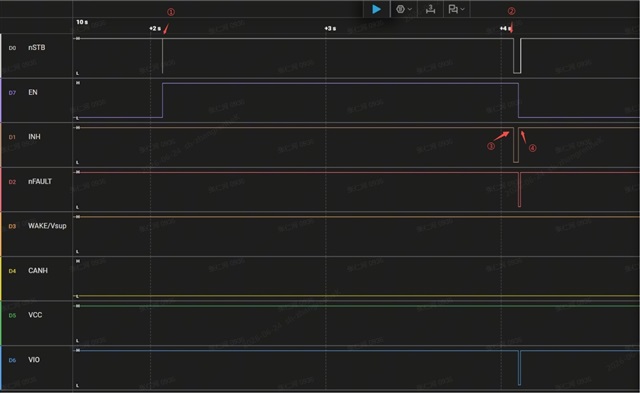
    The timing of the issue is shown in the figure below. Could TI support the analysis of step 4 and the reason why the CAN transceiver INH goes high?
    1. MCU starts up, pulls nSTB and EN high. Theoretically, the CAN transceiver enters Normal mode and can send and receive CAN messages normally.
    2. MCU requests Sleep by pulling nSTB low. The CAN transceiver enters Go-To-Sleep mode.
    3. CAN transceiver INH goes low, and the CAN transceiver enters Sleep mode.
    4. Because the MCU loses power, EN also goes low, at which point the problem occurs. The CAN transceiver INH goes high, supplying power to the MCU. Before INH goes high, CANH stays low, with no CAN signal wake-up, Wake stays high with no rising or falling edge, and no local wake-up occurs.

    Note: ① indicates the MCU power-on time
    ② indicates the MCU starts entering Sleep
    ③ indicates the CAN transceiver INH goes low
    ④ indicates the CAN transceiver INH goes high abnormally

  • Hi Jimmy,

    1. Please help revise your comments while following the state diagram. I.e., as shown, (EN=H, NSTB=L, INH=H) should imply Go-to-sleep mode rather than standby mode. I.e, the MCU can detect go-to-sleep mode when (EN=H, NSTB=L, INH=H) and standby mode when (EN=L, NSTB=L, INH=H). You may also use RXD as shown in table 8-3 where go-to-sleep shows RXD high and standby shows RXD low.

    2. As shown in the state diagram, please note that if VIO goes low, it also implies the device is forced to sleep mode and INH is expected to go low in sleep mode. When VIO goes back high, INH goes back high I.e., INH may follow WUP or UV as indicated in the data sheet. If INH goes low prior to VIO, it may imply Go-to-sleep: Transitional mode for EN = H, nSTB = L until tgo_to_sleep timer has expired for sleep mode (INH = low), thanks.

    Best Regards,

    Michael.