A related question is a question created from another question. When the related question is created, it will be automatically linked to the original question.
If you have a related question, please click the "Ask a related question" button in the top right corner. The newly created question will be automatically linked to this question.
TCA39306: TCA39306 Switch Configuration and Translation Configuration question
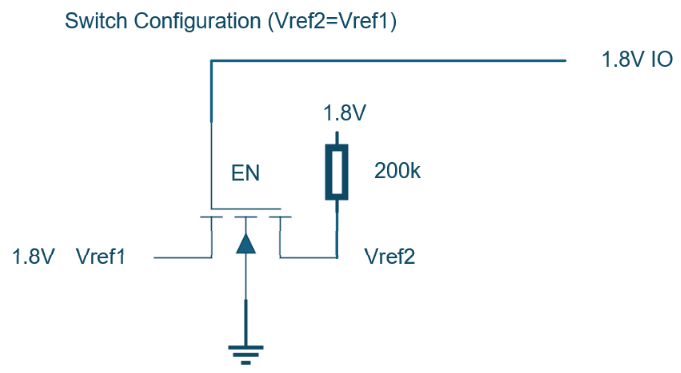
Regardless of which configuration is used, are the HIGH levels on both sides of the MOSFET determined by the external pull-up resistors, with only LOW levels passing through the MOSFET?
Q2:
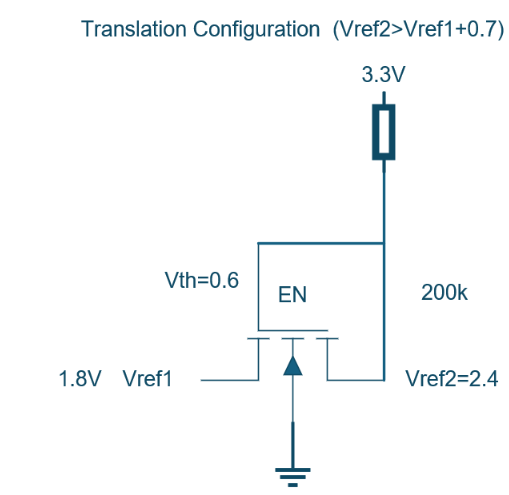
When using the translation configuration, must EN and VREF2 be shorted together to prevent the higher-voltage side from back-feeding into the lower-voltage side, thereby avoiding a direct conduction path from the high-voltage rail to the low-voltage rail?
since Ven = VREF1 + Vth
Q3: Is the 200k ohm resistor required on VREF2 because there is an internal voltage difference of approximately 0.6 V?
2. This particular circuit is needed to regulate the EN voltage to Vth above Vref1. (This clamps all output voltages to Vref1, i.e., it prevents higher voltage from showing up at the low-voltage side, and it allows to generate output signals at Vref1 even without a pull-up to Vref1.)
3. The resistor is needed to limit the current that flows into Vref2 and out of Vref1, and to have a voltage drop so that EN is lower than 3.3 V. Note that this means that the two supplies are not isolated from each other; to disable the device, you would have to pull EN low.