Part Number: TCAN1042-Q1
Hello,
Our engineer who supports this device is currently out of office. He will respond when he returns.
Regards,
Matt
Hi Yarelly,
A common-mode choke is not required at all for a CAN transceiver. TCAN1042 can still transmit at all its rated data rates without the CMC. A CMC is commonly used to pass certain emissions standards. That comment about "up to 500Kbps" is just stating that we can even pass those emissions standards without a CMC, but only for a particular data rate.
Best,
Ethan
Thank you Ethan,
That's helps a lot!
We are experiencing an issue reported by our customer where, at some point during operation, our module appears to lose CAN communication completely and becomes unresponsive.
Once this condition occurs, the module can typically be recovered by disconnecting and reconnecting its power supply. We have also observed that, in some cases, the module may recover on its own for a period of time before being used again.
We would like to know if you have encountered similar behavior in the past, or if there are any known issues, failure reports, application notes, or field experiences related to this type of phenomenon with the TCAN1042-Q1 or similar devices.
Any guidance, recommendations, or troubleshooting suggestions you could provide would be greatly appreciated.
Hi Yarelly,
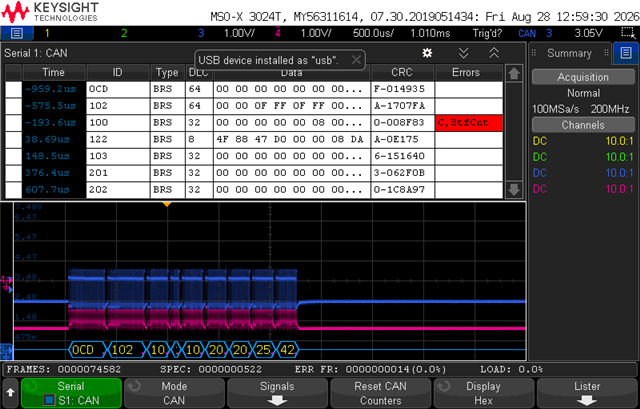
Please provide more information for this failure. For us to understand what is truly going on, we will need a waveform of the RXD, TXD, and CANH/L pins using an oscilloscope. There are many reasons that CAN communication could not be working as expected (software, improper schematic/layout, wrong transceiver mode, etc).
You can also use this guide to start: https://www.ti.com/lit/an/slyt529/slyt529.pdf
Best,
Ethan
Hello Ethan,
We don't have too much information about the issue,
and we neither could reproduce this, that's why I want to confirm with you if you had experienced this before.
Hi Yarelly,
Understood. I do have experience with this, but it is normally a result of the MCU/software environment. TCAN1044A doesn't just randomly stop communicating. However, I would double check the actual part number. TCAN1044A is a rather simple device. TCAN1043A is a more complicated device with many more modes.
Whenever you are able to get more diagnostic info, feel free to post it here.
Best,
Ethan
Hello Ethan,
Thank you for the following up. The part number is TCAN1042-Q1 in our case. Would you mind sharing some guideline or advice what we can do or what we can check for the previous experiences that you have?
Hi Yarelly,
Sure. For this testing, you have to put yourself in the perspective of the transceiver.
With your failing case present, I would probe the TXD, RXD, STB, and VCC pins with an oscilloscope. TXD should show that the CAN controller is actively sending messages on the CAN pins. RXD should be "receiving" or echoing these messages right back. VCC/VIO should be on and present, and STB should be 0V. If this waveform looks good, then you will know the transceiver is not at fault. Everything else at this point will be system related.
Another waveform to collect is the CANH and CANL pins during communication. It is possible that termination was removed negatively affecting signal quality. Or something else in the CAN harness was affected.
Best,
Ethan