This thread has been locked.

If you have a related question, please click the "Ask a related question" button in the top right corner. The newly created question will be automatically linked to this question.

TCAN1043HG-Q1: Question about TCAN1043HGDQ1

Part Number: TCAN1043HG-Q1
Other Parts Discussed in Thread: STRIKE, TCAN1043, ESD2CAN36

Hello:

The customer is currently working on wireless charging for cars, using a TI CAN (model: TCAN1043HGDQ1). When testing ESD, they encounter errors and permanent damage. Please help analyze and support, thanks!

The abnormal situations are as follows:
1. Operating mode: Air and contact ±8KV, message errors occur (almost every pulse causes errors), but after testing ends, it can automatically recover.
2. Sleep mode: Air and contact ±8KV, message errors occur (almost every pulse causes errors), and after testing ends, it can automatically recover. At the same time, INH may go high, causing the MCU to wake up.
3. Operating mode: Air -15KV testing CAN_H, the CAN transceiver may be permanently damaged and unrecoverable.

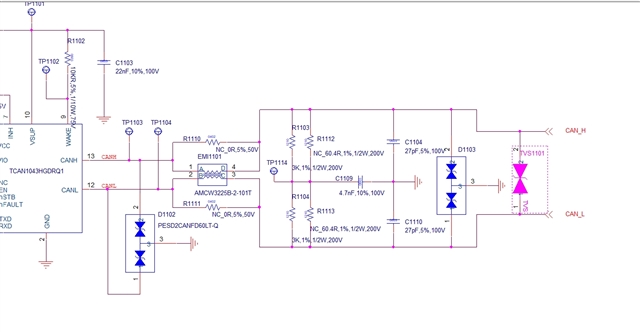
Schematic (attached)

CAN_schmetic.pdf 

Test case description:
Remote discharge testing needs to be performed on a harness 50 mm from the component connector, with a parallel 1700 mm (300 mm/-0 mm) harness, and static discharge applied to the other end of the parallel harness.
Human body model: 330 Ohms / 330 pF

  • Hi Jimmy,

    1. Error messages are possible during an ESD strike. This is not abnormal. The CAN bus is seeing the voltage levels shift drastically so the CAN receiver may interpret the signal in an unusual way.

    2. Please clarify what you mean by error messages. If the transceiver is in Sleep mode, then no CAN bus communication is present. It is possible for the INH pin to go high during an ESD strike if the voltage waveform matches a WUP (Wake-Up Pattern, defined in datasheet). Again, the transceiver is behaving as expected.

    3. If 15kV is damaging the transceiver, then something else is going. In your schematic, I see PESD2CANFD60LT is populated. Can you confirm these were placed during the test? If so, then they are likely the issue. During an ESD strike, that diode has a clamping voltage above 70V. This means that TCAN1043 could see a voltage above its maximum bus fault rating (70V), meaning it would be damaged. They either need to remove this diode, or pick a better diode like our ESD2CAN36 (clamps below 70V).

    Best,

    Ethan

  • Hi Ethan,

    Can it be possible to parallel a bidirectional TVS diode between CAN_H and CAN_L,similar to the TVS1101 in the schematic diagram? If so, are there any special requirements for TVS1101?

    One more thing, we have a DC short circuit test. Connect CAN_H and CAN_L to the DC power supply. The maximum working voltage of the power supply is 58V. The ESD2CAN36 does not have sufficient DC withstand voltage. Are there any other TVS models recommended?

  • Hi Chunhui,

    Here is our guide for CAN ESD protection: https://www.ti.com/lit/an/slvafc1/slvafc1.pdf 

    Yes, you can parallel a TVS diode to the existing diode (D1103), but I am not sure if that would actually help.

    What is the actual DC voltage you need to test up to for your system (not just the power supply rating)? We will need to select an ESD diode that has a working voltage around ~54-58V and clamps before 70V. We currently do not have a diode that supports this at TI. 

    Best,

    Ethan