TLIN1028-Q1: Question about output ESR value

Part Number: TLIN1028-Q1

Dear TI experts,

My customer have a question about output ESR value.

In the datasheet I can find ranged value of output ESR requirements as below ;
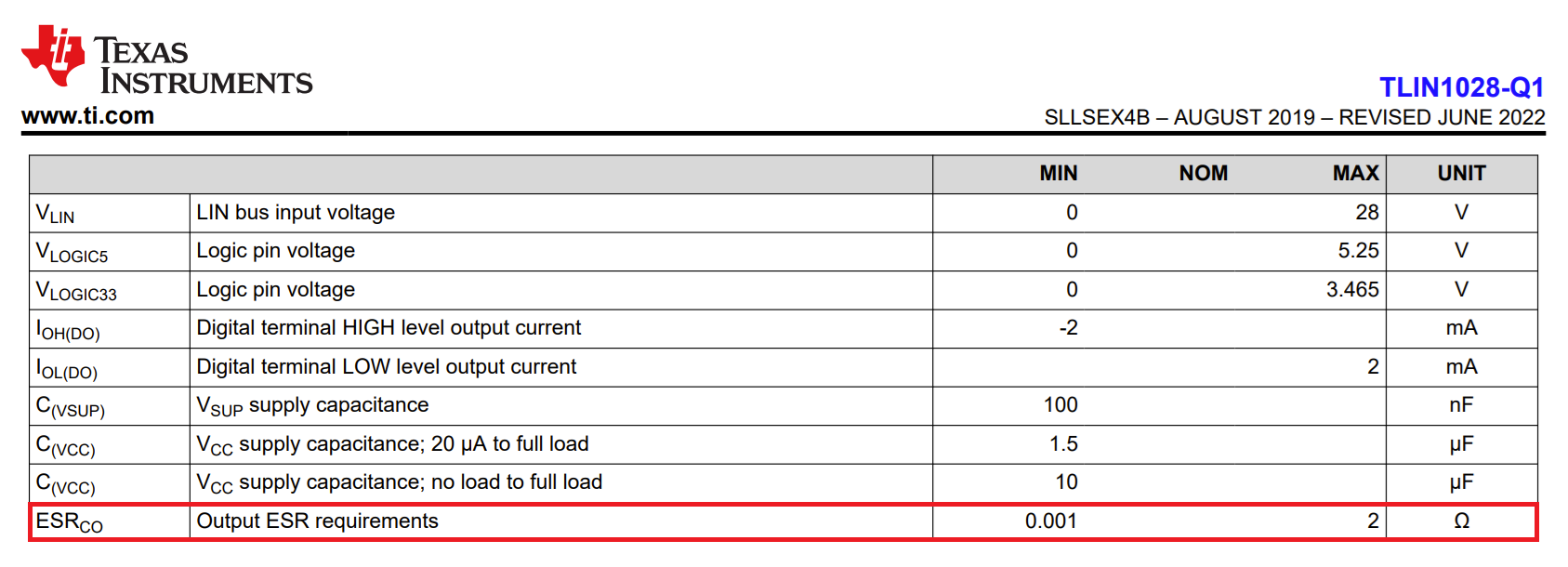
image.png

And my customer want to use the capacitors on VCC pin as below;

MCASL21GBB7106KTNA01 (Taiyo Yuden)

or

GCM31CR71C106KA64 (Murata)

My concern is that in the capacitor's datasheet, ESR values are exceeded in particular frequency.

MCASL21GBB7106KTNA01 (Taiyo Yuden) -> Little exceeded in 0.0001MHz frequency
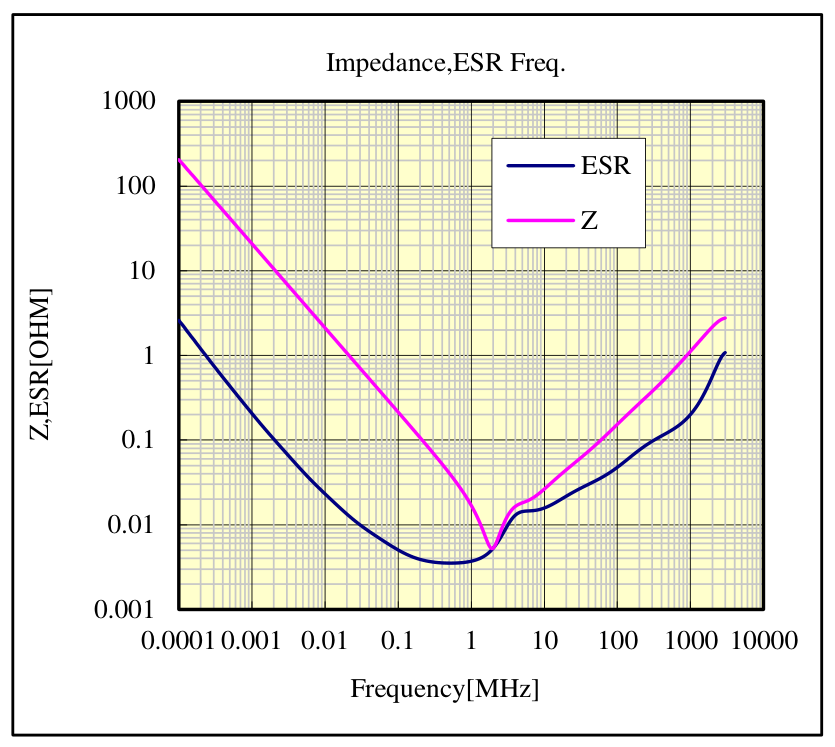
image.png

GCM31CR71C106KA64 (Murata) -> Exceeded under 200Hz and also 4GHz
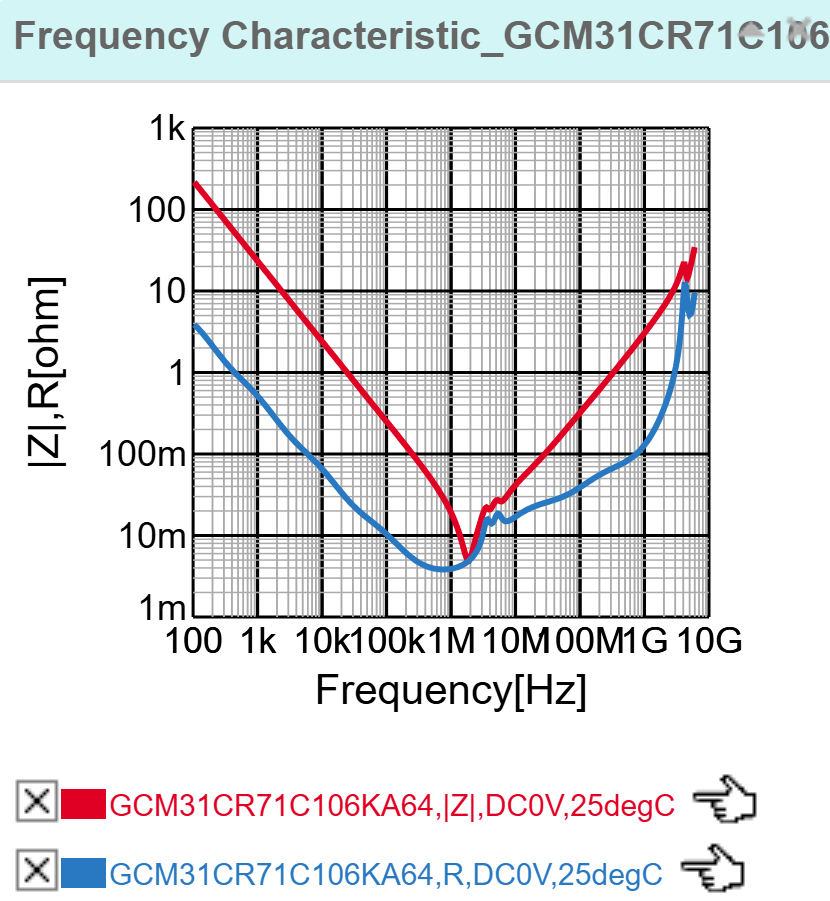
image.png

Can I use this kind of capacitors on VCC pin? or should I choose the capacitor which ESR is in 0.001~2ohm within all frequencies?

Please check this issue. Thanks.

Best regards,

Chase

  • Hi Chase,

    Although the TLIN1028-Q1 specifies an output capacitor ESR range of 0.001 Ω to 2 Ω, this should not be interpreted as requiring the capacitor ESR to remain within this range at every frequency shown in the capacitor manufacturer’s impedance / ESR plot. Capacitor ESR is frequency-dependent, and the relevant consideration is the effective capacitance and ESR of the output capacitor network in the frequency range relevant to the TLIN1028-Q1 LDO stability and load-transient performance.

    Both proposed 10-µF MLCCs may be considered, but the effective capacitance under the applied DC bias and temperature should be verified to ensure that the required VCC capacitance is maintained. Therefore, we would not reject the capacitors solely because their ESR curves exceed 2 Ω at very low frequency or at very high frequency as the caps appear acceptable, assuming the effective capacitance remains adequate and the capacitor network meets the <2 Ω ESR requirement in the relevant operating range, thanks.

    Best Regards,

    Michael.

  • Dear Michael,

    Thank you for your support.

    I cannot understand clearly. Then Which kind of specs should I check more about LIN transceiver and capacitor to check these capacitors are good to use?

    Customer will use about 50mA current using internal LDO.

    Best regards,

    Chase

  • Hi Chase,

    For the proposed 10 µF MLCCs, the most important item to verify should be the effective capacitance under DC bias and temperature, rather than relying only on the nominal 10 µF value.

    If two 10 µF capacitors are used in parallel, their effective capacitances add. The combined effective capacitance should remain ≥10 µF under the actual operating conditions.

    Hence, the two capacitors can be considered potentially suitable, provided the manufacturer confirms adequate effective capacitance under the customer’s VCC voltage, temperature, and tolerance conditions, thanks.

    Best Regards,

    Michael.

  • Dear Michael,

    Thank you for your support, and sorry for my late response due to Korean holidays.

    I checked the datasheet of MCASL21GBB7106KTNA01 (Taiyo Yuden),

    Assuming my customer use TLIN10285DRQ1 in room temperature, actual value of 10uF capacitor would be about 6uF. (-40% because of DC bias)

    Am I right?

    As you said previously, I have to set the value at least 18uF so I can set actual value to over 10uF(because of DC bias) -> Am I right?

    And I ask you again, how can I explain the exceeded ESR value in the range of very low frequency and very high frequency? Their end customer asked it very seriously and they might be change capacitor to not-exceeded one if I cannot provide the right answer.

    Please check this issue. Thanks.

    Best regards,

    Chase

  • Hi Chase,

    Yes, customers should account for effective capacitance under the actual DC bias, temperature, and tolerance. If the resulting effective capacitance is below 10 µF, using a larger nominal capacitance or multiple capacitors in parallel is recommended.

    Note that the single 10-µF capacitor should be checked for effective capacitance under DC bias / tolerance as you mentioned and if two capacitors are used in parallel, the effective capacitance margin is substantially improved and the combined ESR should be reduced for additional system improvements as needed.

    Hence, if you are asking me if they should use it or not, I will have to recommend that they evaluate based on their system environment to confirm as I cannot suggest using components outside the data sheet's recommendation. However, it may or may not work based on their system environment as the ESR range is for additional performance improvement, thanks.

    Best Regards,

    Michael.