Part Number: TCA9803
Other Parts Discussed in Thread: TPS1H200A-Q1, TMUX7462F
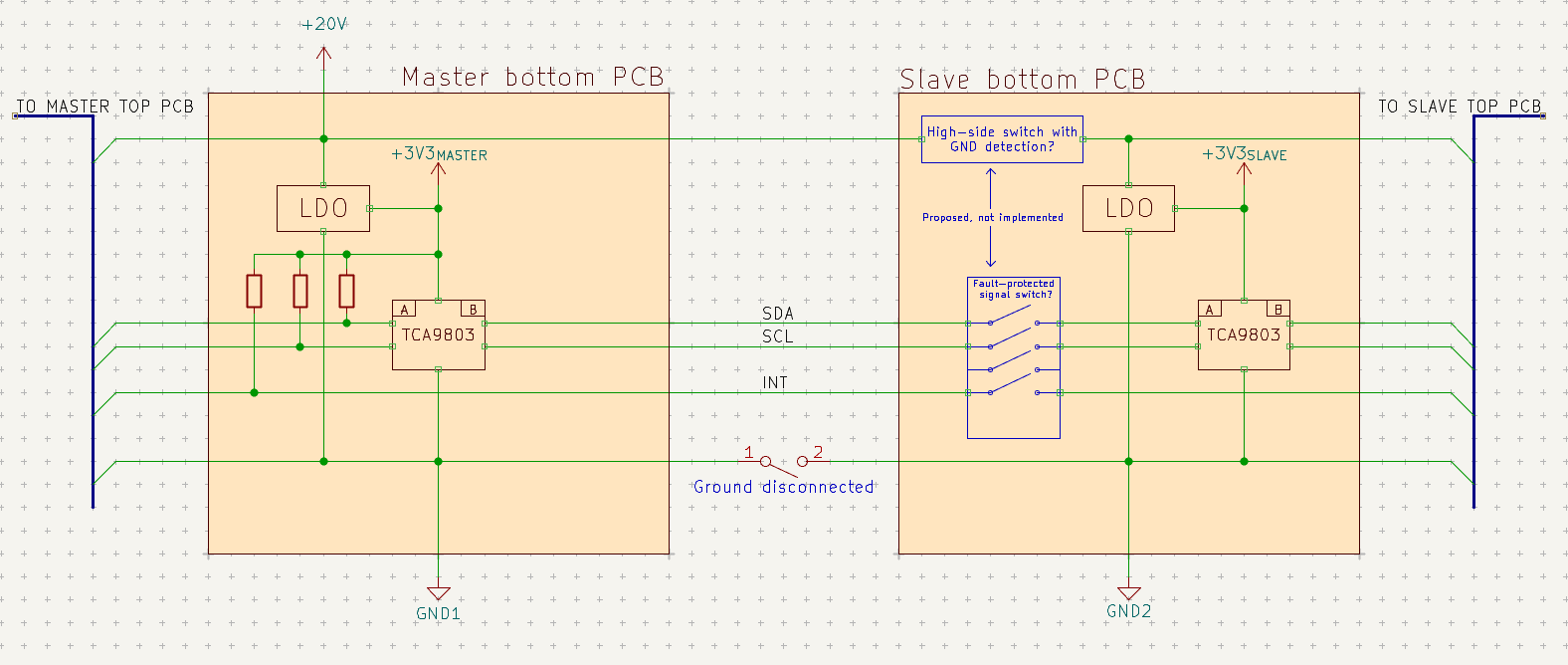
We are designing a modular system in which boards connect directly to neighbouring boards through a shared backplane. We need advice on preventing damage when a module’s ground contacts are disconnected while power and signal contacts remain connected.
System architecture
- One master supplies a nominal 20 V rail to the network. Maximum expected total network current is 3 A.
- Approximately 20 modules maximum, operating I²C at 400 kHz.
- Each module consists of a permanently assembled Bottom interconnect PCB and a Top functional PCB.
- For the configuration being investigated, each Bottom PCB has a local 20 V → 3.3 V LDO supplying its TCA9803. The Top PCB also derives its power from 20 V.
- The master TCA9803 has its A-side toward the controller and B-side toward the shared bus.
- Slave TCA9803 buffers have their A-side toward the shared bus and B-side toward their local Top PCB.
- The master B-side provides the shared bus current sources; there are no external B-side pull-ups.
- A shared INT line also connects the modules.
Fault condition
Users can connect/disconnect complete modules while powered. The existing connector has no guaranteed ground-first/ground-last contact sequence.
We must accommodate 20 V and SDA/SCL/INT being connected while all intended ground-return contacts for a module are disconnected, potentially indefinitely.
Our concern is that the disconnected module’s local ground can float, and its power-supply/load return current can find a path through signal-pin protection structures into another grounded module. Local LDOs do not provide galvanic isolation.
The current schematic also includes low-voltage signal ESD clamps referenced to local ground. These may themselves provide an unintended return path.
Existing power-switch approach
A P-channel MOSFET switches the local Top’s 20 V supply. Its gate is controlled by an N-channel MOSFET whose gate senses VCC through a divider referenced to local ground.
This detects VCC relative to local ground, but apparently cannot distinguish a valid connector ground from an alternative return through signal circuitry.
Questions for TI
- What ground-loss current paths exist through the TCA9803’s A-side, B-side and supply pins, including powered-off conditions?
- What protection architecture would TI recommend for this sustained missing-ground condition?
- Can a TI high-side switch’s “loss-of-ground protection” reliably disconnect the local supply when SDA/SCL/INT or their clamps provide alternative return paths? Specifically, is TPS1H200A-Q1 applicable, and under what conditions?
- Would a fault-protected signal switch such as TMUX7462F, with coordinated external clamps, be suitable? How should its thresholds, response time, resistance and capacitance be assessed against TCA9803 requirements?
- Would a dedicated ground-reference contact and continuity interlock be necessary? We could evaluate reassigning an existing connector contact, although the connector hardware must remain.
Brief communication interruptions are acceptable. The objective is preventing component damage, rather than uninterrupted communication.
No new protection circuit has been selected or validated yet.