TCAN3414: Questions about TCAN3414

Part Number: TCAN3414

Hi Teams,

The customer encountered a strange problem when using the CANFD chip. When three nodes are on a CAN bus, the ACK at the end of each CAN frame sent by each node will be higher than the level amplitude of the data field, and the more nodes there are, the higher the ACK. Can you help analyze the possible reasons for this?
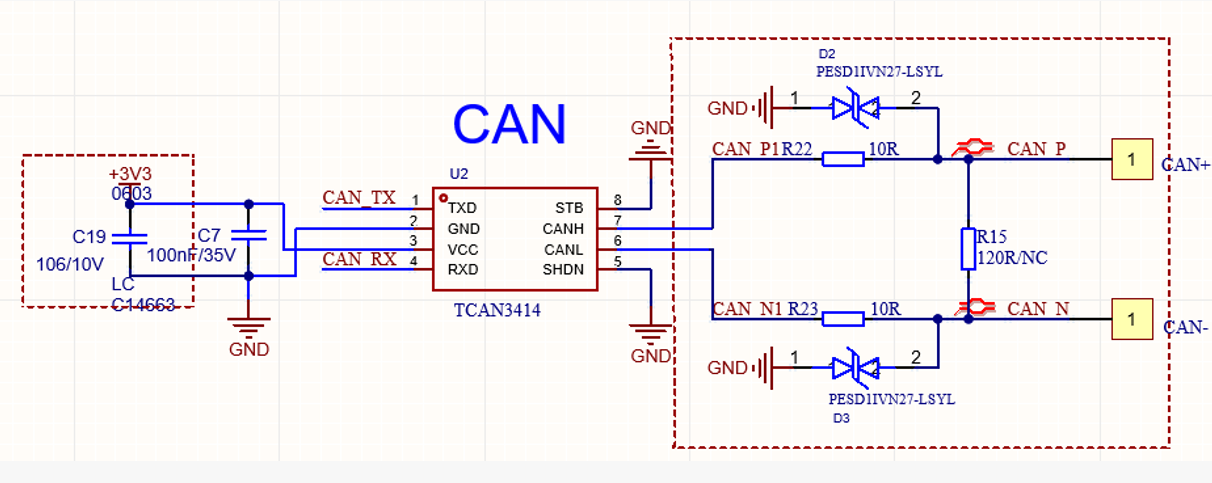
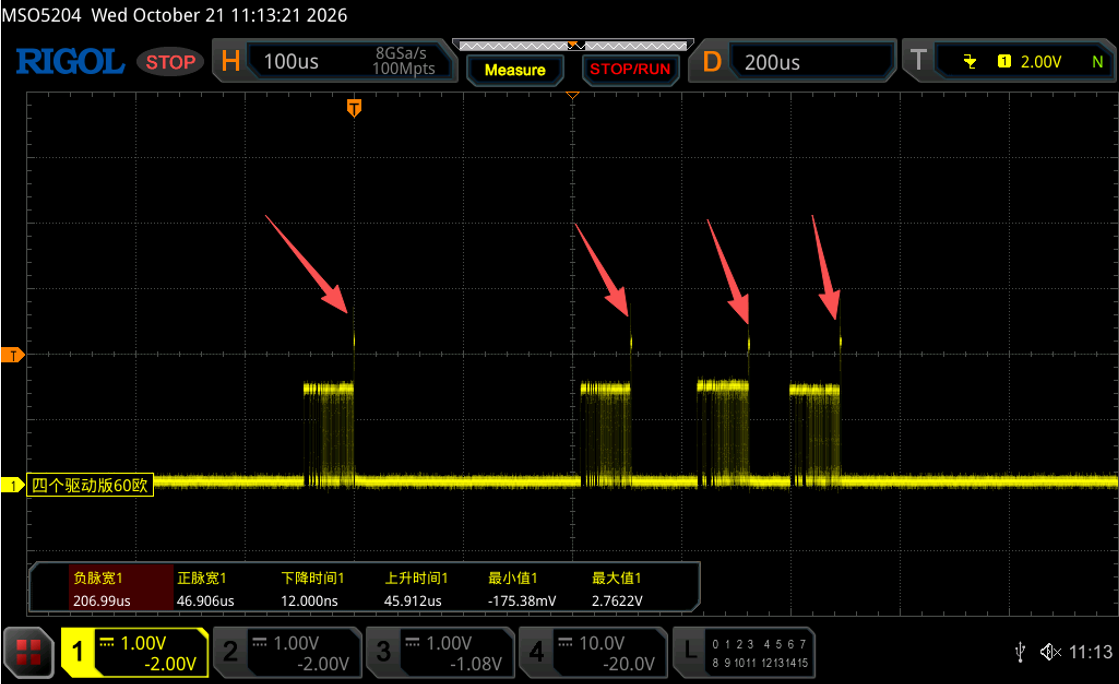
image.png

image.png

  • Hi Vayne,

    Please note that this is an expected multi-driver CAN behavior.

    I.e., during the data and arbitration fields, only one node drives the bus dominant. During the ACK slot, every node that received the frame correctly drives dominant simultaneously. Those drivers are in parallel, so the effective source impedance drops and the differential voltage developed across the 60-Ω bus load rises. Add a node, add another parallel driver, and the ACK bit gets taller — exactly the scaling the customer observes.

    Your schematic seem to amplify this effect: the 10 Ω series resistors (R22/R23) between CANH / CANL and the bus should imply a single transmitter sees ~20 Ω of extra series resistance, dropping its dominant amplitude. When N nodes drive the ACK in parallel, that series contribution should effectively be divided by N, so the ACK plateau sits noticeably above the single-driver data-field plateau. If the customer wants the data-field amplitude closer to the ACK amplitude, they may further reduce or remove R22 / R23. They should be the main reason the single-driver plateau sits low.

    Hence, a taller ACK bit is inherent to CAN arbitration-free acknowledgment with multiple parallel dominant drivers, made more visible here by the 10 Ω series resistors. However, as long as the dominant differential stays within 1.5–3 V and the recessive level is clean, there should be no functional risk, thanks.

    Best Regards,

    Michael.