SN65DSI83: SN65DSI83 - flickering issue on complete setup

Part Number: SN65DSI83

We are a manufacturer of display modules. In our module, which utilizes a TI SN65DSI83 bridge, the screen flickers upon power-up or when waking from sleep mode—though this does not happen every time.
We would appreciate your support in identifying the root cause of this issue. We are unsure whether the problem lies within the IC itself or our bridge configuration.

Here is what we have determined so far:
•    Adjusting the display timings resolved the flickering in 3 out of 6 faulty modules; however, the issue persists in the remaining 3.
•    There is no flickering when the bridge operates in test mode; it only occurs during normal operation.
•    X-ray inspection revealed no soldering defects on the bridge.

We kindly request:
1.    An assessment of whether our bridge configuration is correct.
2.    Guidance on what further checks we should perform to identify the cause of the issue.
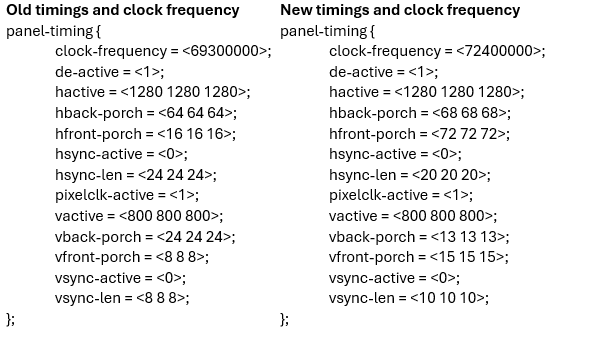
image.png

Fig. 1. module #1 bridge IC register map (with observed flickering).pngFig. 2. module #1 bridge IC register map (with no flickering).pngFig. 3. module #2 bridge IC register map (with observed flickering).png

Fig. 4. module #2 bridge IC register map (with no flickering).pngFig. 5. Riverdi newly assembled module #1 bridge IC register map (with no flickering).pngFig. 6. Riverdi newly assembled module #2 bridge IC register map (with no flickering).png

  • Hi Katarzyna,

    Thank you for sharing the details and register dumps about this issue.

    Display and SoC timings

    When the timings were changed between previous and new config, was the DSI83 also programmed for those specific timings? The DSI input video timings (from SoC or video source) should match the timings programmed on the DSI83. And both these settings should be within the panel tolerance.

    Also, check that the LVDS_CLK_RANGE (CSR 0x0A.3:1) and CH_DSI_CLK_RANGE(CSR 0x12) match the video clock rate.

    Initialization sequence

    Please check that the full initialization sequence shown in the datasheet is followed. There are resets, delays and configurations within the sequence. The DSI clock should always be in HS mode, and DSI data lanes are changed from LP statue to HS state at a certain step. Please check whether the sequence is matching the datasheet and that video output is enabled after the configurations are complete.

    When the flickering occurs, is it momentary and then goes away? Or does it keep persistently flickering till the device is reset or power cycled?

    Best regards,
    Ikram

  • Hello,

    Thank you very much for your response in this thread. I would like to emphasize the importance of this matter, as it concerns a customer complaint. Please find the answers to your questions below:

    1. When changing the timings from the old to the new ones, was the DSI83 bridge also programmed with these new timings? Are the timings from the processor and the bridge consistent and within the panel's tolerance range?

    Yes, they are consistent.

    After decoding, they match the "new timings."

    2. Do the clock range settings in the bridge (registers 0x0A and 0x12) correspond to the actual clock frequency?

    Yes, they do.

    Register

    Value

    0x0A

    0x85

    0x12

    0x2c

    For our clock frequency of 72.4 MHz, this is correct.

    3. Does our bridge startup sequence align with the sequence provided in the datasheet?

    Yes, we are using the standard Linux driver for the TI SN65DSI83. We have verified it against the sequence in the datasheet and extended certain delays to ensure compliance.

    4. When the flickering occurs, does it last for a short while and then disappear, or does it persist until a reset or a power cycle?

    The flickering persists until a reset is performed.

  • Hi Katarzyna,

    If your PCLK 72.4 MHz, what if your DSI clock rate?

    Based on 0x10 register setting, you are using 4 DSI lanes.

    DSI clock rate = (PCLK * bpp) /(2* number of lanes)
    with 24bpp and 4 lanes, this should be = 72.4 MHz * 24 /(2*4) = 217 MHz

    If register 0x12 = 0x2C, this corresponds to 220 - 225 MHz range.

    Please correct me if the DSI settings or DSI clock rate you are using are not what I have calculated here. Otherwise, the 0x12 register should be set to 0x2B for the 215 - 220 MHz range.

    Best regards,
    Ikram

  • Hi

    Thank you for your support. Here is an update on your suggestions and our latest results.

    1. CH_DSI_CLK_RANGE (0x12)
    You were right: the driver (ti-sn65dsi83, Toradex 5.15) rounds the DSI clock range up and sets 0x12 = 0x2C. We modified the driver so that 0x12 = 0x2B (215–220 MHz) is now set after every power-on and every wake-up.
    Result: on a failing module with the new timings, the flickering still occurs.

    2. Initialization sequence
    With the new timings, good modules work correctly with the same driver and the same initialization sequence.

    3. Flickering behavior
    When the flickering occurs, it stays until the device is reset.

    4. IC swap test
    We swapped the SN65DSI83 between a failing and a good module on 2 PCBAs. The flickering followed the IC: [uzupełnić – np. the good module with the IC from the failing module showed flickering, and the failing module with the IC from the good module worked correctly]. This happened with both timing configurations. The PCB itself was ruled out.

    Our request
    Based on these results, we would like to request a failure analysis from TI for the affected SN65DSI83 ICs. Alternatively, could the issue be related to the register settings that we should verify? Please let us know.

    Could you also let us know what we need to provide (number of ICs, date codes, and required submission format) and how to initiate this process?