This thread has been locked.

If you have a related question, please click the "Ask a related question" button in the top right corner. The newly created question will be automatically linked to this question.

HD3SS3415 and DS80PCI800 Design Questions

Other Parts Discussed in Thread: DS80PCI800, HD3SS3415, HD3SS3412

Hi,

I have a customer in the bay who has some design question on the HD3SS3415 and the DS80PCI800.

We are using these together to switch from one PCIe cable to another.  We need to know the following:

  1. Does there need to be termination on the input signal traces into the HD3SS3415 or DS80PCI800?
  2. What order should we use these parts?  Select the signal using the HD3SS3415 part and then use the emphasis part DS80PCI800? Or use the emphasis part after the mux?
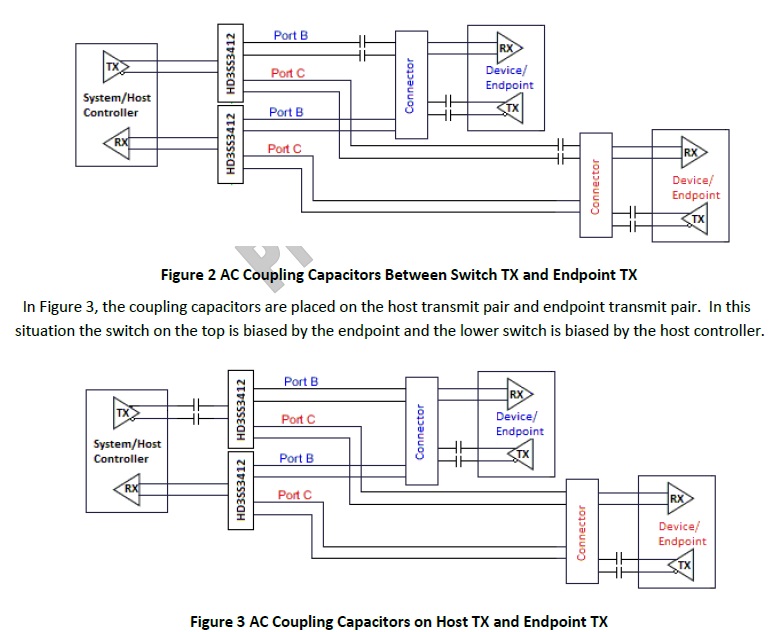
  3. Our board is a transition board from cables to the main board, so we have to cap couple the transmit lines to the Main board and from the transmit board out to the cables.  Does this make a difference on the part that is driving out, either the HD3SS3415 or DS80PCI800?

>>>

Attached are our current design illustrations:


  • Hello,

    The far end terminations are needed on PCIe, however, more of the PCIe transmitter incorporates these terminations and there is no need to place them externally, Make sure your PCIe transmitter have these terminations.

    The HD3SS3412 requires the AC coupling in one of its sides, no matter which one (see the below figure for reference)


  • Thanks Elias, That clears up the termination question.  

    When using the DS80PCI800 with the HD3SS3412.  Should the DS part be used after the signal go through the HD part, or can it be used before the signal inputs to the HD part?  Just need to know if the HD part will negate the positive affects of the DS part.

    Tim

  • Hello Tim,

    I have no experience with the DS90 device, but people on this forum have and I'm sure they will respond.

    Regarding the HD3SS3412, it is not likely that the device cause a negative effect.

    Regards.