


Other Parts Discussed in Thread: TPS65982
I have a customer using the TPS65982 on their design and they tried to configure as PD power sink only. The system also support main power input and if the power connect to the main power connector then the USB type C controller should disable and allow the main power input to power the load. Below is the block diagram of the power input design. I am using the External NMOS FET switch path to sink the power from USB type –C power supply to the load.

I currently have 2 problems that need your help to solve them
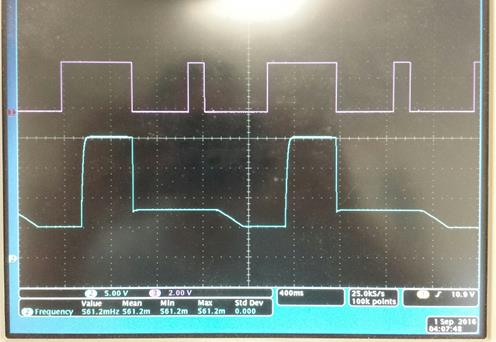
1. When I plug in the USB –C power supply the controller go continuously hiccup even the inrush current is measured only 1.5A, also the GPIO go low when I setup the event P5V overcurrent event ((See below waveform) blue channel is VBUS and purple channel is P5V overcurrent event on GPIO) If I connected the output from the External NMOS FET to another external circuit then I works fine without hiccup. Can you give me suggestion about what maybe the problem?
2. I connected the SENSE signal that is a 3.3V active high signal (H = connected) to the GPIO[2] of the TPS65982 and configure as Barrel Jack detect but I do not see the controller disable the power sink. Can you provide me more information for the barrel jack detection event and how it works? I just want to disable the sink of the USB-Type C when the main power connect to the system.
