This thread has been locked.

If you have a related question, please click the "Ask a related question" button in the top right corner. The newly created question will be automatically linked to this question.

TCA6507 Protection Diodes

Other Parts Discussed in Thread: TCA6507

Hi Everyone,

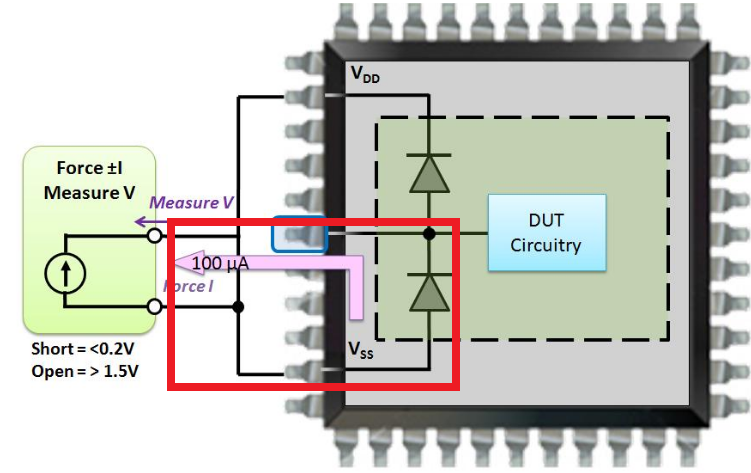
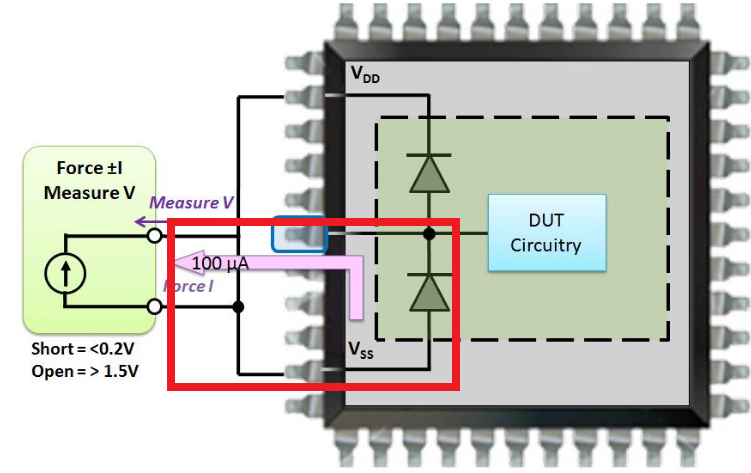
I have this very basic question. I'm currently using the TCA6507, and I want to perform Opens and Shorts Test by following the procedures indicated in the Reference Design, of which I attached the link below.

www.ni.com/.../

I have already done several tests for the SCL and SDA pins, however I'm sensing a voltage drop reading that is greater than 0.65 V. With this, may I confirm with you if all the pins of the TCA6507 have protection diodes in them? I'm curious because I'm not getting the acceptable voltage drop for diodes which is around 0.65-0.7 V. Also, can you confirm if the TCA6507 is a CMOS chip? If it's not, do we still follow the same procedure in testing for Opens and Shorts?

Regards,

John

  • Hello Jude,

    The device is a CMOS-based IC.

    The general procedure for testing for opens/shorts is ok.

    One thing to note is that the TCA6507 only has ESD diodes from ground to the pin. By doing this, you should be able to see the diode drop from ground to each pin.

    What voltages are you seeing on the pins? You mention that you see a larger voltage, but do not state what voltage you see.
  • Hello Jonathan,

    Thank you for your reply!

    I would need to confirm with you a few things:

    1.  You mentioned that the TCA6507 only has ESD diodes from ground to the pin. So you mean to say there is no VDD protection diode and the only way to test for Opens and Shorts is by testing the VSS protection diode? With this in mind, I would need to force negative current to test the VSS diode? Is this right?

    2. May I know what page in the specification sheet does it indicate that the TCA6507 only has diodes from ground to pin? Also, can I test all the signal pins for Opens and Shorts, (SDA, SCL, En, P0-P6) or there are only specific pins that can be tested?

    3. Basically, what I've done is forcing a 100uA current to test the VDD diodes, but based on your reply, if the TCA6507 doesn't have VDD diodes indeed, probably this is the reason why I'm reading a voltage of 1.8V for the SDA and SCL, and all the remaining pins have 3V reading.

    I have yet to try forcing a negative current to test the VSS diodes. I would share with you the results, hopefully I can get a voltage drop reading of around 0.65-0.7 V for the signal pins.

    Hope to hear a response from you!

    Thanks and Regards,

    John

  • Hello Jonathan,

    Thank you for your reply!

    I would need to confirm with you a few things:

    1.  You mentioned that the TCA6507 only has ESD diodes from ground to the pin. So you mean to say there is no VDD protection diode and the only way to test for Opens and Shorts is by testing the VSS protection diode? With this in mind, I would need to force negative current to test the VSS diode? Is this right?

    2. May I know what page in the specification sheet does it indicate that the TCA6507 only has diodes from ground to pin? Also, can I test all the signal pins for Opens and Shorts, (SDA, SCL, En, P0-P6) or there are only specific pins that can be tested?

    3. Basically, what I've done is forcing a 100uA current to test the VDD diodes, but based on your reply, if the TCA6507 doesn't have VDD diodes indeed, probably this is the reason why I'm reading a voltage of 1.8V for the SDA and SCL, and all the remaining pins have 3V reading.

    I have yet to try forcing a negative current to test the VSS diodes. I would share with you the results, hopefully I can get a voltage drop reading of around 0.65-0.7 V for the signal pins.

    Hope to hear a response from you!

    Thanks and Regards,

    John

  • Hello Jonathan,

    Thank you for your reply!

    I would need to confirm with you a few things:

    1. You mentioned that the TCA6507 only has ESD diodes from ground to the pin. So you mean to say there is no VDD protection diode and the only way to test for Opens and Shorts is by testing the VSS protection diode? With this in mind, I would need to force negative current to test the VSS diode? Is this right?

    2. May I know what page in the specification sheet does it indicate that the TCA6507 only has diodes from ground to pin? Also, can I test all the signal pins for Opens and Shorts, (SDA, SCL, En, P0-P6) or there are only specific pins that can be tested?

    3. Basically, what I've done is forcing a 100uA current to test the VDD diodes, but based on your reply, if the TCA6507 doesn't have VDD diodes indeed, probably this is the reason why I'm reading a voltage of 1.8V for the SDA and SCL, and all the remaining pins have 3V reading.
    I have yet to try forcing a negative current to test the VSS diodes. I would share with you the results, hopefully I can get a voltage drop reading of around 0.65-0.7 V for the signal pins.

    Hope to hear a response from you!

    Thanks and Regards,

    John
  • Hello Jonathan,

    Good day again!

    I have a follow-up question. I need to post this, so I can get a reply together with the previous one I posted. Basically, I'm assigned in Asia, and probably I have to wait for one day to get a repl due to dime difference.

    If indeed, there are no VDD protection diodes in the TCA6507. Why is it designed in this way? Are there any reasons why VDD diodes are not included? Because as what I've read, ideally, each signal pin must contain both of the diodes. I'm just new to IC testing, that's why I have very limited knowledge on this. Hope you could enlighten my thoughts.

    Regards,

    John
  • Hello Jonathan,

    I would update again. I hope you can answer me with these questions as well as those previous questions I posted. Basically, I managed to test the VSS diode, by forcing a negative current of -100uA. The voltage drop I'm reading/sensing is around -0.44V for all the pins. It passes my limit of -0.2V to -1.5V. However, I'm just curious if indeed this reading is correct, noting the the approximate voltage drop for silicon diodes is around 0.65. May I know if this indeed is a correct measurement? Is it safe to assume that maybe the diode used as protection diode is not silicon? Do you have any information on the protection diodes itself? Please do confirm.

    Thanks and Regards,

    John
  • Hello Jude,

    Sorry for delay, I am out of the office traveling.

    The ESD diodes do not quite have a drop of 0.65V like a normal diode. Most times it is a bit lower around 0.5V. So your 0.44V rating is consistent with what I would expect.

    In regards to your previous question, we do not put forward biasing diodes on  signal lines because then the device cannot support powered-off high impedance, as any voltage on a pin when the device is unpowered, will result in back-power to the supply.

    We do have a VDD protection diode from VDD/VCC to ground. The ESD diodes typically used for this will have a breakdown voltage of around 7V, meaning that once the voltage hits that, the diode will conduct to prevent damage to the IC.

  • Hello John,

    Your measurements are probably correct.  Depending on the current you are forcing the Vf of the diode will be different.  Vf is also a function of the size of the ESD diode and what temperature you are testing at.  In school, they always implied a Vf of 0.65 or 0.7V, but what they didn't tell you is that it is a function of the size and current carrying capability of the diode, the temp of the diode, and what current you impose on the diode.  If you were to do a curve trace of the ESD diode then you could map Vf with current passing through the diode.  Furthermore, it depends on the type of diode, is it a fast diode?  schottky diode? zener diode???  Different types of diodes react differently, at least on a relative scale.

    Sometimes the design is such that you don't want that pin to have a diode back to the supply.  That would mean you could back bias your supply.  I hope that this is informative.  Let me know if you have any other questions.

    -Francis Houde

  • Hello Francis,

    Thank you very much for the added information. Indeed it is very informative. As to the type of diode, I really don't know what diode are they using for the TCA6507. I would need to confirm this from the TI side. Upon searching, diodes with threshold voltage of 0.4 is most likely to be a Schottky.

    Regards,

    John

  • Hello Jonathan,

    Thank you very much for the information. I have now a clear understanding of it. One last question, you mentioned that the ESD diodes do not have same drop of 0.65 just like a normal diode. Do you have information as to what specific diode is used in the TCA6507? Is it a Schottky or Zener perhaps?

    Regards,

    John