This thread has been locked.

If you have a related question, please click the "Ask a related question" button in the top right corner. The newly created question will be automatically linked to this question.

USB connection with ground differences

Other Parts Discussed in Thread: TPD2E2U06

Hello Team,

I'm considering some protection options to protect an High Speed USB channel.

In particular the device and the host where it would be connected to will only have D+, D- and GND connected together.

The GND might be at different levels so some current might flow between the device and the host.

One way to avoid it, it could be to use an isolate power, but isolating the D+ and D- would be challenging.

I'm also thinking if it TVS may help, maybe connecting Vbus as well to have both rails reference.

Isolation is not really needed but I would need to avoid that the ground reference might create damages.

I need to see the voltage differences between ground but I'm not expecting being that high (but I need to double check).

  • Would the TVS solution work?
  • Any part recommendation to support High Speed (480Mbits)?

Thanks,

SunSet

  • SunSet-

    We have TVS devices that we recommend to protect the USB2.0 480Mbit signal, but I'm a bit confused as to what you are asking about. Are you saying that you are worried current might flow through the D+/D- lines because of an uneven ground reference between the host and the device? As long as you have a connected ground line, that effect should be very minimal. What are you hoping to do with a TVS that would prevent this? Please give more details if I am not thinking about this properly, preferably with a drawn diagram.

    As for a TVS to protection USB2.0, we generally recommend the TPD2E2U06.

    Thanks,
    Alec
  • Hello Alec,

    The problem I may see, is current flowing on the grounds and not necessarily on D+ and D-.

    The concerning is about the different ground potential of the device and the host.
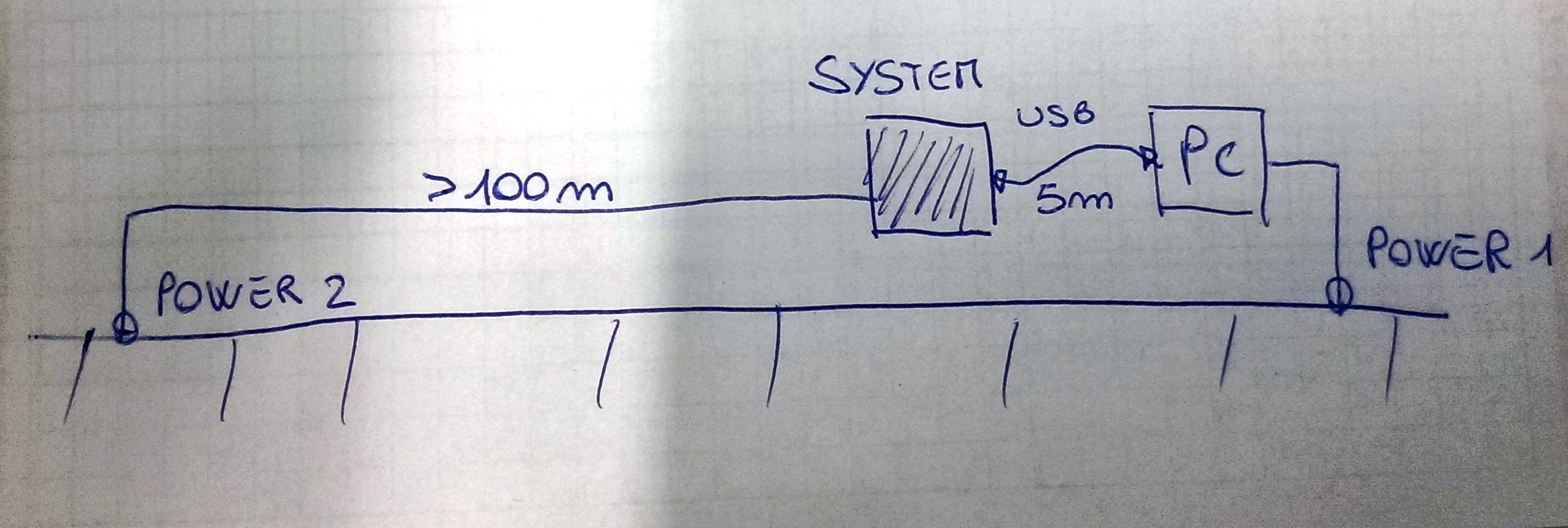
    While the cable between the two, accordingly to the USB spec, could be up to 5m (with good cables), the device might be connected to a power cable that might be quite long and distant from the point where the host/PC will be powered. This may generate a ground difference that can create current flowing on the two connected ground even if D+ and D- are not connected.
    Typically to solve that you can isolate the power, but isolating the USB data bus at 480Mbit/s is not trivial.

    So I was thinking if the TVS can solve such scenario. An isolated power and data line can allow keeping the communication alive while the TVS would short h

    For instance connecting the TVS between GND and earth (as well the other lines) should create a current path to earth in case there is a voltage difference among GND. I'm not sure if you have seen such solution to protect the Host/Device from ground differences.
    I was just thinking about it as possible solution but I'm not confident myself that can work in all scenarios.

    Thanks,

    SunSet
  • SunSet-

    While you can see a ground difference that causes a current to flow the ground line of a cable, with only a 5m cable it is unlikely to be significant, and any current flow should be resolved very quickly. I'm also not sure that a TVS diode would be the best solution to help here, as you're unlikely to see a voltage difference significant enough to trip the TVS.

    Are you seeing this as an issue in an existing system or trying to plan ahead? If it's an existing issue, I would think that you should look to see what is causing the significant ground shift over the cable. If it's planning ahead, I think that you should be fine and not need to worry about this issue.

    Thanks,
    Alec
  • Hello Alec,

    actually the ground difference could be quite a lot since it's not about the 5 m length but the 100m or more power cable.

    Indeed the system gets the powered from point 2 while the PC from point 1 ( as shown in the system below).

    maybe this was not clear from previous description.

    TVS while may protect the system they will not allow the USB connection to work (if they will be activated).

    Thus, to keep the connection working also with a big ground difference, it might be better to have a separated USB controller and isolate the TX and RX lines. The power would also need to be isolated.

    Thanks

    SunSet

  • Hi SunSet,

    I think I understand the problem fully now.  What type of voltage gradient do you expect between Power 1 and Power 2 in an actual system?  Are these power rails going to be off of AC power, or a DC source?  If we're only talking a few hundred mV, then the system should work as-is.  To me, the best method would be a low resistance path between the 'System' and a ground near Power 1 via a ground strap or something similar.  That way the grounds should be well equalized and you wouldn't need to use isolation.  If the voltage delta is 1+ volts, isolation may be the best bet. Is it possible to just lift the ground connection on one of these two systems?  This would allow one of the two systems to reference itself to the other, and the current gradient across USB should be very small.

    Using a TVS diode wouldn't be any better than a hard ground connection, since ultimately you want the ground gradient from 'System' to 'PC' to be a little as possible.  Otherwise, you'll have violations of the common mode range on the USB transceivers and it won't work anyways.

  • Hello Jeff,

    the voltage difference could be up to several volts.

    Currently I'm proposing external USB controller so that they can isolate it from the main controller  via normal isolation barrier rather than isolating a differential lines. I don't think there is anything in the market for High Speed out of the box (there is something for Full speed).

    You are right, the Vcm would be out of spec, nevertheless the TVS would prevent the USB to work in any case.

    Thanks for your follow up,

    SunSet