This thread has been locked.

If you have a related question, please click the "Ask a related question" button in the top right corner. The newly created question will be automatically linked to this question.

TPS2547: TPS2546/7 - About behavior of SDP mode

Guru 21045 points
Part Number: TPS2547
Other Parts Discussed in Thread: TPS2546

TPS2547 - About behavior of SDP mode


Hi Team,


Our customer assume the situation as follows.

Then, can "HOST" and "CDP device" communicate normally if TPS2546 is SDP mode?

So, we worry whether the SDP mode of TPS2546 does not adversely affect this communication.


Regard,

Kanemaru

  • Hi Kanemaru,

    The host and the CDP device should be able to communicate properly with the TPS2546 in SDP mode. When the CDP device is connected, the TPS2546 will go through the BC1.2 protocol as an SDP. Once this finishes the D+/ D- data lines will be switched over to the HOST for USB2.0 communications.

    Regards,
    Donovan
  • Hi Donovan-san,


    Thank you for your prompt reply.

    I understand that HOST side can provide CDP(1.5A) to CDP device even if TPS2546 is SDP mode.

    Is my understanding correct?


    Regards,

    Kanemaru

  • Hi Kanemaru,

    Just a couple questions.  When you say CDP Device in the diagram do you mean a Portable Device such as a Phone?  Also, what mode is the TPS2546 configured for (based on CTL1, CTL2, CTL3, and ILIM_SEL). 

  • Hi Donovan-san,


    I answer your questions.


    [Q1]

    When you say CDP Device in the diagram do you mean a Portable Device such as a Phone?


    [Answer]

    Yes, it is a Portable Device


    [Q2]

    Also, what mode is the TPS2546 configured for (based on CTL1, CTL2, CTL3, and ILIM_SEL).


    [Answer]

    They have not decided concrete setting yet.

    However, if TPS2546 is SDP1 or 2, they would like to know whether HOST side can provide CDP(1.5A) to CDP device using the CDP detection of HOST.


    Regards,

    Kanemaru

  • Hi Kanemaru,

    As long as the Current Limit (ILIM_HI) is set above 1.5 A for the TPS2546, the device should not be bothered with the HOST setting the current OUT to 1.5 A.

    Regards,
    Donovan
  • Hi Donovan-san,


    Thank you for your response.

    I have one more question.


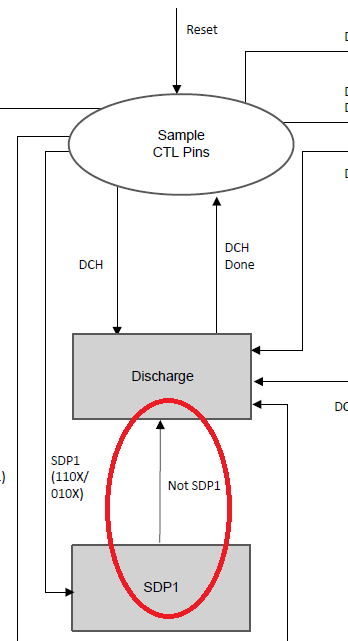
    According to the Charging States of datasheet, if TPS2546/7 is SDP1 or 2(ILIM_HI) and the portable device isn’t SDP(so this device is CDP), TPS2546/7 carries out “discharge”.

    Then, they would like to know whether HOST side can provide CDP(1.5A) to CDP device using the CDP detection of HOST.

    I’d greatly appreciate your verification.


    Regards,

    Kanemaru

  • Hi Kanemaru,

    This state diagram shows how the TPS2546 changes depending on the CTL pins. If a device is connected it does not affect this diagram, only the CTL pins do. Therefore, when it says Not SDP1, it means that the CTL pins have changed to switch the TPS2546 into a different mode (SDP2, CDP, or DCP). Based on the BC1.2 standard, any device that is connected is considered a Portable Device and is not considered to be SDP, CDP, or DCP. The Portable Device goes through a process to determine whether it is connected to an SDP, CDP, or DCP. I believe in your customer's application, they will connect to the TPS2546 and see that the TPS2546 is in SDP mode. Once this is completed the TPS2546 will switch the USB2.0 data lines to the HOST which will renegotiate the power going to the connected Portable Device. What is meant by CDP Detection Mode in the HOST?

  • Hi Donovan-san,


    Thank you for the detail information and I’m sorry for confusing you.

    CDP Detection Mode in the HOST is CDP detection circuit (it is the same as TPS2547’s circuit).

    I understand that HOST is can detect CDP device even if TPS254 can’t detect CDP device.

    Is my understanding correct?


    [Your comment]

    I believe in your customer's application, they will connect to the TPS2546 and see that the TPS2546 is in SDP mode.

    Once this is completed the TPS2546 will switch the USB2.0 data lines to the HOST which will renegotiate the power going to the connected Portable Device.


    Regards,

    Kanemaru

  • Hi Kanemaru,

    No problem I'm just making sure I understand the set-up. Is the HOST trying to charge from the device or provide the device power? I'm thinking of the CDP Device in terms of a portable device which does not provide power and can not be a CDP. I just want to distinguish between the two.

    Regards,
    Donovan
  • Hi Donovan-san,


    Thank you always for your kind support.


    CDP device is the portable device(don’t provide power to HOST side).

    So, HOST side would like to provide the power(5V / 1.5A(CDP mode)) to the portable device(this device can receive 5V/1.5A).

    Even if HOST side has SPD mode detection(TPS254/7) and CDP mode detection( in HOST), can HOST side provide 5V/1.5A to the portable device?


    Regards,

    Kanemaru

  • Hi Kanemaru,

    The TPS2547 will advertise the mode that it is in. The Portable Device, based on the BC1.2 Standard, will determine what it is connected to and how much current it can draw (so CDP Detection is available on the device like you described). If the TPS2547 is in SDP mode, then the TPS2547 will advertise 5 V and 500 mA max on the port and will limit the current to 500 mA because the Portable Device will only see an SDP port not a CDP port, even if the HOST has CDP Detection. I recommend putting the TPS2547 into CDP Mode so it will advertise the port as a Charging Downstream Port and provide 5 V 1.5 A as well as USB2.0 data communications from the HOST to the Portable Device. There is no need to have the TPS2547 advertising as a SDP from my understanding of your customer's set-up.

    Regards,
    Donovan
  • Hi Donovan-san,

    Thank you for the detail information.

    I greatly appreciate your cooperation.

    Regards,

    Kanemaru

  • Hi Kanemaru,

    No problem I hope this helped!

    Regards,
    Donovan
  • Hi Kanemaru,

    Please disregard the previous answer. Sorry I was confused on the set-up and got mixed up. The TPS2547 in SDP mode will just pass the D+ and D- lines through to the host which will then be able to do the CDP detection and set the max charging current for 1.5 A. Just make sure the current limit is higher than 1.5 A and the TPS2547 should be good to go in SDP mode with the HOST using CDP detection to do the CDP handshake. Please forgive me for the confusion.

    Regards,
    Donovan
  • Hi Donovan-san,

    Thank you for the information.

    I understand. Thank you very much.


    Regards,

    Kanemaru