This thread has been locked.

If you have a related question, please click the "Ask a related question" button in the top right corner. The newly created question will be automatically linked to this question.

TLK106L: TLK106L ESD issue

Part Number: TLK106L

Dear TI engineer:

         We used 2pcs TLK106L in the application of EtherCAT communication.The electrical function is OK but there is a issue when ESD test on RJ-45 Cable.

The ESD contacting voltage is 4KV and the ESD test can make the EtherCAT communication break off until the MCU reset the PHY(TLK106L).After ESD test,none of the components are broken.

The fail symptoms are on every PCB(both of 2pcs TLK106L on the same PCB).

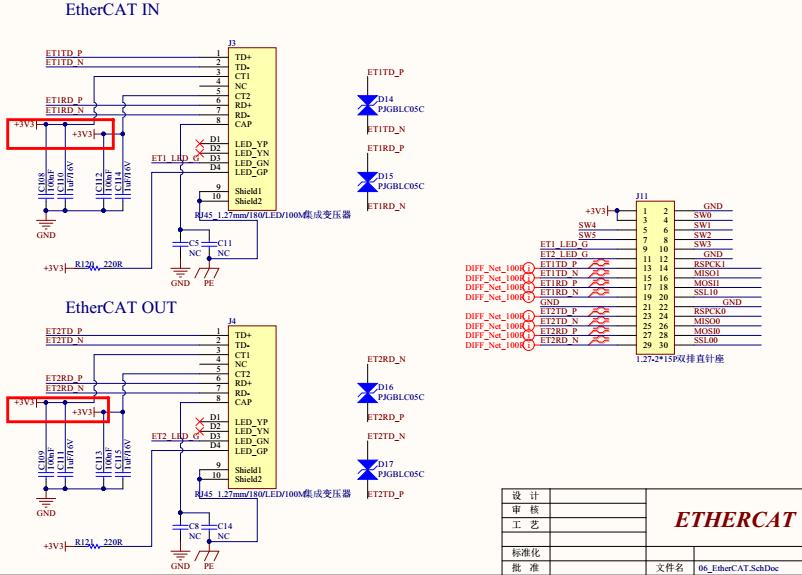
Our schematic and PCB layout is designed according to TLK106L datasheet,the network transformer and TVS between TD+/RD+ and TD-/RD- is designed close to RJ-45 Cable.

The ESD rating of TLK106L is +/-16kV on Ethernet network pins (TD+TD-,RD+,RD-) and is too higher than the test voltage(4KV).So what is the probable reason for this issue?

Which signal should be measured by oscilloscope to help the failure analysis?

Our Schematic is below:

  • Hello Yulei,

    When the PHY stops communication, is there still a link up?

    When the PHY stops communication, can the MCU read/write the registers?

    -Regards,
    Aniruddha
  • Dear Aniruddha

           There are two syptoms when ESD(4kV) test on EtherCAT IN ports.

    The one syptom is that the link break off between the testing slave device and the next slave device connecting OUT ports,we read the registers of the two PHY and we found the data on PHY_IN registers(0~31) was normal but the data was 0xFFFF on PHY_OUT register(0~31).

    The other syptom is that the link break off on both the testing slave device and the next slave device,we read the registers of the two PHY and we found all the data was 0xFFFF on PHY_IN&PHY_OUT registers(0~31).

    When the PHY stops communication, the MCU can not write the any registers of PHY,

    So what is the next step to analyse this issue? 

  • Hello Yulei,

    It looks like the ESD energy is making its way into the System. In IEC61000-4-2 ESD testing, the ESD is tested on RJ-45 connector. RJ-45 connector shield is connected to Earth ground of the system. The Power Ground and Earth Ground are kept separate so that ESD cannot travel from Earth ground to System ground.
    Are you testing for IEC61000-4-2 on the RJ-45 connector? Is the Earth ground and Power Ground kept separate?

    Lastly, is this a new design or a old design? For new EtherCat designs our recommendation is our new DP83822. This PHY has a reference design which has been testing for ESD upto 8KV with passing results.
    www.ti.com/.../TIDA-00928

    -Regards,
    Aniruddha
  • Hello Aniruddha

       Thanks your suggestion at first.We tried to separate the signal GND from PE(product housing GND) as shown below,but it still fail in ESD test.Our test conditon is less harsh than IEC61000-4-2,the ESD contacting voltage is only 4KV and the contacting position is TD+,TD-,RD+,RD- pins of RJ45 Connector.

    In addition,we want to know the difference between DP83822 and TLK106L except ESD rank.If we use DP83822 to replace TLK106L,do we need to modify the register setting?we worry about the registers are different because the EtherCAT software  outsource the third party solution company and it can not be modified complicatedly.

  • Hello Yulei,

    We have a hardware rollover document listing the hardware differences in between DP83822 and TLK106L: www.ti.com/.../snla262.pdf
    For software, there are some new registers in DP83822 and there are some registers that overlap with TLK106L registers. You can check which registers are being used in your TLK106L EtherCAT software and compare them with registers in DP83822 datasheet. If you have more questions, I would recommend posting it as a new thread for better visibility.

    -Regards,
    Aniruddha