This thread has been locked.

If you have a related question, please click the "Ask a related question" button in the top right corner. The newly created question will be automatically linked to this question.

DS90UB933-Q1: Issues about GPIO and I2C.

Part Number: DS90UB933-Q1
Other Parts Discussed in Thread: DS90UB913A-CXEVM, DS90UB914A-CXEVM

Hi Steven,

I have more questions about the previous Q: DS90UB933-Q1: Issues about GPIO and I2C.

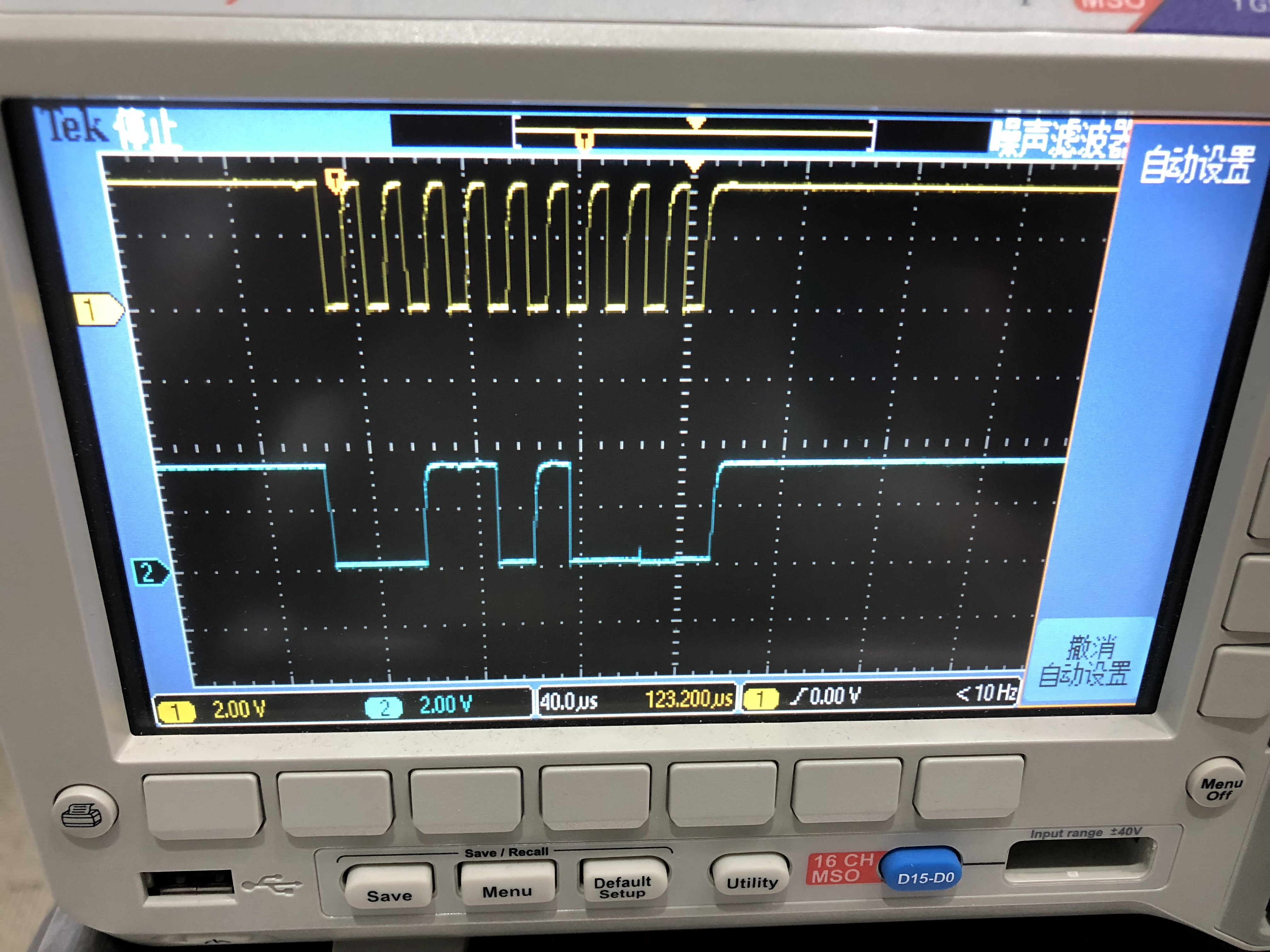
I checked the Vsync signal with Hsync together, both vsync and hsync have the same issue, as above testing pictures showed, we input Hsync(33kHz) to the GPIO1 of 934, but the GPO1 of 933 output an unstable signal about 5~6 kHz, it looks like the signal was stretched. I also tried to feed a 1Hz signal to GPIO0 of 934, no stable 1kHz signal can be output from GPO0 of 933.
We use FPGA generate the H/V signal (3.3V) and directly feed them to the GPIO pins of 934, does there have sth. wrong about the GPIO connections between FPGA and 934 ?

For the I2C, could you give a link about the related app.note ?

Thanks!
Huabin

  • Hi, the freq. through the GPIO can't be stretched, but the pulse width would have few jitter. please note the UB934/933 I/O voltage, does it be matched with FPGA's I/O?

    regarding the I2C operation through FPD-Link, please refer to UB934 d/s page58 as below, it has two app. note in the link.


    11 Device and Documentation Support
    11.1 Documentation Support
    11.1.1 Related Documentation
    For related documentation see the following:
    • DS90UB913A-CXEVM & DS90UB914A-CXEVM REV A User's Guide
    • I2C over DS90UB913/4 FPD-Link III with Bidirectional Control Channel
    • Sending Power Over Coax in DS90UB913A Designs
    • I2C Communication Over FPD-Link III with Bidirectional Control Channel
    • Soldering Specifications Application Report
    • Semiconductor and IC Package Thermal Metrics Application Report
    • Leadless Leadframe Package (LLP) Application Report
    • LVDS Owner's Manual


    regards,
    Steven
  • Hi Steven,

    Sorry for the late reply, just back from vacation.

    For the GPIO issue, the I/O voltage was matched, both use 3.3V.

    For comparison, I captured the I2C signals on both 933/934 sides.

    The first one is measured on the pins of 934, and the second one is measured on the pins of 933. The I2C master(attached to 934) tried to write a data 0x1 at register address 0x3000 to slave sensor device 0x1A, as the signals shows, only part of the signals were transferred to the slave device. Please note the frequency difference between the two SCL signals, is it normal ?

    Thanks,

    -Huabin

  • The
    It sounds the data rate between UB934 and UB933's output is not matched well. please check I2C app. note in page58 of UB934 d/s. it has description how to set the I2C I/f well.

    11 Device and Documentation Support
    11.1 Documentation Support
    11.1.1 Related Documentation
    For related documentation see the following:
    • DS90UB913A-CXEVM & DS90UB914A-CXEVM REV A User's Guide
    • I2C over DS90UB913/4 FPD-Link III with Bidirectional Control Channel
    • Sending Power Over Coax in DS90UB913A Designs
    • I2C Communication Over FPD-Link III with Bidirectional Control Channel
    • Soldering Specifications Application Report
    • Semiconductor and IC Package Thermal Metrics Application Report
    • Leadless Leadframe Package (LLP) Application Report
    • LVDS Owner's Manual


    best regards,
    Steven
  • Hi Steven,

    Thanks for your support, the I2C issue was resolved.

    But I still can't find the root cause of the GPIO issue. Any suggestion ?

    Thanks and Regards,

    -Huabin

  • what is your GPIO issue?

    does it match UB933/ub934's GPIO application request? (what is the link?)

    pls capture the GPI and GPO signals for further analysis.

    regards,

    Steven

  • Hi Steven,

    Please refer to the following thread for the GPIO issue,

    e2e.ti.com/.../715605

    Thanks,
    Huabin
  • pls provide the sch. and the test waveform in UB934's GPI pin and UB933's GPO pin. thanks.

    regards,
    Steven