This thread has been locked.

If you have a related question, please click the "Ask a related question" button in the top right corner. The newly created question will be automatically linked to this question.

TCA4311 question

Other Parts Discussed in Thread: TCA4311, P82B715

My customer asks:

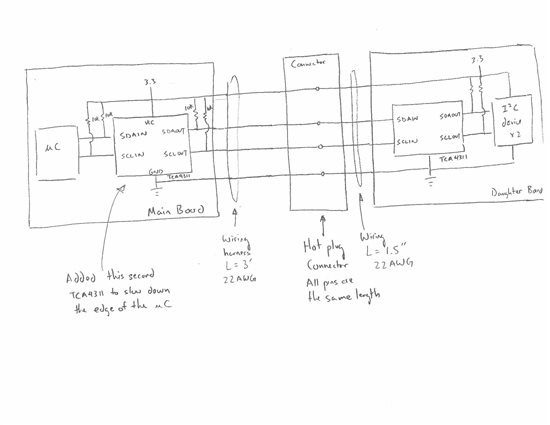
In our application we have our uC driving the I2C bus and this goes off board via a 3’ wiring harness which then goes to a connector that can be hot plugged. On the other side of the connector we plug our daughter board into which has a TCA4311 chip for hot plug of the I2C.

My problem is that the edges that the uC switches the I2C signals is too fast and causes a lot of noise on the daughter board. To slow this edge down, I am thinking about using a second TCA4311 on the main board which acts like a buffer. I have attached a diagram of what I would like to do in this email. From the datasheets of the TCA4311, it shows a application for running long distance I2C by putting two TCA4311 back to back. The part that confuses me is that they have SxxOUT wired to each other.

Also, in my application, I need the hot swap capability and I am not sure if the TCA4311 wired back to back in the datasheet can do that.

  • Customer adds:

    "I have used the TCA4311 in my design but found that there is significant switching noise injected onto other signals when there is I2C activity. My current setup is as follows:

    I2C Master – Connector – 3’ cable – Hot Plug Connector – TCA4311 – I2C Slave

    My I2C slave is on a board that will be hot plugged. I had hoped that the TCA4311 would be able to handle running the cable length but have found that this is causing switching noise. So that is why I am looking at the P82B715. When I use a P82B715 on each end, the switching noise is eliminated. However, from your response below, this will not work in my application as the P82B715 will not support hot plugging. I have another idea on how to hook this up, they are as follows:

    1 - I2C Master – TCA4311– P82B715 – Connector – 3’ cable – Hot Plug Connector – P82B715 – I2C Slave

    2 - I2C Master – P82B715 – Connector – 3’ cable – Hot Plug Connector – P82B715 – TCA4311 - I2C Slave

    Would the above two solutions work for driving I2C over a cable that is hot pluggable? I would prefer to use solution #1 as my I2C board is very space constraint."

  • Sorry for the slow response!

    Are you able to overcome the hot-swap issue in software? The main advantage of the hot swap is that there are no glitches on the line until the card is fully inserted. The P82B715 has ESD protection so will tolerate being hot-swapped, but may allow some glitches to appear on the line while a solid connection is made.  Many customers are able to bypass this issue by using software to monitor the line until a start condition or a line ready condition is seen.

    Either of  the solutions listed above may allow glitches to appear on the I2C bus for either the master or the slave device. Would this be an problem? Which device would be more sensitive to glitches? Will the slave be unpowered until it's connected?