This thread has been locked.

If you have a related question, please click the "Ask a related question" button in the top right corner. The newly created question will be automatically linked to this question.

TCA9509: TCA9509 pull high resistors on A-side

Part Number: TCA9509
Other Parts Discussed in Thread: TCA9517

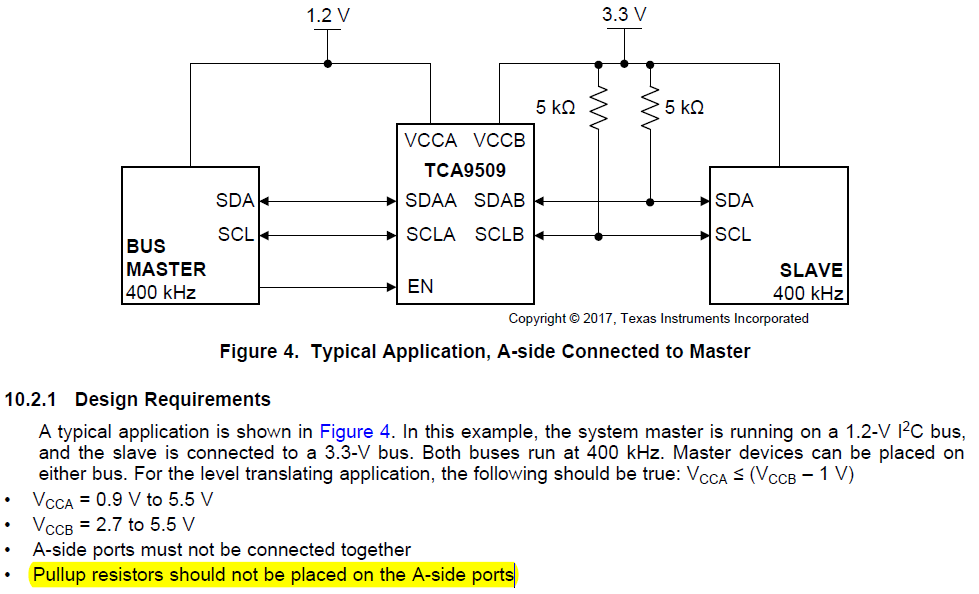
From TCA9509’s data sheet, seems like pull high resistors are not allowed on A-side, the internal pull high circuit on A-side is current source.

What if we put pull high resistors on A-side bus? Will it cause any malfunction or I/O level error?

Thanks.
  • Hey Anne,

    TCA9509 uses current detection (if it is sinking current or sourcing current) on A side in its detection algorithm. Placing a pull up resistor on A side is not needed because A side sources its own current.

    Putting a pull up resistor on A side could potentially mess with the devices ability to sense if it is sinking or sourcing current. Placing a pull up resistor on A side will also increase the Rdson of the master/slave pull down FET which could potentially cause issues with our device's ability to detect if it is fully sourcing current (it must source all of its current in order to detect a low).

    -Bobby
  • 1. Which one is correct, eternal pull high is “not needed” or “forbidden” on A-side?

       From your explanation, TCA9509 uses current source to sense voltage,

       Thus any pull high to voltage source circuit would potentially cause issues, right?

    2. Additional situation, can TCA9509 be applied on a “voltage level shifter” bus?

    Actually this bus has 4 ICs:

    a) SoC: Host, with 2.2KΩ pull high to 1.8V

    b) EC: Device, for keyboard controller

    c) PCIe OCULINK connector: Device, with TCA9509

    d) Touch pad: Device, with back to back level shifter as below figure.

    We found with TCA9509 mounted, touch pad will be fail to operate; we’ve tried to remove host 2.2KΩ pull high, didn’t see improvement, we suspect voltage level shifter will also cause malfunction, right?

    3. How many ICs can be connected on A-side?

    From data sheet, I only see one host and one device in all of the application diagrams in the data sheet, can A-side operate in multi-chips topology?

    4. Just technical discussion, why only A-side uses current source mechanism and B-side doesn’t?

    Is there any special benefit of current sensing mechanism (besides pull high not needed)?

  • Anne,

    "1. Which one is correct, eternal pull high is “not needed” or “forbidden” on A-side?"
    Using a pull up resistor on A side of this device will not help it. It is not forbidden but if you are going to use one it needs to be high.

    " Thus any pull high to voltage source circuit would potentially cause issues, right?"
    Potentially because you are not also messing with the VoL of the TCA9509 due to the current is has to sink (it thinks it should be sinking 1mA but a pull up resistor makes it so it will always sink more).

    "2. Additional situation, can TCA9509 be applied on a “voltage level shifter” bus?"
    What side is the level shifter on? B side is okay but A side is not because it requires a pull up resistor on the other side which this device does not like.

    "we suspect voltage level shifter will also cause malfunction, right?"
    When TCA9509 pulls low on that bus, it will sink current from the 3.3k pull up resistors tied to 3.3V. This is likely the case.

    Do you have waveforms of the communication to the touchpad? I want to see B side and A side of TCA9509.

    "3. How many ICs can be connected on A-side?"
    -The device is only limited by the bus capacitance (400pF) so in theory if the traces had no capacitance and each slave had 10pF of capacitance then this device could support 39 slaves (this device also has about 10pF of capacitance which totals 400pF in this example).

    "4. Just technical discussion, why only A-side uses current source mechanism and B-side doesn’t?"
    All buffers require a way to tell who is pulling low without locking itself up, using a current source is one method of doing this. We have a device which uses B side to do this (TCA980x). Only one side needs to have this and in this device it was A side.

    "Is there any special benefit of current sensing mechanism (besides pull high not needed)?"
    It generates a lower VoL. Other buffers like TCA9517 and TCA9617 use a static voltage offset which generates over 500mV of voltage. If you are interfacing with a lower logic device (like 1.8V) then the ViL is lower (at 1.8V ViL is 540mV) in which cause you need to be sure that the VoL is lower than ViL so using a device which uses a static voltage offset is not ideal. A current source solves this issue with a lower VoL which can interact with lower device logics.
    ----------------------------------------------------------------------------------------------------------------------------
    What is the reason the customer chose TCA9509? We may be able to get this to work if they switch to TCA980x or TCA9517. Any requirements for their buffer?

    Thanks,
    -Bobby
  • Hi Bobby,

    Thanks for your clarify, and we have below questions still need your help,
    Thank you

    1. You said using a pull up resistor on A side of this device will not help it.
    It is not forbidden but if you are going to use one it needs to be high.

    [Question] What do you mean “needs to be high”? The pull high voltage should be higher than TCA9509 VCCA, or the pull high resistance should be as low as possible to make pull high ability strong?

    2. You said, potentially because you are not also messing with the VoL of the TCA9509 due to the current is has to sink
    (it thinks it should be sinking 1mA but a pull up resistor makes it so it will always sink more).

    [Question] The 0 level detection of TCA9509 relies on this “1mA” voltage drop calculation, any pull high path contributes additional current and messes the calculation. Ideally we need to prevent any pull high path, right?


    3. You said, all buffers require a way to tell who is pulling low without locking itself up, using a current source is one method of doing this. We have a device which uses B side to do this (TCA980x). Only one side needs to have this and in this device it was A side.

    [Question] Do you have other models which don’t have this current sensing sub-block on both A and B sides, and also pin-compatible with TCA9509?
  • Hey Anne,

    "[Question] What do you mean “needs to be high”? The pull high voltage should be higher than TCA9509 VCCA, or the pull high resistance should be as low as possible to make pull high ability strong?"
    I mean the resistor should be a larger value so it produces less current.

    "[Question] The 0 level detection of TCA9509 relies on this “1mA” voltage drop calculation, any pull high path contributes additional current and messes the calculation. Ideally we need to prevent any pull high path, right?"
    Yes, that is correct. Because you have a level shifter using the two FETs when the device drives a low, it will sink current from the pull up resistor tied to 3.3V.

    "[Question] Do you have other models which don’t have this current sensing sub-block on both A and B sides, and also pin-compatible with TCA9509?"
    We have TCA9517 which does not use the current sensing but instead uses a static voltage offset on B side. Using pull up resistors with the TCA9517 works.

    Thanks,
    -Bobby