This thread has been locked.

If you have a related question, please click the "Ask a related question" button in the top right corner. The newly created question will be automatically linked to this question.

DS90UB947-Q1: LVDS input signal

Part Number: DS90UB947-Q1

Dear TI Experts,

Now I am using TI DS90UB947 and DS90UB949 and meet with some problem need your suggestion:

1.  I use DS90UB947,  when  the LVDS signal is 3.3V, DS90UB947 can work,but when it's 1.2V or 1.8V ,it cannot work ,can I know why?

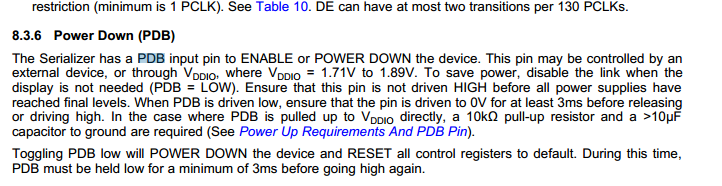
2. I use DS90UB947, PDB voltage is determined by the host,and it‘s 3V, according to the datasheet, it's controlled by an external device or Vddio , so can the PDB voltage be set to 3V?
3. I use DS90UB949, and  the  HDMI input is 3.3V~   Is it meant I must choose  DC coupled mode? Vterm needs to be connected to 3.3V?

If I use DC coupled mode, how to design IN_CLK/D0/D1... and DOUT0/1.. ?

what's the mainly difference when I choose AC coupled or DC coupled?

  • 1. what is your issue? it is lvds diff. swing?
    2.what is your vddio? the voltage in PDB is referred to vddio.
    3.yes. you can use either dc or ac dependent your system design.


    Regards
    Steven
  • Hi Steven,
    1.Yes. As is described in the datasheet, the LVDS signal is between -0.7V-2.5V, but why 3.3V can work well?
    2. As is described in the picture above,PDB may be controlled by an external device or through Vddio。
    Vddio is 1.8V, but PDB pin of DS90UB947 is connected to host,which is 3V, can it be connected to 3V?
    3. What's the mainly difference of AC or DC when using ds90ub949?
    Except for the voltage of Vterm,(1.8V or 3.3V) Is their other difference when I draw the circuit?
  • 1. it is TMDS signal NO LVDS signal.
    2. NO, pls make sure the PDB pin max voltage is matched with VDDIO
    3. either AC or DC is dependent on application. two modes are mentioned in HDMI spec., so TI supports both.

    regards,
    Steven