This thread has been locked.

If you have a related question, please click the "Ask a related question" button in the top right corner. The newly created question will be automatically linked to this question.

TUSB522P: long PCB trace about 24inch application

Part Number: TUSB522P
Other Parts Discussed in Thread: HD3SS3212

Hi,

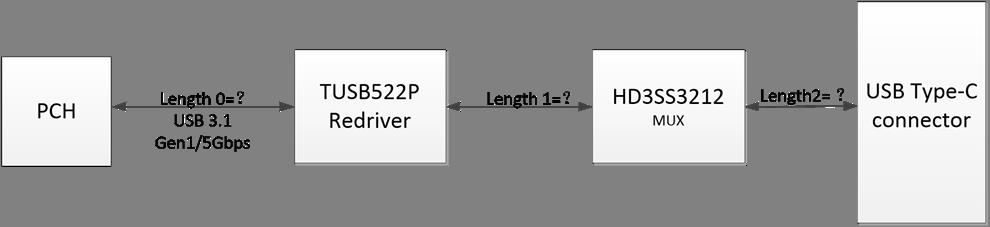
My customer is working on USB3.1 5Gbps in server application. Their PCB trace is long (~24inch) as below. Can you help with below questions?

  1. Could you help to check whether our TUSB522P+HD3SS3212 can support customer’s application? If yes, what’s the suggested length 0/1/2? Appreciate if there’s test results or simulation results. (attached the PCH design guide)
  2. Can you provide a pre and post channel performance test matrix (5'"/10"/15"/20"/25" pre/post PCB trace test results) as a design reference? Then customer can optimize the design by themselves.

 Many thanks.

Brian Zhao
  • Brian

    The PCH design guide gives the trace length recommendation, max Length 0 is 13in. Total Length 1 and Length 2 are 3in.

    Please see section 8.2.3 of TUSB522 datasheet for the measurement result.

    Thanks
    David
  • David,

    The PCH design guide is just a reference while customer's design is much worse (~24inch PCB traces). From the section 8.2.3 of datasheet, it shows 25inch PCB trace with good performance. (Do we have more test results with different PCB trace length?)

    So whether our TUSB522P can support customer's case? If yes, how to set Length 0/1/2 for customer's case?

    Many thanks.

    Brian Zhao

  • Brian

    On the TX side, assume trace length of 24 inches with a 4 mil trace width. This would give us about 0.63 dB per inch of insertion loss at 2.5 GHz. This equates to approximately 15 dB of loss for the entire 24 inches of trace. An additional 1.5 dB of loss is added due to package of the Host, TUSB522P, and the A/C coupling capacitor. This brings the entire channel loss at 2.5 GHz to 15 dB + 1.5 dB = 16.5 dB. A typical USB 3.1 host/device will have around 3 dB of transmitter de-emphasis. Transmitter de- emphasis pre-compensates for the loss of the output channel. With 3 dB of de-emphasis, the total equalization required by the TUSB522P is in the 12.5 dB range. The maximum equalization TUSB522P supports is 9dB, which leaves you 3.5dB uncompensated, adds this to the total loss of channel after TUSB522P which needs to be handled by the device RX.

    On the RX side, I have to assume 24in TX trace would have 24in RX trace plus Host/TUSB522P package and AC coupling capacitor, which is 16.5dB loss. The device plugged into receptacle will have either a short or long channel. USB3.2 standard defines 8.5dB for device, and 6.0dB for cable. So the total is 16.5+8.5+6 = 31dB. You can't set TUSB522P equalizer to max of 9dB, set to maximum would over-equalize the channel for the short channel case. Assume we set to 3dB equalizer, plus 6.2dB de-emphasis on the TX side, you still have 31-3-6.2 = 21.8dB which needs to be handled by the host RX.

    So you have to see how much loss host/device TX (de-emphasis) and RX (equalizer) can handle. If customer wants to use 24in, you can also reduce the insertion loss by use wide trace width, better PCB material (above calculation assumes FR4 board material).

    Thanks
    David
  • David,

    Thank you so much for your detail guide. I got customer's insertion loss data and did some calculation according to your guide. I sent it to you via email and can you help to check and reply?

    Best Regard,

    Brian Zhao

  • Provide support through direct email.

    Thanks
    David