This thread has been locked.

If you have a related question, please click the "Ask a related question" button in the top right corner. The newly created question will be automatically linked to this question.

TCA9803: B-side Pull-up resister

Part Number: TCA9803
Other Parts Discussed in Thread: TL9600

Hi Team,

I am thinking of the following Block Diagram.
In this case, it was configured not to connect static-voltage offsets. Is it possible to transmit?

Also, I would like to attach a pull-up resistor to the B side of TCA9803. This is customer matter.
The board has already been completed and pull-up resistors have to be connected.
Is a pull-up resistor connectable to the A side?


Is it possible to multi-drop connect B side of TCA9803?
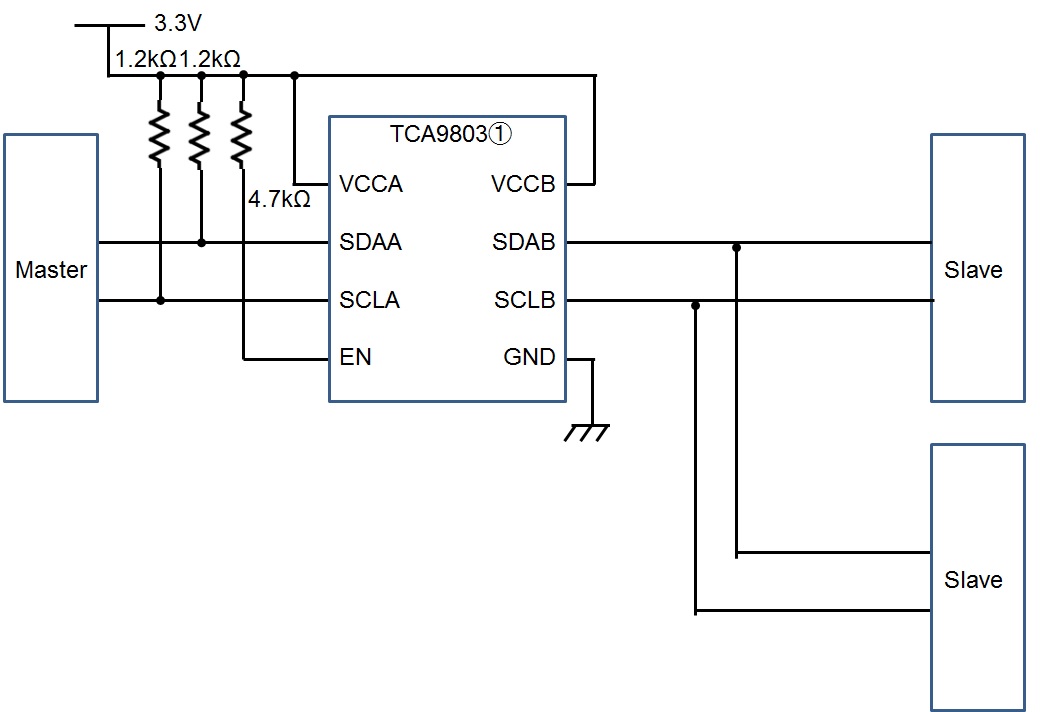
Or is it possible to multi-drop connect the TL9600 T / R side?

Best Regards,
Ishiwata


  • Hey Ishiwata,

    "Also, I would like to attach a pull-up resistor to the B side of TCA9803. This is customer matter.
    The board has already been completed and pull-up resistors have to be connected.
    Is a pull-up resistor connectable to the A side?"

    Pull up resistors on B side of this device will not work well. The 1.2k pull up resistors in general are a bit strong so I don't think this would work.

    "Is it possible to multi-drop connect B side of TCA9803?"

    In your picture, this is okay. I must point out that the first picture has A side on the master but the new picture is B side on the master. Does this mean this is a different I2C bus or did you draw something wrong?

    "Or is it possible to multi-drop connect the TL9600 T / R side?"

    Yes, T/R side is okay but S side is NOT okay.

    Thanks,

    -Bobby


  • Hi Bobby-san,

    Thank you for the answer.
    So, the following configuration without pull-up resistance on the B side may be understood as transmittable?

    Also, if it pull up B side, what is the reason for not work?
    Why is Static Voltage? Is transmission possible if the pull-up resistance value is increased?
    For example, 10kΩ Pull-up


    For multidrop,
    The customer configuration has two slaves.
    In that case, I wanted to confirm where in the following configuration it is possible to branch.
    Multidrop with TCA9803 or Multidrop with TL9600.

    or

    I thought that the B side of TCA9803 could not branch because of the static offset voltage.

    Can you transmit in either configuration?

    Best Regards,
    Ishiwata

  • "So, the following configuration without pull-up resistance on the B side may be understood as transmittable?"
    That should work. You may want to be careful and check to see if the master has an internal pull up resistor though.

    "Also, if it pull up B side, what is the reason for not work?"
    Section 9.4.1.2.1 discusses this. Essentially this device uses the internal current it supplies on B side to detect if A side or B side pulls low. By adding an external pull up current, you could disrupt the low detection algorithm for the device.

    "Why is Static Voltage?"
    Are you talking about TL9600 or TCA9803?

    "Is transmission possible if the pull-up resistance value is increased?"
    I am assuming you are asking about TCA9803 B side pull up resistor. So I've seen cases where this does work but when you use an external pull up resistor, you need to ensure that the Master's NFET can pull all of the current from the internal pull up source of TCA9803 B side. The stronger your drive strength of your master is, the more likely you can use a stronger external pull up resistor. 10k is pretty weak but if you have a weak drive strength on a master then it may not work.

    "In that case, I wanted to confirm where in the following configuration it is possible to branch.
    Multidrop with TCA9803 or Multidrop with TL9600."
    Both images I see work. No problem with either of them.

    "I thought that the B side of TCA9803 could not branch because of the static offset voltage."
    B side cannot connect to another buffer with a static voltage offset. TL9600 has a static voltage offset on Sy/Sx BUT TCA9803 is connected to TL9600 by A side NOT B side. This means that this will work.

    "Can you transmit in either configuration?"
    I see no problem.

    Thanks,
    -Bobby
  • Hi Bobby-san,

    Thank you for your support.

    " "Why is Static Voltage?"
    Are you talking about TL9600 or TCA9803? "
    -> This is talking about TCA9803.

    "So I've seen cases where this does work but when you use an external pull up resistor, you need to ensure that the Master's NFET can pull all of the current from the internal pull up source of TCA9803 B side. The stronger your drive strength of your master is, the more likely you can use a stronger external pull up resistor. 10k is pretty weak but if you have a weak drive strength on a master then it may not work. "
    ->The drive capacity of the master is 3 mA. In this case, is transmission possible with a 1.2kohm pull-up?


    There is another matter, can I input only SDA to TCA9803?
    The customer says that it wants to transmit SCL by another path.
    If possible, are the unused pins (SCLA, SCLB) connected to VCC? Is it GND connection?

    Best Regards,
    Ishiwata

  • Hi Team

    I have no response.
    Please your answer.

    Best Regards,
    Ishiwata
  • Hi Ishiwata-san,

    Sorry for the delay. Bobby has been out of the office for a few days. We will get back to you tomorrow.

    Regards,
    Max
  • Hey Ishiwata,

    Sorry for the late reply. I was out of office when you sent the earlier reply and just got back in today.

    The TCA9803 does not have a normal/conventional static voltage offset. It uses a current source like you know. In a sense, it does have a static voltage offset because the current source is constant and the Rdson of the device is constant in a steady state sense. So the 3.3mA current multiplied by the Rdson of B side NFET of TCA9803 will generate a static voltage offset but this offset is much lower than most static voltage offset buffers because it does not use a diode.

    Now, what needs to be understood is how the device detects which side is pulling low (this is necessary for the device to insure it does not latch itself low). The device can tell if B side is driving low because it can see if the internal current source is being sunk externally. If the B side is sourcing current then it means B side master/slave is driving low. When the current source is being sunk internally, it means A side is driving low. In a contention state where A side is driving low and B side master/slave wants to also drive low (example would be an ACK hand off) the master/slave needs to be able to pull enough current away from the TCA9803's NFET to recognize that B side is driving low. This means the master/slave needs to have enough drive strength to accomplish this (the parameter I am referring to is IiLc).

    "The drive capacity of the master is 3 mA. In this case, is transmission possible with a 1.2kohm pull-up?"
    1.2k is alot of current. You are adding an additional 2.75mA of current into the master/slave side plus the TCA9803 current source. This effectively means the master/slave now needs to drive 6.05mA of current instead of just the 3.3mA from the TCA9803 during a low condition. TCA9803 requires atleast 1mA of the current source to be pulled in order for it to recognize that the B side is driving low during contention. TCA9803 specs that the master/slave must provide a drive strength of 150 ohm or less to ensure lows can be passed during contention. A standard I2C slave/master will provide 0.4V at 3mA which is 133 ohm. By adding the 1.2k external resistor you may increase the Ron of the master/slave such that the drive strength is no longer less than 150 ohms. Because you spec'd the 'drive capacity of the master' at 3mA I assume that the drive strength is only standard and not especially strong like some FPGAs. This leads me to think you will violate the RiLc requirement.

    "There is another matter, can I input only SDA to TCA9803?
    The customer says that it wants to transmit SCL by another path.
    If possible, are the unused pins (SCLA, SCLB) connected to VCC? Is it GND connection?"
    This still seems odd to me but yes, you can make SCL high (externall pull ups on A side and leave B side floating)

    Thanks,
    -Bobby
  • Hi Bobby-san,

    Thank you for contacting. Thank you for your support.

    Low can not be driven correctly if sufficient current is not supplied to the 9803 NFET.
    Therefore, it does not operate correctly if there is a current of 3 mA in the B-side counter device.
    Therefore, transmission with 1.2kΩ pull-up will not be possible. And you are judging.
    I understood that way, but is that understanding correct?

    Best Regards,
    Ishiwata
  • Hey Ishiwata-san,

    "Low can not be driven correctly if sufficient current is not supplied to the 9803 NFET."
    Should read: Low can not be driven correctly if sufficient current is not sourced from the 9803 current source during contention.

    "Therefore, it does not operate correctly if there is a current of 3 mA in the B-side counter device."
    Should read: Therefore, it MAY not operate correctly if there is an EXTERNAL current source (like 1.2k pull up) on the B-side of 9803 device.

    "Therefore, transmission with 1.2kΩ pull-up will not be possible."
    A side 1.2k pull up should be okay, B side with 1.2k pull up may not be. It is dependent on Master/slave drive strength.

    " And you are judging."
    Correct, I heard when this device was designed that they did do testing to see if B side could handle external pull up resistors and for weak pull ups, the device worked. [I did not find data for this testing] For strong pull ups (like 1.2k) they started to see problems. I personally have not done testing but my thoughts are the issues are due to the drive strength of the master/slave not being able to sufficiently draw the IiLc from 980x.

    Thanks,
    -Bobby
  • Hi Bobby-san,

    Sorry for the delay in contacting you.

    I read, but I could not understand because I am not good at English.
    I was able to understand.Thank you.

    Thank you for your support.

    Best Regards,
    Ishiwata