Other Parts Discussed in Thread: PCF8574, , TCA6416A, TCA9534
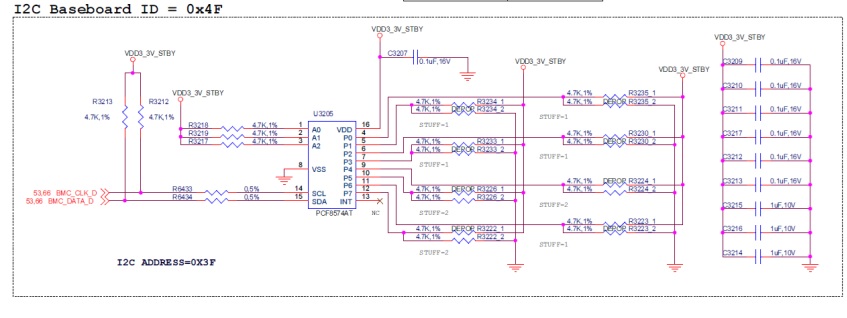
Hi There:
This thread has been locked.
If you have a related question, please click the "Ask a related question" button in the top right corner. The newly created question will be automatically linked to this question.
Hey Kay,
May I ask why you are making a switch from the PCF series?
"What items need to be take care or which issue would be happend if directly swap those two? "
The major difference is that PCF device does not have internal registers to set while the 9534 has 4 registers. The software would need to be changed to be able to address this difference.
Thanks,
-Bobby
Hey Kay,
I would recommend our TCA family. It is more cost competitive than our PCA line up and fixes some bugs from the older PCA design. They also support wider Vcc ranges.
I have example C code from an Arduino MCU I made for fun on my off time (See Below). We typically do not off software support/drivers for our I2C devices. Also please do not treat the code below as something that represents/owned by TI as Arduino is open source and the code was developed outside of TI.
Code was written for TCA6416A but it should be similar to PCA9534/TCA9534 in the sense of accessing registers through I2C.
#include <Wire.h>
int GPIO = 31;
int input = 0;
int readdata = 0;
int flowcontrol = 0;
int dataread[2]={0,0}; //this is the users input converted hex which can be used after using datainput1()
int totalHEX = 0; //this is an 8 bit number in hex which can be used after using datainput1(),
int deviceAddress = 0x21;
int command = 0;
int datawrite = 0;
void setup() {
// put your setup code here, to run once:
pinMode(GPIO, INPUT);
Serial.begin(9600);
Wire.begin();
Wire.setClock(400000L);
Serial.println("Press 0 to set GPIO low or press 1 to set GPIO HIGH || enter custome mode by entering 9");
}
void loop() {
if (Serial.available()){
input = userinput();
//toggles a GPIO LOW for input mode
if (input==0){
pinMode(GPIO, OUTPUT);
digitalWrite(GPIO, LOW);
Serial.println("GPIO set low");
Serial.println("GPIO will revert to an input in:\n");
for(int i=10; i>=0; i--){
Serial.println(i);
delay(1000);
}
pinMode(GPIO, INPUT);
}
//toggles GPIO HIGH for input mode
else if (input==1){
pinMode(GPIO, OUTPUT);
digitalWrite(GPIO, HIGH);
Serial.println("GPIO set HIGH");
Serial.println("GPIO will revert to an input in:\n");
for(int i=10; i>0; i++){
Serial.print(i);
delay(1000);
}
pinMode(GPIO, INPUT);
}
//changes device to be an INPUT
else if (input==3){
Wire.beginTransmission(deviceAddress);
Wire.write(0x06);
Wire.write(0xFF);
Wire.write(0xFF);
Wire.endTransmission();
Serial.println("Device configured as an INPUT");
Wire.beginTransmission(deviceAddress);
Wire.write(0x06);
Wire.endTransmission();
Wire.requestFrom(deviceAddress, 2);
Wire.endTransmission();
Serial.println("I2C programing complete");
for (int i=0;i<=1;i++){
readdata = Wire.read();
Serial.println(readdata);
}
}
//changes device to be an output
else if (input==4){
Wire.beginTransmission(deviceAddress);
Wire.write(0x06);
Wire.write(0x00);
Wire.write(0x00);
Wire.endTransmission();
Serial.println("Device configured as an output");
Wire.beginTransmission(deviceAddress);
Wire.write(0x06);
Wire.endTransmission();
Wire.requestFrom(deviceAddress, 2);
Wire.endTransmission();
Serial.println("I2C programing complete");
for (int i=0;i<=1;i++){
readdata = Wire.read();
Serial.println(readdata);
}
}
//automatically sets outputs as low (does not configure as outputs though)
else if (input==5){
Wire.beginTransmission(deviceAddress);
Wire.write(0x02);
Wire.write(0x00);
Wire.write(0x00);
Wire.endTransmission();
Serial.println("outputs set LOW");
Wire.beginTransmission(deviceAddress);
Wire.write(0x02);
Wire.endTransmission();
Wire.requestFrom(deviceAddress, 2);
Wire.endTransmission();
Serial.println("I2C programing complete");
for (int i=0;i<=1;i++){
readdata = Wire.read();
Serial.println(readdata);
}
}
// //automatically sets outputs as HIGH (does not configure as outputs though)
else if (input==6){
Wire.beginTransmission(deviceAddress);
Wire.write(0x02);
Wire.write(0xFF);
Wire.write(0xFF);
Wire.endTransmission();
Serial.println("outputs set HIGH");
//read what we wrote
Wire.beginTransmission(deviceAddress);
Wire.write(0x02);
Wire.endTransmission();
Wire.requestFrom(deviceAddress, 2);
Wire.endTransmission();
Serial.println("I2C programing complete");
for (int i=0;i<=1;i++){
readdata = Wire.read();
Serial.println(readdata);
}
}
//reads input ports 0 and 1
else if(input==8){
Wire.beginTransmission(deviceAddress);
Wire.write(0x00);
Wire.endTransmission();
Wire.requestFrom(deviceAddress, 2);
Wire.endTransmission();
Serial.print("Input registers 0 and 1 have been read, INT should reset\n");
}
else if(input==9){
Serial.print(
"Device Registers:\n"
"--------------------------------------------------\n"
"0x00 - INPUT PORT0 \n"
"0x01 - INPUT PORT1 \n"
"0x02 - OUTPUT PORT0 \n"
"0x03 - OUTPUT Port1 \n"
"0x04 - Polarity Inversion 0 \n"
"0x05 - Polarity Inversion 1 \n"
"0x06 - Configure 0 \n"
"0x07 - Configure 1 \n"
"--------------------------------------------------\n"
);
Serial.print("\n ----------------------------\n"
"[input command byte to send]\n");
datainput();
command = totalHEX;
Serial.print("Command byte 0x");
Serial.println(command, HEX);
Serial.print("\n ----------------------------\n"
"[input data byte to write]\n\n");
datainput();
datawrite = totalHEX;
Serial.print("data to write 0x");
Serial.println(datawrite, HEX);
Wire.beginTransmission(deviceAddress);
Wire.write(command);
Wire.write(datawrite);
Wire.endTransmission();
Serial.println("I2C transaction has been sent\n");
Serial.print("doing a read transaction, please check to see if the data read matches\n");
Wire.beginTransmission(deviceAddress);
Wire.write(command);
Wire.endTransmission();
Wire.requestFrom(deviceAddress, 1);
Wire.endTransmission();
while (Wire.available()){
Serial.print("data read is: 0x");
Serial.println(Wire.read(),HEX);
}
}
else{
Serial.println("invald input, please try again");
}
}
}
int userinput(){
char value = Serial.read();
Serial.println(value);
value = value - 48; //ASCII to 0-9 inputs
return value;
delay(50);
}
int datainput(){
flowcontrol = 0;
int datacheck[2]={0,0};
Serial.println("Input 2 characters in HEX then hit enter");
while(flowcontrol==0){
delay(50);
if(Serial.available()==2){
//when we have 2 inputs from user, we will read and store the inputs
for(int i=0; i<=1; i++){
dataread[i]=Serial.read();
if(dataread[i]<=57 && dataread[i]>=48){
//need to convert the input into hex
dataread[i]= dataread[i]-48;
datacheck[i] = 1;
}
else if(dataread[i]<=70 && dataread[i]>=65){
//need to convert the input into hex
dataread[i]= dataread[i]-55;
datacheck[i] = 1;
}
else if(dataread[i]<=102 && dataread[i]>=97){
//need to convert the input into hex
dataread[i]= dataread[i]-87;
datacheck[i] = 1;
}
else{
Serial.println("Invalid character input");
datacheck[i] = 0;
}
Serial.print("Input in hex: ");
Serial.println(dataread[i], DEC);
}
if ((datacheck[0]&datacheck[1])==1){
totalHEX=(dataread[0]<<4)+dataread[1];
flowcontrol = 1;
}
else {
flowcontrol = 0;
Serial.println("one more both of the inputs were note valid, enter 2 valid hex inputs again");
}
}
else if(Serial.available()>2){
Serial.println("too many inputs, Input only 2 characters");
//need to flush the serial buffer
while(Serial.available()){
Serial.read();
flowcontrol = 0;
}
}
//if else statement for flow control incase any inputs were not acceptable
}
return 1;
}
-Bobby