This thread has been locked.

If you have a related question, please click the "Ask a related question" button in the top right corner. The newly created question will be automatically linked to this question.

DS90UB926Q-Q1: BCC watchdog timer

Part Number: DS90UB926Q-Q1


Hi team,

I have some questions for BCC watchdog timer.

Under what conditions does the Des926 BCC watchdog work and how do it terminate the transaction?

The following system is considered for reference.

I considered the following four cases.

Case 1 & 2.
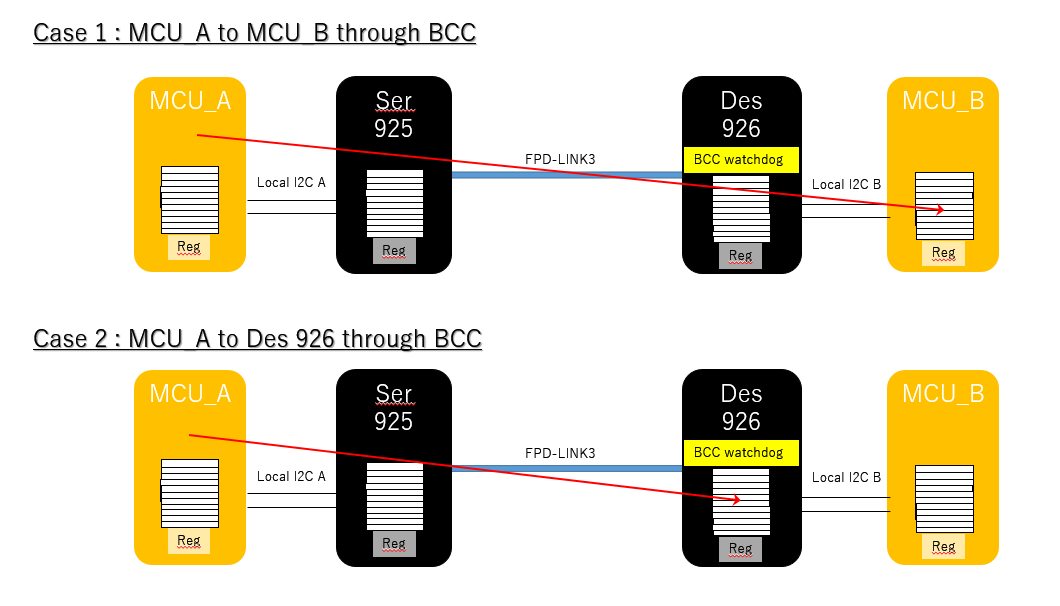
On which path can the 925 BCC watchdog timer monitor transaction completion, eg Local I2C_B, FPD-LINK BCC, Local I2C_A?

I think that 926 BCC watchdog timer does not work if it fails to complete on Local I2C_B and Local I2C_A.

Is it correct?

How does 926 BCC watchdog timer terminate the transaction?

I think that 926 will work to make 925 release the Local I2C_A.

Is it correct?

Case 3 & 4.

What about Cases 3 & 4?

Best regards,

Tomoaki Yoshida

  • BCC Watchdog Timer prevent a lock-up condition on the control channel when no response is available from the remote/remote-slave device.  The BCC Watchdog timer is active for both I2C master and slave operation, but only when the device is actively holding SCL low.

    An example of when this might happen is if link becomes lost before or during a control channel access.  In this case, no response will arrive from the remote serializer or deserializer.  If no response is seen within the timer window, the serializer/deserializer will release the SCL and indicate a not acknowledge on the I2C bus.  

    For case 1&2, MCU_A is the I2C master and 925 will hold the SCL low when communication to either 926 or MCU_B. BCC watchdog will monitor FPD-Link BCC and Local I2C B. If the response doesn't arrive, 925 will terminate the I2C communication.

    For case 3&4, it is the opposite of case 1&2.

    Best Regards,

    Charley Cai