This thread has been locked.

If you have a related question, please click the "Ask a related question" button in the top right corner. The newly created question will be automatically linked to this question.

SN65HVD1780-Q1: Different Vcc at two side

Part Number: SN65HVD1780-Q1

Hi, team,

I have some questions about SN65HVD1780-Q1 may need your confirmation.

1. If two side SN65HVD1780-Q1 is with different Vcc (3V3 and 5V), can it work?
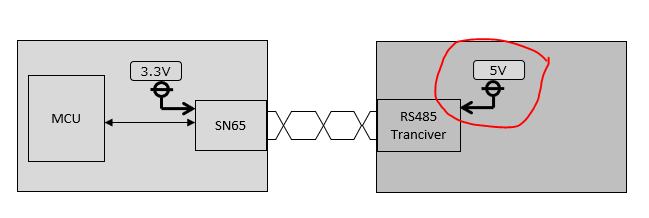
2. If chip is off power and add 13.2V at A/B pin, is there any leakage current through chip?

3. Is there any Vcc power up/down speed requirement?

Thanks.

Johnny

  • Hi Johnny,

    An RS-485 transceiver should support the requirements of the RS-485 physical layer regardless of whether it is powered via VCC = 3.3 V or VCC = 5 V.  So, there are not issues connecting these two transceivers together (it is very common to inter-operate between these kinds of transceivers).  One thing to be careful of, though, is if there are pull-up resistors included on both sides.  (These resistors are sometimes used for failsafe biasing.  You can read more about that here: https://e2e.ti.com/blogs_/b/industrial_strength/archive/2016/12/06/rs-485-basics-two-ways-to-fail-safe-bias-your-network.)  In that case, you could have some current flow through the resistors from the 5 V supply to the 3.3 V supply.  The solution would be to either use only pull-ups on one side or to include a series diode to prevent back current flow.

    There is limited leakage into the A/B lines whether the device is powered on or off.  You can refer to the II(BUS) specification to get some idea of the effective input resistance.  For example, a 12-V applied voltage results in a worst-case input leakage of just 100 uA.

    There is no limitation on the ramp rate for VCC, although the device will not be fully functional per datasheet specifications until the voltage reaches the proper level.

    Regards,
    Max