This thread has been locked.

If you have a related question, please click the "Ask a related question" button in the top right corner. The newly created question will be automatically linked to this question.

TPS65987EVM: TS3USB221 switch control

Part Number: TPS65987EVM
Other Parts Discussed in Thread: TS3USB221, TPS65987, TPS65986EVM, TPD8S300, TUSB1064, SN65DP159, DP159RSBEVM, TUSB564

Hi

I'm just going through the schematics of the TPS65987EVM and the 10G-EXPANSION-EVM and have a question about the control of the TS3USB221 MUX on the expansion board. The switch pin is connected back through the Samtec connector and is labelled as GPIO8, but on the TPS65987EVM schematic this connection is not labelled from the connector. There are some unlabelled wires on the expansion connector section.

I just wanted to confirm that this is indeed connected to GPIO8 as the TPS65987 datasheet says GPIO8 is the MISO line for the SPI flash chip. I had a look at the Application Customization Tool and when I select it as a DP only device, there are no options for GPIO8.

Help much appreciated.

Thanks

  • Hi Laurence,

    Ths TS3USB221 is not used when the 10G-EXPANSION-EVM is connected to the TPS65987EVM. The TS3USB221 is used to ensure backward compatibility with the TPS65986EVM. The TPS65987 does not integrate the SBU/AUX mux so the SBU/AUX lines need to go through the SuperSpeed Mux. The SBU/AUX mux is integrated into the TPS65986 so the TS3USB221 is used to route those signals around the SuperSpeed Mux.

    Thanks,
    Eric

  • Hi Eric

    OK thanks for the speedy reply.

    So I will connect the AUXP on the TUSB1064 to the SBU1 on the TPD8S300 and the AUXN to the SBU2?

    Also, on a slightly different note, am I able to use the TS3USB221 to connect 2 hosts to one device? It is the reverse direction from what is shown in the datasheet.

    Thanks

  • Hi

    Sorry, I realised I had it the wrong way round. SBU1 and 2 connects between TUSB1064 and TPD8S300 and the AUXP and N go onwards. For my application I am converting the DP signal to HDMI using the SN65DP159 IC.

    I am still trying to understand with the AUX about its DDC functionality though. In the SN65DP159 datasheet it says to use the RGZ variant which incorporates I2C over AUX, but the DP159RSBEVM sends the I2C through the AUX channels anyway.

    My question is, what does it depend on whether you need to use the RGZ version or the RSB version? Does the TUSB1064 require the RGZ version which provides I2C over AUX?

    Thanks

  • Hi Laurence,

    I'm reassigning this thread to the product line that owns the DP159RSBEVM. They should get back to your question shortly.

    Thank you,
    Eric

  • Laurence

    The DP159RSB AUX_SRCp/n is N/A, the block diagram in the user guide is incorrect. If you look at the schematic, only DDC goes through the DP159RSB.

    Thanks

    David

  • Hi David

    Thanks for the response.

    This is my first use of DisplayPort to HDMI conversion and I'm trying to understand it. As I understand, DP uses the AUX lines for DDC, which are differential. HDMI has I2C SDA and SCL lines for DDC.

    I'm just a little confused in what scenario SRC-SDA and SRC-SCL pins are used? Is it when the DP source is in dual mode and outputting HDMI? Either way, I'm guessing that the DP output being MUXed through the TUSB1064 is regular DP and therefore the DP159RSB will not work and I will need to use the DP159RGZ? I would prefer to use the DP159RSB as it is smaller and slightly cheaper, but if it cannot allow communication between the HDMI sink and the DP source, it is not useable.

    Sorry for the naive questions.

    Many thanks

  • Laurence

    Let me make a clarification on the DP and DP++. While DP++ can transmits DVI/HDMI signals as well as DP, DP transmits DP only.

    The TUSB1064 is able to support both DP and DP++. The DP159RSB/RGZ support DP++ only. If you want to go from DP to HDMI, then you need an active DP to HDMI adapter which we currently do not have a solution.

    The Type-2 I2C-over-AUX to DDC bridge function provides an opportunity to communicate the DDC information either through the DDC or the AUX bus. Figure 31 of the DP159 shows a source that has separate DDC and AUX channel. In this case, RGZ is used. Figure 32 of the DP159 shows a source with DDC and AUX muxed internally, so in this case, either RGZ or the RSB can be used.

    Thanks

    David

  • Hi David

    Thanks for the reply.

    OK, so as in figure 31, I could use the DP159RSB and connect the SCL_SRC to AUX_P and SDA_SRC to AUX_N of the TUSB1064?

    Also, my understanding is that USB-C does not support DP++, so am I right in thinking there is no way to make the combination of TUSB1064 and DP159 work at all? I would have to replace the DP159 with another vendors active converter? Are there any ways of getting a HDMI signal using the USB-C spec without an active converter?

    Thanks

  • Laurence

    Correct, USB Type C does not support DP++. 

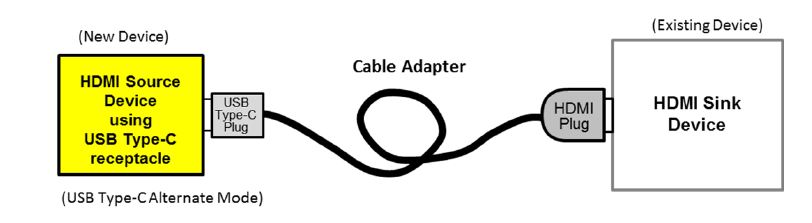
    The HDMI over Type C spec only defined the HDMI over Type C on the source side. On the sink side, it is still HDMI only as shown in the diagram below.


    If you want to support HDMI over Type C on the sink side, the only solution I see is to use DP and then use an active DP to HDMI adapter.

    Thanks

    David

  • Hi David

    OK, thanks. So does the source PD controller recognize the sink as a HDMI receiver and automatically transmit that? Does the cable communicate to the USB-C source to transmit HDMI?

    In my application I don't have a need for DP specifically, but I do need the power delivery and HDMI. I'm guessing that none of the TI PD controllers can simulate a HDMI sink once a power delivery contract has been negotiated?

    Looks like an active converter route is most likely.

    Thanks

  • Laurence

    The HDMI cable adapter contains the logic circuit to implement the PD communication and supports the HDMI Discovery Process. 

    But even if a PD controller supports HDMI, it will be in the source and the cable adapter, not on the HDMI sink side. HDMI sink side has no concept of HDMI over Type C.

    DP to DP over Type C is a straightforward process. TUSB546/1046 will be used on the source side while TUSB564/1064 will be used on the sink side. For the active converter, you can take a look at Megachips STDP2650.

    Thanks

    David

  • Hi David

    Thanks for the reply. I understand better now. Would there ever be a situation where a source can provide HDMI over USB-C but not DP? Would this be in the USB-C spec?

    Thanks for the tip with the MegaChips part. We are also going to look at the ParadeTech PS176 device.

    Many thanks

  • Laurence

    The HDMI over Type-C spec is already released, I would refer to the HDMI.org: https://www.hdmi.org/manufacturer/HDMIAltModeUSBTypeC.aspx.

    Thanks

    David