This thread has been locked.

If you have a related question, please click the "Ask a related question" button in the top right corner. The newly created question will be automatically linked to this question.

P82B715: P82B715 -Single Pullup

Part Number: P82B715


1)In the datasheet it is mentioned as "If P82B715 devices are to be permanently connected into a system, the circuit may be configured with only one pullup resistor on the buffered bus"

It means we can provide pull up to lx and ly.

Where sx and sy connected to i2c device without pullup resistor

In this case how the i2c device with open drain input be driven high? can it's working be explained?

Is there any weak pull up internally at sx and sy pins? If yes what is the resistance value

2)As per datasheet "If only a single pullup is used, it must be placed on the buffered bus (as R2 in Figure 5) and the associated total system capacitance calculated by combining the individual bus capacitances into an equivalent capacitive loading on the buffered bus"

(kindly verify P82B715 datasheet page no 10 for image)

Here why pull up is not provided for clock lines?

  • Hi Mithun,

    1) In this case how the i2c device with open drain input be driven high?
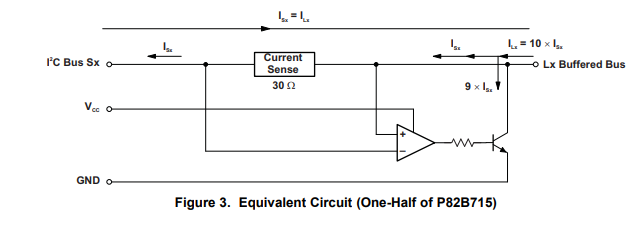
    P82B715 does not buffer the I2C lines, but only amplifies the current sinking capabilities in one direction. This means lx/ly are indeed connected to sx/sy and a pull-up resistor on the buffered bus (lx/ly) will also provide current to pull up the I2C side (sx/sy). Refer to Figure 3 on the datasheet for a visual representation of the equivalent circuit. The reason this pull-up must exist on the buffered bus is because current must be sourced from this side for P82B715 to recognize the signal direction and amplify current accordingly. 

    Is there any weak pull up internally at sx and sy pins?
    No. There is no internal pull-up resistor in this device. 

    2) Here why pull up is not provided for clock lines?
    This is a simplified diagram which focuses on pull-up resistor placement - which ones are necessary and which improve performance. I believe the resistors for the clock line were omitted to avoid cluttering the figure. However a similar pull-up network will be needed for this line. 

    Let me know if you have any more questions.

    Regards,
    Eric

  • Thank you Eric, those explanations cleared most of my doubts. Kindly confirm whether  the below statement is true if not kindly explain.

    1)So to be straight, the pull up on lx/ly side will source current to the open drain inputs of I2C master/ slave(without any pull-up on sx/sy lines) connected to sx/sy

    2)And sx/sy are not open drain terminal and it is shorted with lx/ly  with 30 ohm resistance.

    3)And in the equivalent circuit (figure 3) the potential difference across 30 ohm resistor is fed to comparator to turn on/off the transistor

    And one more question.

    What improvement happen if R1,R3 and R4 are included along with R2 in figure5 (kindly verify P82B715 datasheet page no 10 for image)?

  • Hi Mithun,

    Yes, your understanding is correct.

    Adding resistors on the I2C side of P82B715 will allow another current path to charge this line. When being charged from the current that flows through P82B715, the device is also sinking a large amount of current to ground. This could increase the time it takes to pull up the I2C side of the device and will consume more power to do so. This is why it is recommended to include these resistors, though not necessary depending on your system requirements. 

    Regards,
    Eric

  • Eric Schott1 said:

    Hi, my question is in some way similar to this topic. Our P82B715 is powered by it`s own 5V source, separately from the rest of the circuit. Our client seems to be able to transmit the data even when P82B715 is not powered on. Looking at this simplified schematic of current sinking on the bus, it seems to me it would be possible. But I haven`t the device with me to test myself. Can you confirm if P82B715, when not powered on, does allow passive data bidirectional transmission or not?

    Thanks

    Karl

  • Hi Karl,

    Thanks for sharing this! Based on the Equivalent Circuit, I would expect this to be the case. Because there is no isolation or buffering being done by the device, it will still propagate LOWs when unpowered. Applying Vcc will enable the extra current sinking capabilities of the device to help pull down the Lx/Ly lines. In certain system designs, this extra strength may be needed for successful communication. In other implementations where Lx/Ly bus capacitance/pull-up values are low/weak enough, the driving device on Sx/Sy may be able to transfer data without the added help of P82B715. 

    Let me know if you find out anything else interesting during your testing. 

    Regards,
    Eric

  • Thanks, that explains  what the clients have seen in practice.