This thread has been locked.

If you have a related question, please click the "Ask a related question" button in the top right corner. The newly created question will be automatically linked to this question.

ONET1151L: Not getting the requested modulation current

Part Number: ONET1151L


I've designed a circuit around the ONET 1151L to drive a laser diode with 1-2 Gbps signals. We have been trying in open loop so far, setting the bias and modulation current. When setting different bias currents with no modulation and measuring power we get the P-I graph matching the datasheet. But when adding modulation current (PRBS signal DC balanced) the resulting power is not the expected (corresponding to IBIAS + 1/2 IMOD) but much less. A practical example:

We set Ibias = 20 mA (right above the laser knee) and Imod = 0. Optical power is P1

We set Ibias = 20 mA and Imod = 20 mA, we measure optical power P2.

We set I bias = 20 + 0.5 * 20 = 30 mA. We measure optical power P3.

We expect P2 being equal to P3, but what we observe is P2 just slightly above P1.

I assumed modulation current is on top of bias current, even if the laser is AC-coupled, because the driver only sinks current. From results it looks like modulation current is AC added to bias. Even though, the AC amplitude is less than expected

Looking at the waveform from the detector, it is well shaped up to 2 GHz, but again the AC amplitude doesn't show the same gain, for example, with Imod = Ibias, we observe a DC voltage and an AC voltage less than the DC, while we expected the same.

I'm aware the rest of circuitry may affect the results I'm getting but I'd appreciate any pointers about potential reasons and ways of further testing

  • Hi Juan,

    in case of P3, what is Imod. Is this 0 like P1?

    Regards,, Nasser

  • Yes, in that case Imod is 0. 

    I'm now convinced that because of the AC coupling, modulation is superposed to bias not added on top as in the DC case. In that case, adding modulation wouldn't change the average optical power.

    When looking at the optical detector signal on the scope with Ibias = Imod, we expect the amplitude ('1' - '0') to be equal to the DC (middle) but it isn't. We get some DC at 10 - 12 mV but the amplitude is 4 - 5 mV.

    We tried a second (new) board to check if the chip was damaged, same poor result. We also swapped the laser for a new one. Same. 

    The signals come from an FPGA where amplitude can be adjusted. I'm just thinking if the input level has an impact on the output current.

  • Below is a detailed example of my results. I write and read the registers through the serial port. Below are the settings for the 1st case (Ibias 25 mA Imod 10 mA). 

    register contents (hex)
    -----------------------------------
    00:D8 01:09 02:00 03:1D
    04:01 05:3D 06:00 07:7F
    08:00 09:00 10:00 11:00
    12:00 13:00 14:84 15:00

    Chip ENAble 1
    PhotoDiode RaNge 2
    Open Loop ENable 1
    Fault Detection ENable 1
    Output POLarity 0
    EQualizer ENable 0
    PhotoDiode POlarity (RO) 0
    Cross-Point Temp Coeff adjust 0
    Cross-Point Adjustment Range 0
    Cross-Point Adjustment Enable 0
    Offset Cancellation DIsable 1
    BIas current POlarity bit (RO) 0
    DISable Mode 0
    Two-Wire TErmination 1
    I MODulation setting (uA) 9976
    BIAS current setting (uA) 24990
    EQualizer ADjustment 0
    Eye Cross-Point Adjustment 0
    Path Gain Control Mode 0
    Output Resistance ADjustment 0
    Output De-Emphasis Adjustment 0
    Limiter Bias Current Sign 0
    Limiter Bias current SElection 0
    Emitter Follower Sign Bit 0
    Emitter Follower SElection 0
    PhotoDiode current Fault Enable 0
    Digital PD current Mon. enable 0
    Digital Bias Curr. Mon. enable 0
    Bias Mon. Fault Threshold 0
    Power Mon. Fault Threshold 0
    Adc DISable 0
    Adc OScillator Disable 0
    Adc INput Selection 0

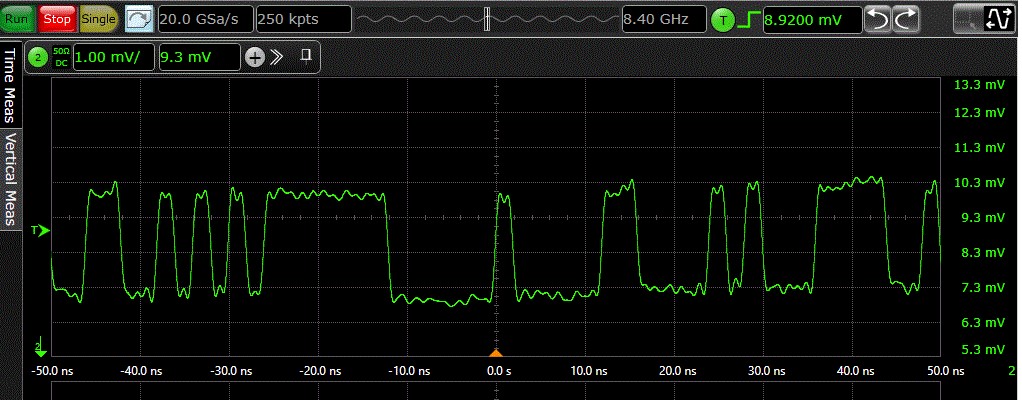
    And what I get from the optical detector is:

    So the amplitude is 3 mV and DC is 8.8 mV

    A second experiment with Ibias = 30 mA and Imod = 15 mA produces:

    register contents (hex)
    -----------------------------------
    00:D8 01:01 02:02 03:2B
    04:02 05:49 06:00 07:7F
    08:00 09:00 10:00 11:00
    12:00 13:00 14:86 15:02

    Chip ENAble 1
    PhotoDiode RaNge 2
    Open Loop ENable 1
    Fault Detection ENable 1
    Output POLarity 0
    EQualizer ENable 0
    PhotoDiode POlarity (RO) 0
    Cross-Point Temp Coeff adjust 0
    Cross-Point Adjustment Range 0
    Cross-Point Adjustment Enable 0
    Offset Cancellation DIsable 0
    BIas current POlarity bit (RO) 0
    DISable Mode 0
    Two-Wire TErmination 1
    I MODulation setting (uA) 14964
    BIAS current setting (uA) 29988
    EQualizer ADjustment 0
    Eye Cross-Point Adjustment 0
    Path Gain Control Mode 0
    Output Resistance ADjustment 0
    Output De-Emphasis Adjustment 0
    Limiter Bias Current Sign 0
    Limiter Bias current SElection 0
    Emitter Follower Sign Bit 0
    Emitter Follower SElection 0
    PhotoDiode current Fault Enable 0
    Digital PD current Mon. enable 0
    Digital Bias Curr. Mon. enable 0
    Bias Mon. Fault Threshold 0
    Power Mon. Fault Threshold 0
    Adc DISable 0
    Adc OScillator Disable 0
    Adc INput Selection 0

    So some 18 mV DC and some 4.5 mV amplitude.

    The DC values are consistent with the laser datasheet, showing a knee at 20.2 mA and a slope of  1.84 (mV detector/ mA laser), but if the modulation current was really 10 mA the expected amplitude would be 18 mV and it's 3 mV. Same for the second experiment, 15 mA * 1.84 = 27.6 mV but it's barely 4.5 mV.

  • The conclusion seems to be that because of the on-chip pull-up in the output driver, a fraction of the modulation current goes actually to the laser diode. The laser has an internal series resistor of 20 ohm so it seems in the best case only half of the current goes to the laser, then the advertised "85 mA modulation driver" results in being capable of only 40 mA.

  • Hi Juan,

    1). Scope shots you have shown are from your optical detectors. Normally there is some correction factor that you have to apply to your scope measurement. Please check or discuss this with your laser manufacturer.

    2). Suggestion is if you can check output of the  ONET1151L directly in electrical mode using 25-ohm load. Then use scope and sweep across modulation current. Like figure 27 and 28 of the data sheet, you should observe a linear response.

    3). Lastly, you can check optical eye diagram using scope optical plug in. In this case, you can check for any abnormality as you sweep modulation or bias current.

    Regards,, Nasser

  • Hi, Nasser,

    Thanks for your answers. Some more details:

    1. Yes, the scope signal is related to the laser current with the optical detector gain, but anyways we expect the same response for the bias and the modulation current and that is not showing. For example, 40 mA bias and 40 mA modulation does not produce equal DC and AC voltages.

    2. We have connected the scope (50 ohm) directly to ONET1151L output and calculated the modulation current that was lower than that commanded. If the internal 25 ohm pull-up resistor makes a current divider, that would explain it, but in that case it is not possible to have the stated 85 mA current through the laser.

    3. We have good eye diagrams. The system as it is would work for a normal laser link but we need an especially high extinction rate (> 5) and a high modulation current with a '0' current close to the knee is required. Our laser has a maximum modulation current of some 50 mA that I expected the ONET1151L to fulfill and now it turns out the maximum current to the laser seems to be half of 85 mA in the best case if the laser impedance equals the pull-up.

  • Hi Juan,

    With internal 25-ohm back termination device is targeted to deliver 85mA into 25 ohm load. Can you please share your electrical measurement result, schematic, and scope shots with register settings.

    Regards,, Nasser

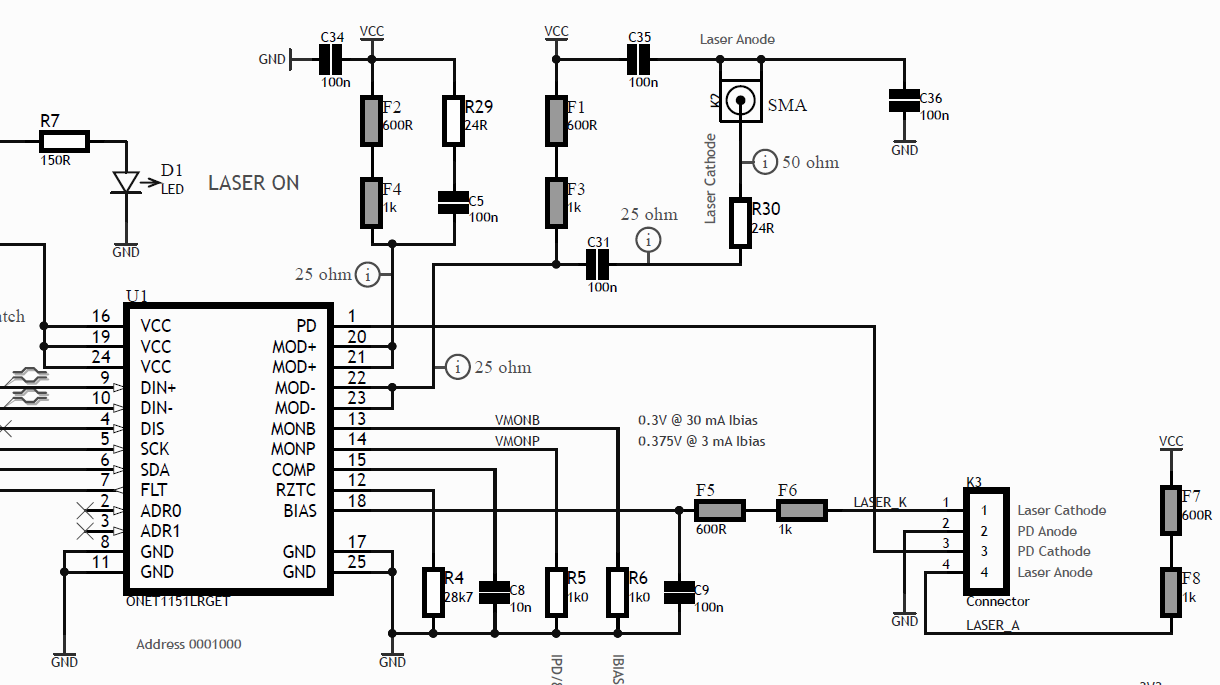
  • Below is the schematic

    The ONET output goes to the laser via a (short) coaxial cable of 50 ohm, the 25 ohm resistor in series adapts the output impedance (25 ohm) to the cable. 

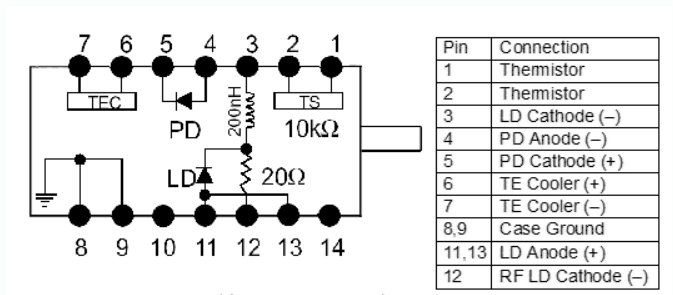
    The laser itself has this circuit:

    Where the RF LD cathode and LD anode are connected to the other SMA connector. The laser is mounted on a separate board.

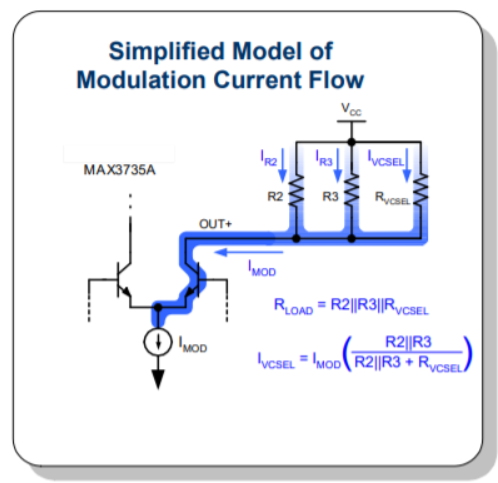
  • An application note shows how the modulation current is split across different paths so not all the current goes to the laser, unless, of course, what you call "load" includes the pull-up resistor that doesn't generate any light.

    The schematic above is DC but I think it's also valid in AC as the capacitor is a negligible impedance

  • We have two different ways of measuring the output power, a detector with an analogue output that we connect to a scope and a ThorLabs power meter. We switch them with a mirror in the optical bench. We noticed an important discrepancy in the measurements between them what added even more confusion.

    After doing some adjustments to the optical bench, we got both measurements to match each other, nevertheless, the laser current calculated from the AC power observed (using the ratio between the observed DC power and bias current) shows a lower value than that set by the registers.

    Eventually, we managed to get a satisfactory extinction rate what allows us to go ahead. 

  • Hi Juan,

    Glad you were able to get to your desired extinction ratio(>5). I am assuming this is at 50mA modulation current. I checked and device has good enough linearity even a bit above 85mA of mod current.I go ahead and close this case. Please let us know if there is a question.

    Regards,, Nasser

  • Hi Nasser,
    I am currently working on this issue with Juan. We can now achieve extinction ratios greater than 5, however the issue is not exactly regarding achievable extinction ratio, but rather the discrepancy between commanded imod and achieved imod. We only see approximately 1/3 of the commanded imod, limiting our total modulation current to 1/3 of the dynamic range stated in the datasheet.

  • Hi Liam,

    Actually your application is similar to the ONET1151L AC parametric table page 7 of the data sheet. The only difference i see is that there is 85mA maximum modulation current with 10-ohm differential load(please note AC parametric table). I think you are driving the laser single ended mode into 25-ohm. This could be the difference. With 85mA into 10-ohm we have 850mV swing. However, due to headroom issue, device cannot do 85mA into 25-ohm load. Therefor i believe  in your application we are limited due to  the load and single ended  versus differential limitation.

    Regards,, Nasser