This thread has been locked.

If you have a related question, please click the "Ask a related question" button in the top right corner. The newly created question will be automatically linked to this question.

TCAN1042G-Q1: Bus fault protection

Part Number: TCAN1042G-Q1

Hi,

There are a couple of questions.

1. Time to active bus fault protection when increased to 58V

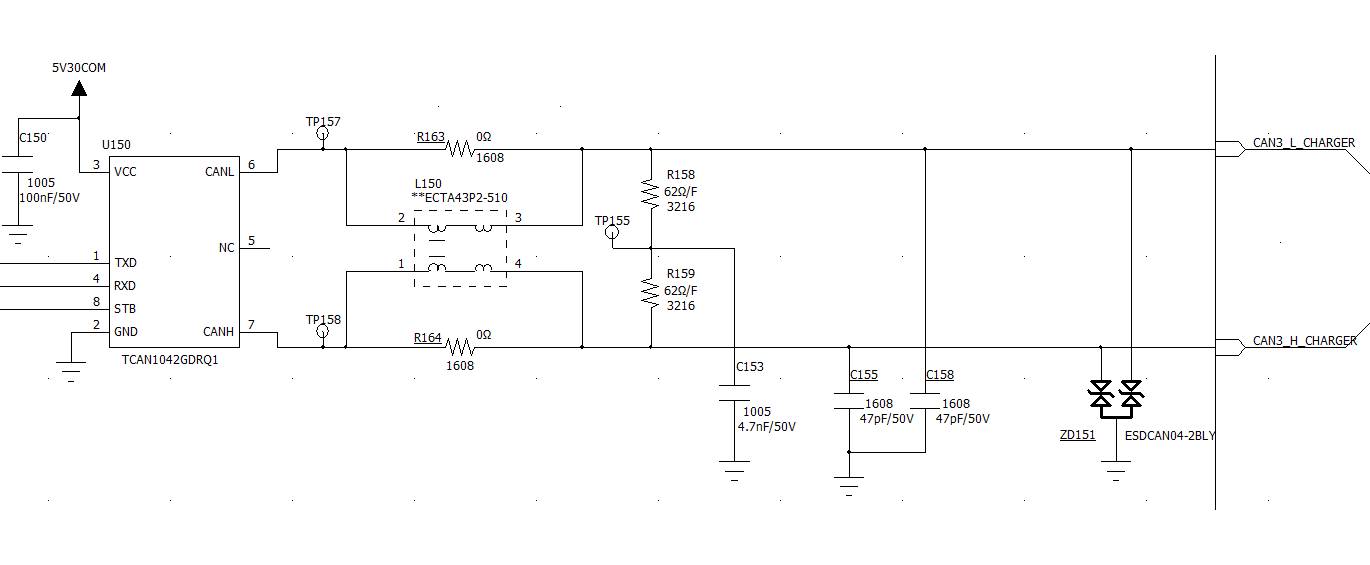
2. Do you have any recommendation for resistor and TVS diode considering time delay for bus fault protection?
  • Hi David,

    In this case bus fault protection means that the absolute maximum voltage rating of the CANH/CANL pins extends to 58 V. So, it is something that applies continuously and does not require an enable time.

    Regarding the TVS, this is something that could be used to enhance the transient protection but should not be used to clamp DC faults. Typically you would choose a diode with working voltage greater than the maximum expected DC voltage and a peak clamping voltage below the transceiver's absolute maximum rating for the expected peak clamp current.

    The series resistance can be useful in improving transient and DC immunity since it limits the current into the transceiver, but it also introduces attenuation to the CAN signaling. For this reason, the maximum value should typically be limited to ~10 Ohms.

    Regards,

    Max

  • Hi Max,

    For termination, is 60ohm resistance enough to support 50V?

    10W is needed. is it correct?

    Thanks.

  • Hi David,

    If a fault occurs where one side of the termination resistance is shorted to 0 V and the other side is shorted to 50 V, then the power dissipated in the resistance would be quite high. If only one side is shorted, though, the power dissipation is much lower. The worst single-fault case would be if the 50-V short is applied to CANH, since the transceiver would pull current through the resistance when trying to drive CANL low. This only occurs during dominant output states, though, which typically make up less than 50% of the operating time. And, the transceiver would limit the worst-case current to ~100 mA.

    Max