This thread has been locked.

If you have a related question, please click the "Ask a related question" button in the top right corner. The newly created question will be automatically linked to this question.

TUSB211: TUSB211 doesn't work no matter which EQ is setting.

Part Number: TUSB211
Other Parts Discussed in Thread: TUSB212

Hi TI team,

You can refer to the attached email for the details.RE (F0C) USB2 0 eye margin.msg

We have tried the EQ setting[MB R5238 to 3.9K ohm to GND and change BP R4451 = 100 ohm to GND], but it doesn’t help(as fig-1).

We have also checked the eye-diagram in Location1 and Location2. (with and without re-driver, we pull down pin-5(RSTN) to GND to disable re-driver)

Strangely, there is no much difference in eye-diagram no matter with or without re-driver as attached(pw:123).

Does it mean the re-driver doesn’t work in the MB?


Could you let us know the TUSB211 EQ strategy(ex. much many dB for leve0, 1, 2, 3)?

And, do you have any idea to improve the eye-diagram result?

  • Hi TI team,

    We want to know if TUSB211 works in high speed mode.

    1. Could we check the pin-11, 4, 9 to confirm if it works in high speed mode?

    ex. pin-11 = 1.8V, pin-4= high, pin9= high

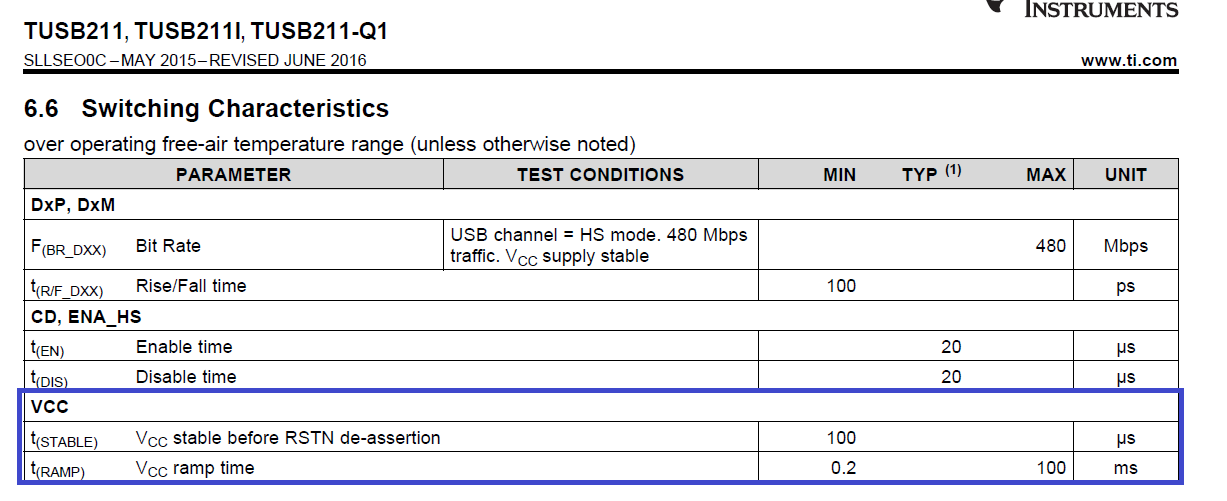
    2. Is there power-on sequence requirement except 6.6 in spec?

    Thanks.

    Andy

  • Hi Andy,

    Please be sure to follow the producre listed in section 8.2.2.1 For a Host Side Application in the TUSB211 datasheet. TUSB211 needs to enter test mode for HS eye diagram test. In this mode you will see the boosting function effect the eye diagram. 

    Keep in mind that when EQ resistor is changed, TUSB211 needs to see a reset (RSTN pin) in order to change the boosting level.

  • Hi TI team,

    Our test procedure as follows:

    1. set TUSB211 EQ

    2. power on system

    3. add probe in measurement point

    4. send the test pattern

    5. generate eye-diagram report
    We will follow steps 1~5 when we change the different EQ setting.
    Please refer to the attached(item4,5,6).(pw:123)
    It seems no signficant eye-diagram different and we find TUSB211-pin11(VREG) is 0V during test.
    Could you help check what's wrong?
    How could we check if it runs at high-speed mode?
    Thanks.
    Andy
  • Hi Andy,

    Lets focus on CD and ENA_HS, would you also be able to share the state of CD & ENA_HS during testing? When TUSB211 is in the test mode CD should be low and ENA_HS should be high. To see the boosting effect I recommend measuring at the test point farthest away from your USB Hub (and TUSB211). Steps appear okay, could you verify power and RSTN are at appropriate levels at step 3? Also make sure no test pattern appears on DP/DM in step 3, if test pattern is seen on bus by TUSB211 then test mode will not be entered. TUSB211 is on the downstream port of your USB hub correct?  

  • Hi TI team,

    TUSB211 is on the downstream port of USB HUB(USX2064AEZGTR).

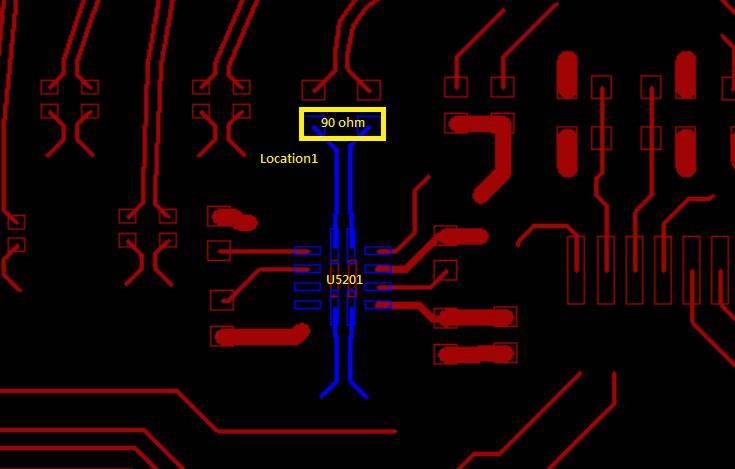
    We use a 90-ohm resistor as a termination between DN/DP to check the USB2.0 eye at Location1 as fig-4.

    We have checked the CD and ENA_HS status during test(fig-1) and no test pattern(fig-2). Both CD and ENA_HS are 0V.

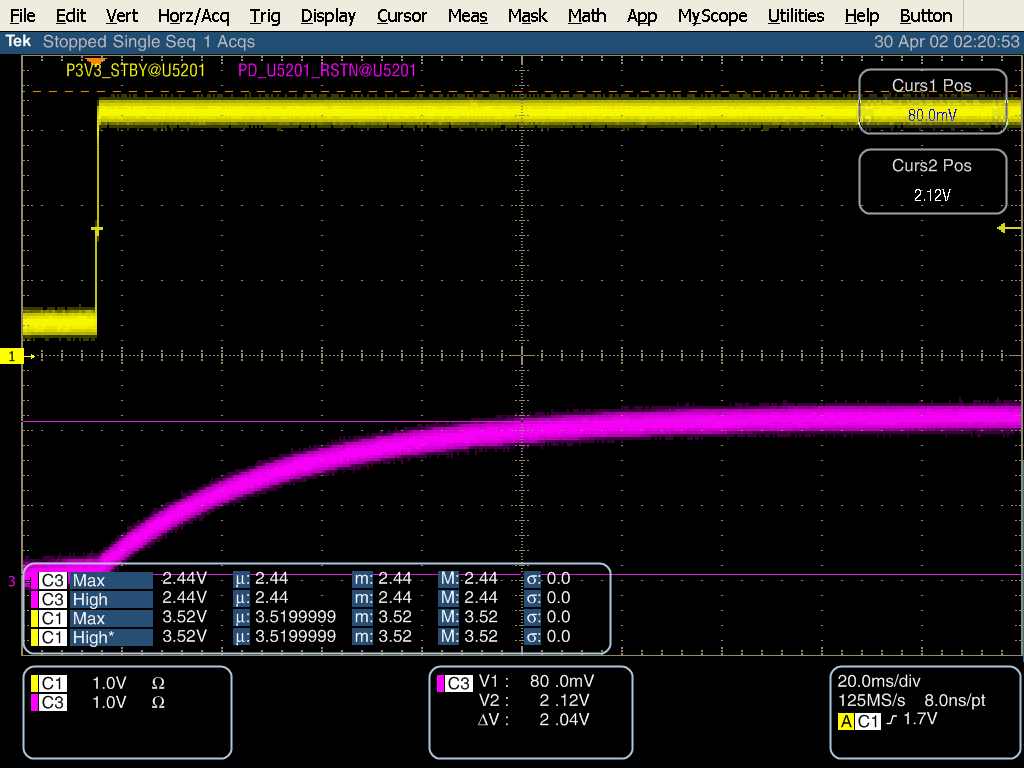
    3.3V power and RSTN seuqence as fig-3.

    Please help let us know the next action or check point:

    fig-1:

     fig-2:

    fig-3:

    fig-4:

    Thanks.

    Andy

  • Hi Andy,

    You should see CD should be low and ENA_HS should be high when no test pattern is present and correct termination is present. I recommend that you use ~45-50 ohm singled-ended termination, this can simply be provided by the high speed scope (if 50 ohm termination is available on scope inputs/probes). 

  • Hi TI team,

    After we add 45-ohm singled-ended termination(without sending test pattern), CD pin will be low and ENA_HS is high and VREG is 1.8V.

    When we send the test pattern, CD becomes high and ENA_HS is high and VREG is 1.8V. Is it expected behavior?

    We will check if EQ setting works at 45-ohm single-ended termination.


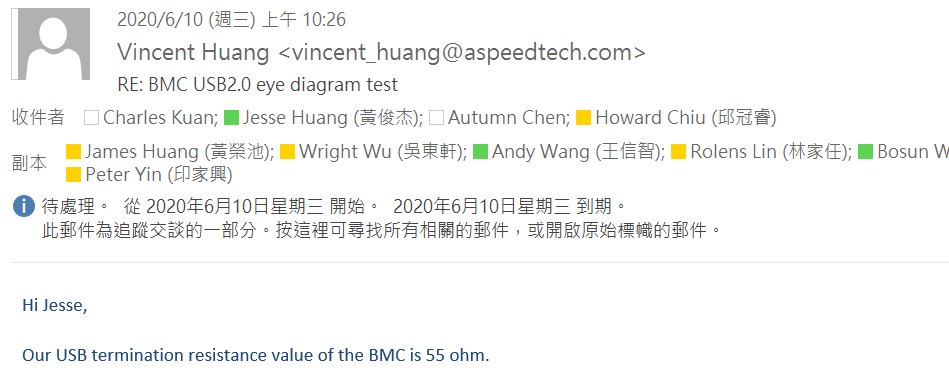
    BMC(AST2500A2) confirms their internal termination is 55-ohm(fixed).

    Is it ok to enable TUSB211 to the high-speed mode and get the signal compensation? or it has a risk that can't enable TUSB211 to high-speed mode?

    Thanks.

    Andy

  • HI Andy,

    Was there a reset to TUSB211 before CD went high?

    BMC termination is high, based on USB 2.0 spec. higher termination mean that TUSB211 boost should minimized, as long as signal quality meets eye diagram, as to avoid the HS disconnect threshold is violated.  

  • Hi TI team,

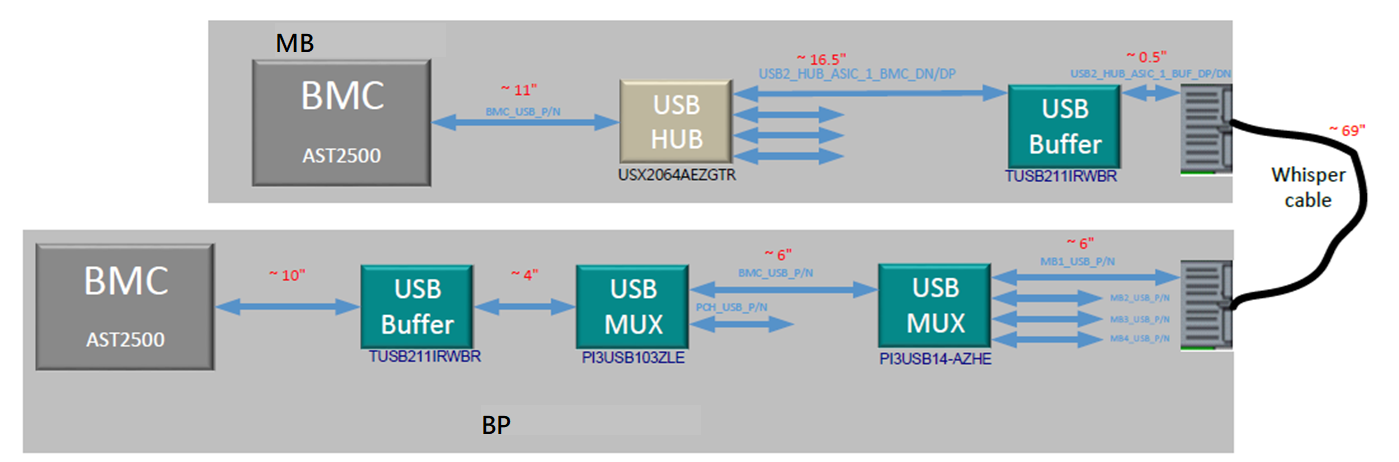
    F0C is MB; JG7 is BP.

    We test the eye-diagram with 45-ohm singled-end termination at Location4(re-driver2 output).

    Please refer to the eye-diagram as attached.

    From re-driver2 to BMC(end-point, 55ohm single-end termination) is about 10inch, could you also suggest the EQ setting?

    https://e2e.ti.com/cfs-file/__key/communityserver-discussions-components-files/138/5_2D00_-Check-re_2D00_diver2-for-different-EQ-setting-at-Location-4.7z

  • Hi Andy,

    I recommend sticking to level 3 or level 0 boost as to not boost the ringing in the waveform too much.  

  • Hi TI team,

    If we use the AST2500 internal termination, it can't let TUSB211 enter high speed mode(ENA_HS is low).

    Sometimes, we find TUSB211 pin11(VREG) is 1.8V but pin9(ENA_HS) is low.

    Can’t we have a virtual USB device(AST2500 USB port) at the end-point when we measure the USB2.0 eye even we set the AST2500 to internal termination?

    Test procedure:

    1. Power on BP, Set AST2500 internal termination(at BP)
    2. Power on Host MB
    3. Transfer test pattern
    4. Find TUSB211 can’t work at high-speed mode.(ENA_HS is low)


    Thanks.


    Andy

  • Hi TI team,

    Consider USB2.0 is a dual-way communication, could you base on our topology(TUSB211 locations) to suggest EQ setting for fist TUSB211 and second TUSB211?

    We want to make sure both "Hub to device" and "device to Hub" eye-diagram quality.

    Thanks.

    Andy

  • Hi TI team,

    We would like to know if the CD pin is high(we use the AST2500 internal termination and CD pin will be high), can it still let ENA_HS pin change from low to high?

    Another question, if AST2500 internal termination is about 63~67-ohm, is there any concern about high-speed negotiation for TUSB211?

    Thanks.

    Andy

  • Hi Andy,

    Tuning of each TUSB211 settings will be necessary to ensure proper signal quality. MB TUSB211 could start with Level 1 AC boost and BP TUSB211 could use Level 2 AC boost. I would also consider TUSB212 for added DC boost functionality, good for long cable and multiple muxes scenarios.

    CD and ENA_HS are independent. Also CD is an output, what kind of termination does AST2500 provide?

  • We have measured AST2500 internal termination is about 63~67ohm singled-end.

  • AST2500 termination may be too strong for CD output to drive high. You may consider adding a series resistance to help this case if you are using CD for other purpose. CD is only a status indicator and should not impact the HS enumeration process.