This thread has been locked.

If you have a related question, please click the "Ask a related question" button in the top right corner. The newly created question will be automatically linked to this question.

DS90UB935-Q1: difference between non-sync external mode and non-sync internal mode

Part Number: DS90UB935-Q1


Dear team,

In my understanding, in the sync mode, only deserializer needs an oscillator, image sensor and serializer don't need the oscillator, right?

in the non-sync external mode, deserializer needs an oscillator; serializer needs an oscillator; image sensor don't need the oscillator, right?

in the non-sync internal mode, deserializer needs an oscillator; image sensor needs an oscillator; serializer don't need the oscillator, right?

Do we have any recommendation about the clock mode? Sync mode? or non-sync mode?

About the non-sync mode, which one do we recommend?

Thanks & Best Regards,

Sherry

  • Hi Sherry,

    Your assessment is correct. I suggest sync mode as it doesn't require additional clocks on the ser side.

    Jiashow

  • Hi Jiashow,

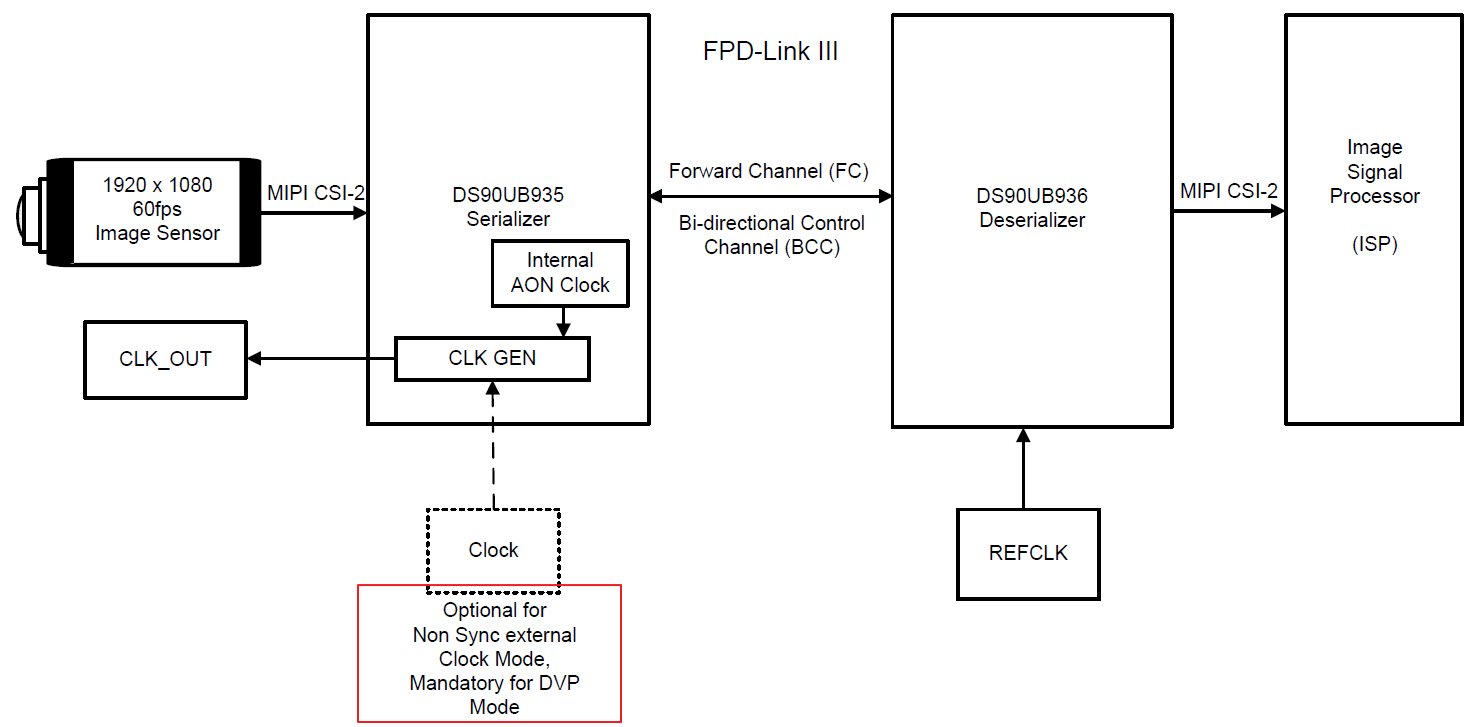
    Thanks for your reply! For non-sync external mode, below red marker shows that serializer doesn't need the oscillator, and I am confused about this. If serializer doesn't attach the oscillator, where does the reference clock of image sensor and serializer come from?

    As the red marker below, which means in the non-sync internal mode, the serializer also need attach the oscilattor?

    Simply put, in non-sync external mode, how much oscillators we need, and which part need the oscillator?

    In the in non-sync internal mode, how much oscillators we need, and which part need the oscillator?

    Thanks & Best Regards,

    Sherry

  • HI Sherry,

    The diagram is trying to say that non sync mode can be configured to use an external clock or to use AON clock. You can reference table 7-6 in the datasheet for the external clock frequency and their expected forward channel rate.

    I would suggest running in sync mode, but if the customer has to run in non-sync mode, I would suggest using an external clock, and only use AON clock as a back up when external clock fails.

    Jiashow

  • Hi Jiashow,

    Compared with sync mode, does non-sync mode have some advantages? If no, why does the non sync still exist while sync mode doesn't need additional clock and non-sync mode has no advantage? 

    Thanks & best Regards,

    Sherry

  • Hi Sherry,

    I would suggest sync mode for ease of operation and not needing to use an extra oscillator.

    Sometimes the customer prefers to use nonsync mode in case the local oscillator on the des fails which causes the back channel of the deserializer to fail.

    Best,

    Jiashow

  • Hi Jiashow,

    1. For sync mode and non sync external mode, the image sensor's reference clock could be either 935's CLKOUT or the external oscillator, right? If the customer worries the local oscillator on the des/ser fails, then he can choose the external oscillator, right?

    2. If the customer choose the sync mode, according to below picture, the FC data rate should be 160*25=4G because 960's reference clock is 25MHz. The camera is 1280*1280*30fps, YUV422 8bit, so the CSI rate=1280*1280*30*16*1.25=0.983Gbps. Under this condition, I think 2G POC is enough for the customer. But the FC data rate is 4G, can I choose the 2G POC network? Or I have to choose the 4G POC network even though the actual CSI rate is only 1Gbps.

    3.  The third row of the above table is 2G FC data rate, but the ref frequency is 12.5MHz. That means 960 can also use 12.5MHz REFCLK instead of 25MHz? If I want to use 2G POC network, I should set 960's REFCLK=12.5MHz?

    4. In my understanding, non-sync external mode must have the external clock, but the forth row of the above table shows that the reference source comes from back channel(half rate), which means non sync mode has two types, one type needs the external oscillator, and the other type doesn't need the external oscillator, right? But in this way, non sync external has no difference with the sync mode.

    Recently the customer is designing our serdes, so they want to know more.

    Thanks & Best Regards,

    Sherry

  • Hi Sherry,

    1. Yes, the imager sensor can either take in refclk from CLK_OUT or external oscillator. AON mode doesn't support CLK_OUT.

    2. The link operates at 4G, regardless of the input bandwidth. They'll need to use the 4G POC network.

    3. No, the 960 should still have 23MHz - 26MHz refclk. But the back channel can be changed from the default 50MHz to 25MHz. In this case the forward channel rate will run at 2G. The 2G PoC network was validated in DVP mode. It might work, but you'll have to validate it yourself to make sure it can meet the channel requirement for 25MHz to 2G.

    4. Nonsync mode can support 1) internal clock 2) external oscillator. With internal clock, there's no need to have an external oscillator. The CLKIN_DIV = 1 condition doesn't use the back channel. It's still using the external oscillator as the source.

    Jiashow

  • Dear team,

    My customer plans to use 935 to pair with 934, so they have to choose non sync mode. In order to cost down, they prefer to non-sync internal mode because they won't add additional oscillator using this mode. Is it ok?

    Thanks & Best Regards,

    Sherry

  • Hello Sherry,

    No, this is only supported between 935->936/962 (4G mode). DVP mode requires and external OSC with specific frequency matching characteristics based on the CSI-2 clock rate. See here: https://www.ti.com/lit/pdf/snla270 

    Best Regards,

    Casey