This thread has been locked.

If you have a related question, please click the "Ask a related question" button in the top right corner. The newly created question will be automatically linked to this question.

TLIN1029-Q1: Max length

Part Number: TLIN1029-Q1


Hello team,


LIN standard specify the maximum length is 40m.

What is the limitation for specification of max length at 40m ?


And our device TLIN1029 is also max length 40m ? or can TLIN1029 be applied to longer length ?


Thank you and best regards,

Michiaki

  • Michiaki-san,

    You're correct about the specification.

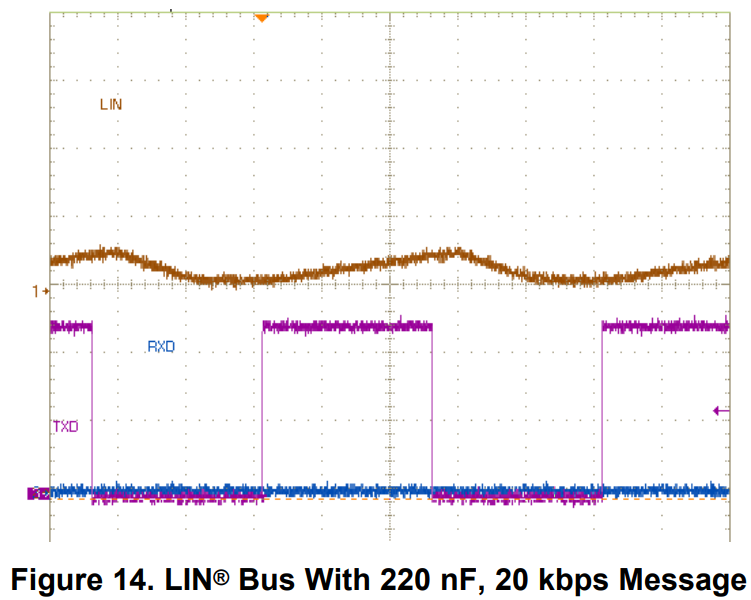
    This definition allows for the designer to design without too much worry regarding the capacitance and inductance of the cable. Take a look at these figures that show the effect of increasing capacitance on a LIN bus (orange line) and how the rising edge is too slow, resulting in errors on RXD (blue line). These figures are from TI's LIN Protocol and Physical Layer Requirements application note.

    If you use a bus length above 40 m, you will be exceeding the maximum allowed by the LIN specification.

    For longer distances, is another communication protocol (such as CAN) possible? CAN allows for longer bus lengths depending on bit rate (for example, 250 meters at 250 kbps).

    Best,

    Danny

  • Hello Dany,


    Please let me double check on the below.


    Customer doesn’t need to follow LIN standard but they would like to extend the length a little bit more for 40m.

    If the signal condition is OK, customer can use TLIN1029 for more than 40m length application ?


    I believe it is no problem but let me double check.

    Thank you and best regards,

    Michiaki

  • Michiaki-san,

    What kind of distance are you implying? Would this be for an application at hundreds of meters? Or do you mean slightly over 40 m, like 42 m or 45 m?

    Do you have any estimate for the effective capacitance or LRC characteristic of the cabling?

    Best,

    Danny

  • Hello Danny,


    They don’t have the exact number for the length right now so they will evaluate and check the signal conditions.

    Are there any concerns for their requirements ?


    Thank you and best regards,

    Michiaki

  • Michiaki-san,

    Well, I was just trying to get an idea for what was being considered. If we are talking about hundreds and hundreds of meters, then I would expect to see degradation of signal significant enough to cause errors. But if it is only a few meters, then the customer would be out of LIN spec (which you mentioned is okay for the customer) but likely still functional.

    One option is the possibility of reducing the data rate if the rise/fall times become too long.

    Ultimately, my answer is that the transceiver does not have any implicit characteristics that make it impossible to operate across 41 meters or longer. The 40 meter specification comes from the LIN standard. As shown by Figure 12, Figure 13, and Figure 14 of my earlier post, it would most heavily be impacted by effective bus capacitance. Generally, 10 nF serves as the upper limit for capacitance along the bus.

    Best,

    Danny