Part Number: TCAN4550-Q1
Hi team,
I'd like to know the relationship between load capacity(CL) and communication speed.
If you have any documents about this, could you share us?
I would like the following relationship graph.
Sincerely.
Kengo.
This thread has been locked.
If you have a related question, please click the "Ask a related question" button in the top right corner. The newly created question will be automatically linked to this question.
Part Number: TCAN4550-Q1
Hi team,
I'd like to know the relationship between load capacity(CL) and communication speed.
If you have any documents about this, could you share us?
I would like the following relationship graph.
Sincerely.
Kengo.
Hi Kengo,
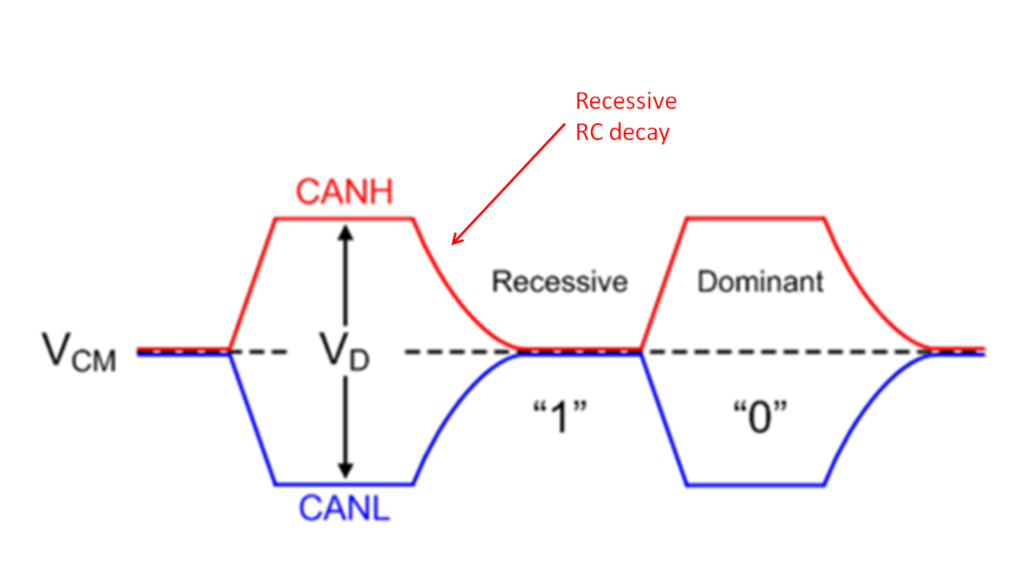
Apologies for the delay. We don't have any documents discussing this topic in depth, but the concept regarding this relationship is between bit-width and the RC decay time of dominant-to-recessive transition.
In CAN, dominant bits are actively driven by CAN transceivers by driving the CANH line towards Vcc potential and CANL towards Ground potential. The current path between CANH and CANL through the resistive load on the bus (primarily from termination resistance) creates a differential voltage. Recessive bits are passively driven by transceivers, which go high impedance to allow CANH and CANL to decay to a common recessive voltage (typically weakly biased to Vcc/2) through the same resistive load. Because this transition from a dominant to recessive state is not actively influenced by the driven (in cases without recessive nulling), the transition time is largely dependant on the RC constant formed in the system by the bus capacitance and resistive between CANH and CANL.
Generally, complex or large CAN networks with large bus capacitances encounter other limitations before this decay time becomes the primary issue. Loop delay, signal reflections, and bus overloading are all factors that limit the achievable data rate of a system which will be introduced, along with bus capacitance, as longer cables, more nodes, and more complex topologies are added. These topics and other physical layer characteristics and requirements are discussed in this applications report: Controller Area Network Physical Layer Requirements.
I'm sorry I couldn't provide a more elaborate answer for your question, but I hope this brief overview helps you and your customer. Let me know if you have other particular questions regarding the impacts of bus capacitance or would like to know more about something discussed in the app report.
Regards,
Eric Schott