This thread has been locked.

If you have a related question, please click the "Ask a related question" button in the top right corner. The newly created question will be automatically linked to this question.

TCAN1043-Q1: Does our Vsup pin need a pull up resistor?

Part Number: TCAN1043-Q1

Dear team,

1. Could you please tell me what R8 function is? R10 is to protect WAKE pin from over current conditions, and R9 is to used to set the static voltage level of the WAKE pin. R8 is also to protect Vsup pin from over current conditions? In below design, is R8 connect to the GND or R9?

2. Before my customer use TJA1043, they use a pull up resistor. I am not sure whether we also need to a resistor, If need, what is the recommendation? 1K/1W?
Thanks & Best Regards,

Sherry

  • Sherry,

    Thanks for bringing this to E2E. The function of R8 is to create a low-pass filter for the power input of the transceiver. This is not a requirement and in fact all systems should and typically do have much more filtering on their battery input in different parts of the application circuit. This example is just showing that there needs to be some type of filtering on the battery input, but R8 is not required.

    Regards,

  • Hi Eric,

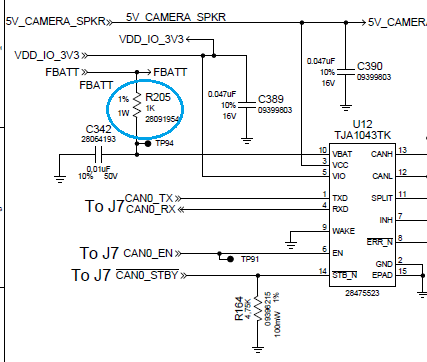
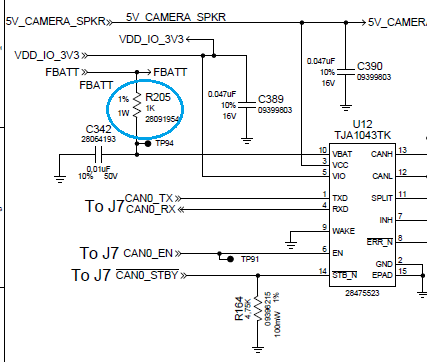
    Thanks for your quick reply! R205 in below schematic is to create a low-pass filter, right? Before they use NXP device, and now the customer wants to add the resistor in our TCAN1043-Q1 design. But I am not sure what resistance we should use, 1kohm? In addition, I need to choose the rated power of the resistor according to the current consumption. The power dissipation=I*I*R should be smaller than the rated power. Isup_max=70uA in our datasheet means that this pin only needs 70uA current sink during working, right? In this way, I*I*R=70uA*70uA*1Kohm=4.9uW, so 1W(rated power) is too large, right?

    Thanks & Best Regards,

    Sherry

  • Hi Sherry,

    I touched on this on an email to you, but I'll elaborate here for E2E posterity.

    Your power calculations are correct and the extra power rating for this resistor is likely done to provide a buffer region for non-typical system behavior (though it is a very large buffer!). Such events may be shorts or transients that could temporarily cause this resistor to dissipate much more energy than it would need to during normal operation. This extra power capability will not impact the effectiveness of the filter or of the transceiver itself, and likely comes at the cost of component size. In some cases, a resistor with a much lower power rating could be used as a make-shift fuse that would fail before damage occured to the transceiver, but there are likely better and more robust ways of implementing this type of battery protection. If the customer is fine using a resistor with this power rating, there's not too much reason to recommend a smaller one.

    Regards,
    Eric Schott