A related question is a question created from another question. When the related question is created, it will be automatically linked to the original question.
If you have a related question, please click the "Ask a related question" button in the top right corner. The newly created question will be automatically linked to this question.
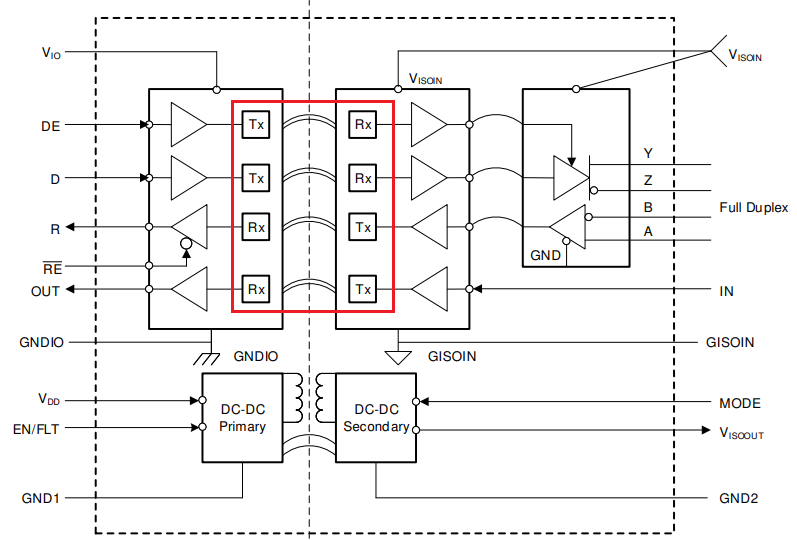
If a full-duplex communication is required - then DE (Driver Enable) and RE/ (Receiver Enable) both needs to enable during the communication.
RTS and CTS can be used as RE/ and DE respectively if needed by customer but a simple LOGIC HIGH on DE and LOW on RE/ will also work fine for full duplex.
I cannot comment much on the RTS/CTS - you need to verify this from the UART protocol. However, if the RTS/CTS signal are digital signals you can connect them to RE/DE directly but need to make sure that they are always Low/High respectively.
But asl long as you need Full-Duplex make sure DE is pulled HIGH and RE is pulled low - this is the simplest way to implement
May I ask if RE is inverted internally inside the IC? Logically, with my current use of RTS, I should be able to achieve DE/RE High/Low at the same time.
The end customer's requirements are RS485 full-duplex, RS485 half-duplex, and RS422.
The URL you provided should be a design for changing RS485 full-duplex to half-duplex, correct?
Could you please help to re-verify this? Thank you.
Please note that RS-485 interface is protocol agnostic. ISOW1432 simply transfers the data that is applied to it provided the driver is enabled by asserting DE pin. Similarly, the receiver receives data when it is enabled by asserting RE\. It is upto customer when or how to enable the driver and receiver.
I am not familiar with CTS and RTS pins of XR21V1410 and how they change. Therefore, I will let customer decide how to use them and if they should be connected to DE or RE\. As Varun already explained, DE needs to be HIGH to enable the driver and RE\ needs to be LOW to enable receive.
I would also like to mention that ISOW3086 is the next generation device to ISOW1432 that offers better overall performance and we recommend that you use this part for your designs to get the best performance.
Let us know if you have any other questions, thanks.